|
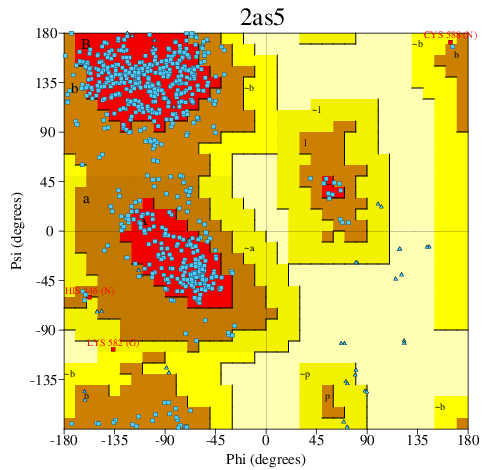
PDBsum entry 2as5

|
|
|
|
|
|

|
|

|
|

|
|

|
|

|
|

|
|

|
|

|
|

|
|
|
 |

|

|
|
|
|
|
|
|
|
|
|
|
|
|
|
|
|
|
|
|
|
|
|
|
|
|
|
|
|
|
|
|
|
|
|
Transcription/DNA
|
PDB id
|
|
|
|
2as5
|
|
|
|
|
|
|
|
|
|
|
|
|
|
|

|

|

|
|
|
|
|
|
References listed in PDB file
|
|
|
Key reference
|
|
|
Title
|
|
Foxp3 controls regulatory t cell function through cooperation with nfat.
|
|
|
Authors
|
|
Y.Wu,
M.Borde,
V.Heissmeyer,
M.Feuerer,
A.D.Lapan,
J.C.Stroud,
D.L.Bates,
L.Guo,
A.Han,
S.F.Ziegler,
D.Mathis,
C.Benoist,
L.Chen,
A.Rao.
|
|
|
Ref.
|
|
Cell, 2006,
126,
375-387.
[DOI no: ]
|
|
|
PubMed id
|
|
|
|
|
|
Abstract
|
|
|
Antigen stimulation of immune cells activates the transcription factor NFAT, a
key regulator of T cell activation and anergy. NFAT forms cooperative complexes
with the AP-1 family of transcription factors and regulates T cell
activation-associated genes. Here we show that regulatory T cell (Treg) function
is mediated by an analogous cooperative complex of NFAT with the forkhead
transcription factor FOXP3, a lineage specification factor for Tregs. The
crystal structure of an NFAT:FOXP2:DNA complex reveals an extensive
protein-protein interaction interface between NFAT and FOXP2. Structure-guided
mutations of FOXP3, predicted to progressively disrupt its interaction with
NFAT, interfere in a graded manner with the ability of FOXP3 to repress
expression of the cytokine IL2, upregulate expression of the Treg markers CTLA4
and CD25, and confer suppressor function in a murine model of autoimmune
diabetes. Thus by switching transcriptional partners, NFAT converts the acute T
cell activation program into the suppressor program of Tregs.
|
|
|
|

|
|

|
|
Figure 3.
Figure 3. Protein-Protein Interactions between NFAT and FOXP
|
|
Figure 8.
Figure 8. T Regulatory Function Requires the NFAT:FOXP3
Interface
|
|
|
|
|
|
The above figures are
reprinted
by permission from Cell Press:
Cell
(2006,
126,
375-387)
copyright 2006.
|
|
|
|
|
|
|