
|
|
|
|
|
 |
Contents |
 |
|
|
|
|
|
|
|
|
|
|
|
 237 a.a.
|
|
|
|
|
|
|
|
|
|
|
 218 a.a.
|
|
|
|
|
|
|
|
|
|
|
 230 a.a.
|
|
|
|
|
|
|
|
|
|
|
* Residue conservation analysis
|
|
|
|
|
|
PDB id:
|
|
|
|
| Name: |
|
Immune system
|
|
|
Title:
|
|
Crystal structure of a ternary complex between psa, a substrat-acyl intermediate and an activating antibody
|
|
Structure:
|
|
Prostate-specific antigen. Chain: p. Fragment: unp residues 25-261. Synonym: psa, kallikrein- 3, semenogelase, gamma-seminoprotein, seminin, p-30 antigen. Kgissqy. Chain: s. Engineered: yes. Monoclonal antibody 8g8f5 fab.
|
|
Source:
|
|
Homo sapiens. Human. Organism_taxid: 9606. Other_details: seminal fluids. Synthetic: yes. Other_details: peptide synthesis. Mus musculus. House mouse. Organism_taxid: 10090.
|
|
Resolution:
|
|
|
3.10Å
|
R-factor:
|
0.223
|
R-free:
|
0.275
|
|
|
Authors:
|
|
R.Menez,E.Stura,C.Jolivet-Reynaud
|
Key ref:

|
|
R.Ménez
et al.
(2008).
Crystal structure of a ternary complex between human prostate-specific antigen, its substrate acyl intermediate and an activating antibody.
J Mol Biol,
376,
1021-1033.
PubMed id:
DOI:

|
|
|
Date:
|
|
|
09-Nov-07
|
Release date:
|
29-Jan-08
|
|
|
|
|
|
|
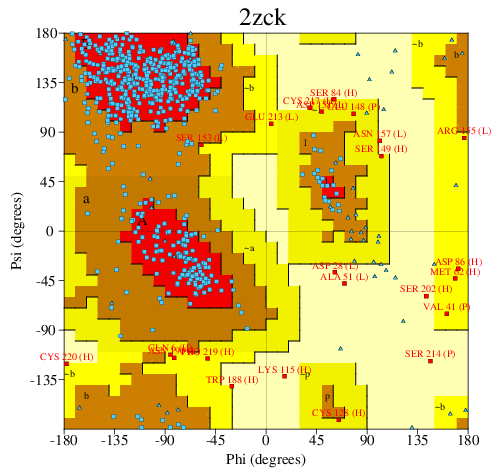
PROCHECK
|
|
|
|
|
|
Headers
|
|
|
|
References
|
|
|
|
|
|

|
|
P07288
(KLK3_HUMAN) -
Prostate-specific antigen from Homo sapiens
|
|
|
|
Seq:
Struc:
|
|
|
|
261 a.a.
237 a.a.
|
|

|

|
|
|
|
|
|
|
|
|
|
|
|
|
|
|
|
|
|
Enzyme class:
|
|
Chain P:
E.C.3.4.21.77
- semenogelase.
|
|
|
|
|
|
|
Reaction:
|
|
Preferential cleavage: Tyr-|-Xaa.
|
|
|
|
|
|
|
|
|
|
|
|
|
|
|
|
|
|
 |
|
|
|
|
|
|
| |
|
DOI no:
|
J Mol Biol
376:1021-1033
(2008)
|
|
PubMed id:
|
|
|
|
|
|
| |
|
Crystal structure of a ternary complex between human prostate-specific antigen, its substrate acyl intermediate and an activating antibody.
|
|
R.Ménez,
S.Michel,
B.H.Muller,
M.Bossus,
F.Ducancel,
C.Jolivet-Reynaud,
E.A.Stura.
|
|
|
|
|
| |
ABSTRACT
|
|
|
|
| |
|
|
Human prostate-specific antigen (PSA or KLK3) is an important marker for the
diagnosis and management of prostate cancer. This is an androgen-regulated
glycoprotein of the kallikrein-related protease family secreted by prostatic
epithelial cells. Its physiological function is to cleave semenogelins in the
seminal coagulum and its enzymatic activity is strongly modulated by zinc ions.
Here we present the first crystal structure of human PSA in complex with
monoclonal antibody (mAb) 8G8F5 that enhances its enzymatic activity. The mAb
recognizes an epitope composed of five discontinuous segments including residues
from the kallikrein loop and stabilizes PSA in an "open and active conformation"
that accelerates catalysis. We also present the crystal structure of PSA in
complex with both the mAb 8G8F5 and a fluorogenic substrate Mu-KGISSQY-AFC,
derived from semenogelin I. By exploiting the inhibition of PSA by zinc ions, we
were able to obtain a substrate acyl intermediate covalently linked to the
catalytic serine, at pH 7.3 but not at pH 5.5. Moreover, the inhibition of PSA
activity by zinc was found to be modulated by pH variations but not by the
antibody binding. The correlation of the different data with the physiological
conditions under which PSA can cleave semenogelins is discussed.
|
|
|
|
|
|
| |
Selected figure(s)
|
|
|
|
| |
|
|

|
|

|
|
Figure 2.
Fig. 2. Details of the Fab′ 8G8F5 epitope. (a) Interactions
of PSA (pink) with 8G8F5 heavy chain (dark blue). (b)
Interactions of PSA (pink) with 8G8F5 light chain (blue).
|
|
Figure 5.
Fig. 5. Crystallographic dimer in PSA and HPK. (a) The dimer
for PSA. The kallikrein loop is shown in dark green, the
substrate in light green sticks and the carbohydrate moieties in
CPK (beige and red). (b) PSA dimer (yellow and pink as in a) and
crystal contacts with the antibody heavy chain (dark blue)
showing the relationship between the substrate (CPK, light
green) and the CH1 domain C-terminus bound by PSA (dark blue
sticks). (c) The dimer for HPK.
|
|
|
|
|
|
| |
The above figures are
reprinted
by permission from Elsevier:
J Mol Biol
(2008,
376,
1021-1033)
copyright 2008.
|
|
| |
Figures were
selected
by an automated process.
|
|
|
|
|
|
|
|
|
|
|
|
|
|
|
|
 |
 |
 |
|
Literature references that cite this PDB file's key reference
|
|
|
| |
PubMed id
|
|
Reference
|
|
|
|
|
|
A.M.LeBeau,
M.Kostova,
C.S.Craik,
and
S.R.Denmeade
(2010).
Prostate-specific antigen: an overlooked candidate for the targeted treatment and selective imaging of prostate cancer.
|
| |
Biol Chem,
391,
333-343.
|
|
|
|
|
|
|
P.Goettig,
V.Magdolen,
and
H.Brandstetter
(2010).
Natural and synthetic inhibitors of kallikrein-related peptidases (KLKs).
|
| |
Biochimie,
92,
1546-1567.
|
|
|
|
|
|
|
R.Ganesan,
C.Eigenbrot,
and
D.Kirchhofer
(2010).
Structural and mechanistic insight into how antibodies inhibit serine proteases.
|
| |
Biochem J,
430,
179-189.
|
|
|
|
|
|
|
F.Cantini,
D.Veggi,
S.Dragonetti,
S.Savino,
M.Scarselli,
G.Romagnoli,
M.Pizza,
L.Banci,
and
R.Rappuoli
(2009).
Solution structure of the factor H-binding protein, a survival factor and protective antigen of Neisseria meningitidis.
|
| |
J Biol Chem,
284,
9022-9026.
|
|
|
PDB code:
|
|
|
|
|
|
|
|
G.Sotiropoulou,
G.Pampalakis,
and
E.P.Diamandis
(2009).
Functional roles of human kallikrein-related peptidases.
|
| |
J Biol Chem,
284,
32989-32994.
|
|
|
|
|
|
|
K.Y.White,
L.Rodemich,
J.O.Nyalwidhe,
M.A.Comunale,
M.A.Clements,
R.S.Lance,
P.F.Schellhammer,
A.S.Mehta,
O.J.Semmes,
and
R.R.Drake
(2009).
Glycomic characterization of prostate-specific antigen and prostatic acid phosphatase in prostate cancer and benign disease seminal plasma fluids.
|
| |
J Proteome Res,
8,
620-630.
|
|
|
|
|
|
|
Y.T.Aminetzach,
J.R.Srouji,
C.Y.Kong,
and
H.E.Hoekstra
(2009).
Convergent evolution of novel protein function in shrew and lizard venom.
|
| |
Curr Biol,
19,
1925-1931.
|
|
|
|
|
|
|
A.M.LeBeau,
P.Singh,
J.T.Isaacs,
and
S.R.Denmeade
(2008).
Potent and selective peptidyl boronic acid inhibitors of the serine protease prostate-specific antigen.
|
| |
Chem Biol,
15,
665-674.
|
|
|
|
|
|
|
H.Koistinen,
A.Närvänen,
M.Pakkala,
C.Hekim,
J.M.Mattsson,
L.Zhu,
P.Laakkonen,
and
U.H.Stenman
(2008).
Development of peptides specifically modulating the activity of KLK2 and KLK3.
|
| |
Biol Chem,
389,
633-642.
|
|
|
|
|
|
|
H.Koistinen,
G.Wohlfahrt,
J.M.Mattsson,
P.Wu,
J.Lahdenperä,
and
U.H.Stenman
(2008).
Novel small molecule inhibitors for prostate-specific antigen.
|
| |
Prostate,
68,
1143-1151.
|
|
|
|
|
|
|
J.A.Clements
(2008).
Reflections on the tissue kallikrein and kallikrein-related peptidase family - from mice to men - what have we learnt in the last two decades?
|
| |
Biol Chem,
389,
1447-1454.
|
|
|
|
|
|
|
M.Debela,
N.Beaufort,
V.Magdolen,
N.M.Schechter,
C.S.Craik,
M.Schmitt,
W.Bode,
and
P.Goettig
(2008).
Structures and specificity of the human kallikrein-related peptidases KLK 4, 5, 6, and 7.
|
| |
Biol Chem,
389,
623-632.
|
|
|
|
|
|
|
S.Liu,
M.Z.Sun,
C.Sun,
B.Zhao,
F.T.Greenaway,
and
Q.Zheng
(2008).
A novel serine protease from the snake venom of Agkistrodon blomhoffii ussurensis.
|
| |
Toxicon,
52,
760-768.
|
|
|
|
|
|
The most recent references are shown first.
Citation data come partly from CiteXplore and partly
from an automated harvesting procedure. Note that this is likely to be
only a partial list as not all journals are covered by
either method. However, we are continually building up the citation data
so more and more references will be included with time.
Where a reference describes a PDB structure, the PDB
code is
shown on the right.
|
 |
|


 Links
Links


