 |
PDBsum entry 1zmd

|
|
|
|
|
|

|

|

|

|
|

|
|

|
|

|
|

|
|

|
|

|
|
|
 |

|

|
|
|
|
|
|
|
|
|
|
|
|
|
|
|
|
|
|
|
|
|
|
|
|
|
|
|
|
|
|
|
|
|
|
|
Oxidoreductase
|
PDB id
|
|
|
|
1zmd
|
|
|
|
|
|
|
|
|
|
|
|
|
|
|

|

|

|
|
|
|
|
|
|
|
 |
Contents |
 |
|
|
|
|
|
|
|
|
|
|
|
|
* Residue conservation analysis
|
|
|
|
|
|
PDB id:
|
|
|
|
| Name: |
|
Oxidoreductase
|
|
|
Title:
|
|
Crystal structure of human dihydrolipoamide dehydrogenase complexed to nadh
|
|
Structure:
|
|
Dihydrolipoyl dehydrogenase. Chain: a, b, c, d, e, f, g, h. Synonym: dihydrolipoamide dehydrogenase, glycine cleavage system l protein. Engineered: yes
|
|
Source:
|
|
Homo sapiens. Human. Organism_taxid: 9606. Gene: dld, gcsl, lad, phe3. Expressed in: escherichia coli. Expression_system_taxid: 562.
|
|
Biol. unit:
|
|
 Dimer (from
)
Dimer (from
)
|
|
Resolution:
|
|
|
2.08Å
|
R-factor:
|
0.221
|
R-free:
|
0.249
|
|
|
Authors:
|
|
C.A.Brautigam,J.L.Chuang,D.R.Tomchick,M.Machius,D.T.Chuang
|
Key ref:

|
|
C.A.Brautigam
et al.
(2005).
Crystal structure of human dihydrolipoamide dehydrogenase: NAD+/NADH binding and the structural basis of disease-causing mutations.
J Mol Biol,
350,
543-552.
PubMed id:
DOI:

|
|
|
Date:
|
|
|
10-May-05
|
Release date:
|
28-Jun-05
|
|
|
|
|
|
|
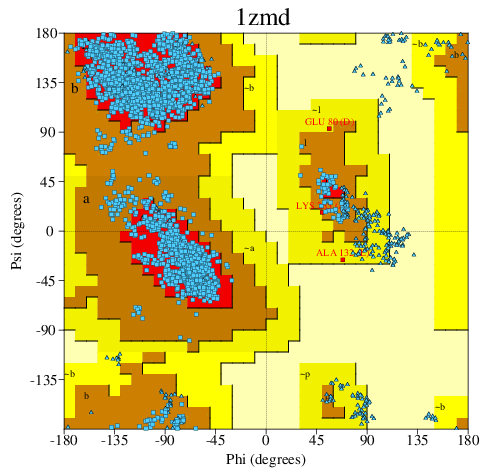
PROCHECK
|
|
|
|
|
|
Headers
|
|
|
|
References
|
|
|
|
|
|

|
|
P09622
(DLDH_HUMAN) -
Dihydrolipoyl dehydrogenase, mitochondrial from Homo sapiens
|
|
|
|
Seq:
Struc:
|
|
|
|
509 a.a.
472 a.a.*
|
|

|

|

|
|
|
|
|
|
|
|
|
|
|
Key: |
 |
PfamA domain |
|
|
 |
Secondary structure |
|
 |
CATH domain |
|
|
*
PDB and UniProt seqs differ
at 1 residue position (black
cross)
|
|
|
|
|
|
|
|
|
|
|
|
|
Enzyme class:
|
|
E.C.1.8.1.4
- dihydrolipoyl dehydrogenase.
|
|
|
|
|
|
|
Pathway:
|
|
Glycine Cleavage System
|
|
|
|
|
|
Reaction:
|
|
N6-[(R)-dihydrolipoyl]-L-lysyl-[protein] + NAD+ = N6-[(R)-lipoyl]- L-lysyl-[protein] + NADH + H+
|
|
|
|
|
|
N(6)-[(R)-dihydrolipoyl]-L-lysyl-[protein]
|
+
|
NAD(+)
Bound ligand (Het Group name = )
corresponds exactly
|
=
|
N(6)-[(R)-lipoyl]- L-lysyl-[protein]
|
+
|
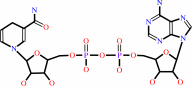 NADH
NADH
|
+
|
H(+)
|
|
|
|
|
|
|
|
|
|
Cofactor:
|
|
FAD
|
|
|
|
|
|
FAD
Bound ligand (Het Group name =
FAD)
corresponds exactly
|
|
|
|
|
|
|
Molecule diagrams generated from .mol files obtained from the
KEGG ftp site
|
|
|
|
|
|
|
|
|
|
|
|
|
|
 |
|
|
|
|
|
|
| |
|
|
| |
|
DOI no:
|
J Mol Biol
350:543-552
(2005)
|
|
PubMed id:
|
|
|
|
|
|
| |
|
Crystal structure of human dihydrolipoamide dehydrogenase: NAD+/NADH binding and the structural basis of disease-causing mutations.
|
|
C.A.Brautigam,
J.L.Chuang,
D.R.Tomchick,
M.Machius,
D.T.Chuang.
|
|
|
|
|
| |
ABSTRACT
|
|
|
|
| |
|
|
Human dihydrolipoamide dehydrogenase (hE3) is an enzymatic component common to
the mitochondrial alpha-ketoacid dehydrogenase and glycine decarboxylase
complexes. Mutations to this homodimeric flavoprotein cause the often-fatal
human disease known as E3 deficiency. To catalyze the oxidation of
dihydrolipoamide, hE3 uses two molecules: non-covalently bound FAD and a
transiently bound substrate, NAD+. To address the catalytic mechanism of hE3 and
the structural basis for E3 deficiency, the crystal structures of hE3 in the
presence of NAD+ or NADH have been determined at resolutions of 2.5A and 2.1A,
respectively. Although the overall fold of the enzyme is similar to that of
yeast E3, these two structures differ at two loops that protrude from the
proteins and at their FAD-binding sites. The structure of oxidized hE3 with NAD+
bound demonstrates that the nicotinamide moiety is not proximal to the FAD. When
NADH is present, however, the nicotinamide base stacks directly on the
isoalloxazine ring system of the FAD. This is the first time that this
mechanistically requisite conformation of NAD+ or NADH has been observed in E3
from any species. Because E3 structures were previously available only from
unicellular organisms, speculations regarding the molecular mechanisms of E3
deficiency were based on homology models. The current hE3 structures show
directly that the disease-causing mutations occur at three locations in the
human enzyme: the dimer interface, the active site, and the FAD and
NAD(+)-binding sites. The mechanisms by which these mutations impede the
function of hE3 are discussed.
|
|
|
|
|
|
| |
Selected figure(s)
|
|
|
|
| |
|
|

|
|

|
|
Figure 1.
Figure 1. The crystal structure of the hE3 homodimer. Shown
is a stereo ribbon diagram of the dimer. The atoms from the FAD
and NADH are shown as spheres. In the left monomer, the domains
are differently colored: the FAD-binding domain is green; the
NAD^+-binding domain, purple; the central domain, blue; the
interface domain, orange. The other monomer is colored tan.
Bound molecules of FAD and NADH are colored brown and cyan,
respectively, for the left monomer, and tan in the right monomer.
|
|
Figure 6.
Figure 6. Residues whose mutation causes E3 deficiency.
Stereo representations of disease-causing mutations that occur
(a) at the homodimer interface, (b) near to the
disulfide-exchange site, or (c) near to the bound FAD or NADH
molecules. The coordinates represented here come from the G
(blue) and H (tan) monomers of hE3-Lip-NADH. Mutation to V188 is
not known to cause disease; it is included to show its proximity
to I358. The section of electron density in (b) is a 2F[o] -F[c]
map contoured at the 1s level. In (b), the N3 atom of FAD is
labeled. Secondary structure is shown semi-transparently to
allow all atoms to be viewed. Atoms and secondary structural
features are colored as in Figure 2 and Figure 3.
|
|
|
|
|
|
| |
The above figures are
reprinted
by permission from Elsevier:
J Mol Biol
(2005,
350,
543-552)
copyright 2005.
|
|
| |
Figures were
selected
by an automated process.
|
|
|
|
|
|
|
|
|
|
|
|
|
|
|
|
 |
 |
 |
|
Literature references that cite this PDB file's key reference
|
|
|
| |
PubMed id
|
|
Reference
|
|
|
|
|
|
M.Rapoport,
L.Salman,
O.Sabag,
M.S.Patel,
and
H.Lorberboum-Galski
(2011).
Successful TAT-mediated enzyme replacement therapy in a mouse model of mitochondrial E3 deficiency.
|
| |
J Mol Med,
89,
161-170.
|
|
|
|
|
|
|
R.M.Payne,
P.M.Pride,
and
C.M.Babbey
(2011).
Cardiomyopathy of Friedreich's Ataxia: Use of Mouse Models to Understand Human Disease and Guide Therapeutic Development.
|
| |
Pediatr Cardiol,
32,
366-378.
|
|
|
|
|
|
|
R.Bryk,
N.Arango,
A.Venugopal,
J.D.Warren,
Y.H.Park,
M.S.Patel,
C.D.Lima,
and
C.Nathan
(2010).
Triazaspirodimethoxybenzoyls as selective inhibitors of mycobacterial lipoamide dehydrogenase .
|
| |
Biochemistry,
49,
1616-1627.
|
|
|
PDB code:
|
|
|
|
|
|
|
|
S.Vijayakrishnan,
S.M.Kelly,
R.J.Gilbert,
P.Callow,
D.Bhella,
T.Forsyth,
J.G.Lindsay,
and
O.Byron
(2010).
Solution structure and characterisation of the human pyruvate dehydrogenase complex core assembly.
|
| |
J Mol Biol,
399,
71-93.
|
|
|
|
|
|
|
B.E.Keyes,
and
D.J.Burke
(2009).
Irc15 Is a microtubule-associated protein that regulates microtubule dynamics in Saccharomyces cerevisiae.
|
| |
Curr Biol,
19,
472-478.
|
|
|
|
|
|
|
C.A.Brautigam,
R.M.Wynn,
J.L.Chuang,
and
D.T.Chuang
(2009).
Subunit and catalytic component stoichiometries of an in vitro reconstituted human pyruvate dehydrogenase complex.
|
| |
J Biol Chem,
284,
13086-13098.
|
|
|
|
|
|
|
M.S.Patel,
L.G.Korotchkina,
and
S.Sidhu
(2009).
Interaction of E1 and E3 components with the core proteins of the human pyruvate dehydrogenase complex.
|
| |
J Mol Catal B Enzym,
61,
2-6.
|
|
|
|
|
|
|
C.Gelling,
I.W.Dawes,
N.Richhardt,
R.Lill,
and
U.Mühlenhoff
(2008).
Mitochondrial Iba57p is required for Fe/S cluster formation on aconitase and activation of radical SAM enzymes.
|
| |
Mol Cell Biol,
28,
1851-1861.
|
|
|
|
|
|
|
L.J.Yan,
N.Thangthaeng,
and
M.J.Forster
(2008).
Changes in dihydrolipoamide dehydrogenase expression and activity during postnatal development and aging in the rat brain.
|
| |
Mech Ageing Dev,
129,
282-290.
|
|
|
|
|
|
|
M.Rapoport,
A.Saada,
O.Elpeleg,
and
H.Lorberboum-Galski
(2008).
TAT-mediated delivery of LAD restores pyruvate dehydrogenase complex activity in the mitochondria of patients with LAD deficiency.
|
| |
Mol Ther,
16,
691-697.
|
|
|
|
|
|
|
P.M.Vyas,
and
R.M.Payne
(2008).
TAT opens the door.
|
| |
Mol Ther,
16,
647-648.
|
|
|
|
|
|
|
R.M.Wynn,
M.Kato,
J.L.Chuang,
S.C.Tso,
J.Li,
and
D.T.Chuang
(2008).
Pyruvate dehydrogenase kinase-4 structures reveal a metastable open conformation fostering robust core-free basal activity.
|
| |
J Biol Chem,
283,
25305-25315.
|
|
|
PDB codes:
|
|
|
|
|
|
|
|
T.Nakai,
S.Kuramitsu,
and
N.Kamiya
(2008).
Structural bases for the specific interactions between the E2 and E3 components of the Thermus thermophilus 2-oxo acid dehydrogenase complexes.
|
| |
J Biochem,
143,
747-758.
|
|
|
|
|
|
|
Y.C.Wang,
S.T.Wang,
C.Li,
L.Y.Chen,
W.H.Liu,
P.R.Chen,
M.C.Chou,
and
T.C.Liu
(2008).
The role of amino acids T148 and R281 in human dihydrolipoamide dehydrogenase.
|
| |
J Biomed Sci,
15,
37-46.
|
|
|
|
|
|
|
Y.Kim,
L.O.Ingram,
and
K.T.Shanmugam
(2008).
Dihydrolipoamide dehydrogenase mutation alters the NADH sensitivity of pyruvate dehydrogenase complex of Escherichia coli K-12.
|
| |
J Bacteriol,
190,
3851-3858.
|
|
|
|
|
|
|
L.J.Yan,
S.H.Yang,
H.Shu,
L.Prokai,
and
M.J.Forster
(2007).
Histochemical staining and quantification of dihydrolipoamide dehydrogenase diaphorase activity using blue native PAGE.
|
| |
Electrophoresis,
28,
1036-1045.
|
|
|
|
|
|
|
M.M.Islam,
R.Wallin,
R.M.Wynn,
M.Conway,
H.Fujii,
J.A.Mobley,
D.T.Chuang,
and
S.M.Hutson
(2007).
A novel branched-chain amino acid metabolon. Protein-protein interactions in a supramolecular complex.
|
| |
J Biol Chem,
282,
11893-11903.
|
|
|
|
|
|
|
N.E.Babady,
Y.P.Pang,
O.Elpeleg,
and
G.Isaya
(2007).
Cryptic proteolytic activity of dihydrolipoamide dehydrogenase.
|
| |
Proc Natl Acad Sci U S A,
104,
6158-6163.
|
|
|
|
|
|
|
Y.C.Wang,
S.T.Wang,
C.Li,
W.H.Liu,
P.R.Chen,
L.Y.Chen,
and
T.C.Liu
(2007).
The role of N286 and D320 in the reaction mechanism of human dihydrolipoamide dehydrogenase (E3) center domain.
|
| |
J Biomed Sci,
14,
203-210.
|
|
|
|
|
|
|
C.A.Brautigam,
R.M.Wynn,
J.L.Chuang,
M.Machius,
D.R.Tomchick,
and
D.T.Chuang
(2006).
Structural insight into interactions between dihydrolipoamide dehydrogenase (E3) and E3 binding protein of human pyruvate dehydrogenase complex.
|
| |
Structure,
14,
611-621.
|
|
|
PDB codes:
|
|
|
|
|
|
|
|
E.M.Ciszak,
A.Makal,
Y.S.Hong,
A.K.Vettaikkorumakankauv,
L.G.Korotchkina,
and
M.S.Patel
(2006).
How dihydrolipoamide dehydrogenase-binding protein binds dihydrolipoamide dehydrogenase in the human pyruvate dehydrogenase complex.
|
| |
J Biol Chem,
281,
648-655.
|
|
|
PDB code:
|
|
|
|
|
|
|
|
M.Smolle,
A.E.Prior,
A.E.Brown,
A.Cooper,
O.Byron,
and
J.G.Lindsay
(2006).
A new level of architectural complexity in the human pyruvate dehydrogenase complex.
|
| |
J Biol Chem,
281,
19772-19780.
|
|
|
|
|
|
|
K.R.Rajashankar,
R.Bryk,
R.Kniewel,
J.A.Buglino,
C.F.Nathan,
and
C.D.Lima
(2005).
Crystal structure and functional analysis of lipoamide dehydrogenase from Mycobacterium tuberculosis.
|
| |
J Biol Chem,
280,
33977-33983.
|
|
|
PDB code:
|
|
|
|
|
|
|
The most recent references are shown first.
Citation data come partly from CiteXplore and partly
from an automated harvesting procedure. Note that this is likely to be
only a partial list as not all journals are covered by
either method. However, we are continually building up the citation data
so more and more references will be included with time.
Where a reference describes a PDB structure, the PDB
code is
shown on the right.
|
|


 Links
Links


