
|
|
|
|
|
 |
Contents |
 |
|
|
|
|
|
|
|
|
|
|
|


 309 a.a.
|
|
|
|
|
|
|
|
|
|
|


 (+ 0 more)
174 a.a.
(+ 0 more)
174 a.a.
|
|
|
|
|
|
|
|
|
|
|
|
|
* Residue conservation analysis
|
|
|
|
|
|
PDB id:
|
|
|
|
| Name: |
|
Hydrolase
|
|
|
Title:
|
|
Asymmetric complex between hslv and i-domain deleted hslu (h. Influenzae)
|
|
Structure:
|
|
Atp-dependent hsl protease atp-binding subunit hslu. Chain: a, b, c. Fragment: residues 1-107,244-444. Engineered: yes. Atp-dependent protease hslv. Chain: g, h, i, l, m, n. Engineered: yes
|
|
Source:
|
|
Haemophilus influenzae. Organism_taxid: 71421. Strain: rd. Expressed in: escherichia coli. Expression_system_taxid: 469008.
|
|
Biol. unit:
|
|
 80mer (from PDB file)
|
|
Resolution:
|
|
|
2.50Å
|
R-factor:
|
0.224
|
R-free:
|
0.277
|
|
|
Authors:
|
|
A.R.Kwon,B.M.Kessler,H.S.Overkleeft,D.B.Mckay
|
Key ref:

|
|
A.R.Kwon
et al.
(2003).
Structure and reactivity of an asymmetric complex between HslV and I-domain deleted HslU, a prokaryotic homolog of the eukaryotic proteasome.
J Mol Biol,
330,
185-195.
PubMed id:
DOI:

|
|
|
Date:
|
|
|
14-Apr-03
|
Release date:
|
03-Jul-03
|
|
|
|
|
|
|
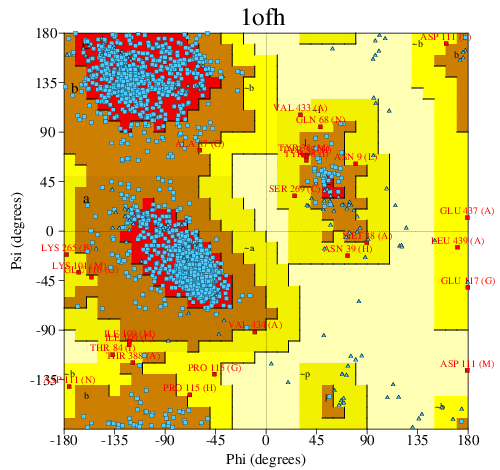
PROCHECK
|
|
|
|
|
|
Headers
|
|
|
|
References
|
|
|
|
|
|
|
|
|
|
|
|
Enzyme class 2:
|
|
Chains A, B, C:
E.C.?
|
|
|
|
|
|
|
Enzyme class 3:
|
|
Chains G, H, I, L, M, N:
E.C.3.4.25.2
- HslU--HslV peptidase.
|
|
|
|
|
|
|
|
|
|
Note, where more than one E.C. class is given (as above), each may
correspond to a different protein domain or, in the case of polyprotein
precursors, to a different mature protein.
|
|
|
|
|
|
|
|
|
|
|
|
|
|
 |
|
|
|
|
|
|
| |
|
DOI no:
|
J Mol Biol
330:185-195
(2003)
|
|
PubMed id:
|
|
|
|
|
|
| |
|
Structure and reactivity of an asymmetric complex between HslV and I-domain deleted HslU, a prokaryotic homolog of the eukaryotic proteasome.
|
|
A.R.Kwon,
B.M.Kessler,
H.S.Overkleeft,
D.B.McKay.
|
|
|
|
|
| |
ABSTRACT
|
|
|
|
| |
|
|
In the prokaryotic homolog of the eukaryotic proteasome, HslUV, the "double
donut" HslV protease is allosterically activated by HslU, an AAA protein of
the Clp/Hsp100 family consisting of three (amino-terminal, carboxy-terminal, and
intermediate) domains. The intermediate domains of HslU, which extend like
tentacles from the hexameric ring formed by the amino-terminal and
carboxy-terminal domains, have been deleted; an asymmetric
HslU(DeltaI)(6)HslV(12) complex has been crystallized; and the structure has
been solved to 2.5A resolution, revealing an assembly in which a HslU(DeltaI)
hexamer binds one end of the HslV dodecamer. The conformation of the protomers
of the HslU(DeltaI)-complexed HslV hexamer is similar to that in the symmetric
wild-type HslUV complex, while the protomer conformation of the uncomplexed HslV
hexamer is similar to that of HslV alone. Reaction in the crystals with a vinyl
sulfone inhibitor reveals that the HslU(DeltaI)-complexed HslV hexamer is
active, while the uncomplexed HslV hexamer is inactive. These results confirm
that HslV can be activated by binding of a hexameric HslU(DeltaI)(6) ring
lacking the I domains, that activation is effected through a conformational
change in HslV rather than through alteration of the size of the entry channel
into the protease catalytic cavity, and that the two HslV(6) rings in the
protease dodecamer are activated independently rather than cooperatively.
|
|
|
|
|
|
| |
Selected figure(s)
|
|
|
|
| |
|
|

|
|

|
|
Figure 2.
Figure 2. Structure of the HslU(DI)[6]HslV[12] complex. (a)
A drawing of one complex viewed perpendicular to the 6-fold
axis, with a-helices represented as cylinders. Color scheme:
HslU(DI), magenta with one subunit blue; HslU(DI)-complexed
HslV, yellow with one subunit red; uncomplexed HslV, cyan with
one subunit green. (b) View of one HslU(DI)[6] hexamer looking
parallel with the 6-fold axis. (c) HslU(DI)-complexed HslV
hexamer viewed from the top of the molecules. (d) Uncomplexed
HslV hexamer viewed from the bottom of the molecule.
|
|
Figure 4.
Figure 4. NLVS inhibitor. (a) F[o] -F[c] electron density
map contoured at 2.6s, computed using calculated phases from
model without inhibitor, showing that inhibitor is present in
upper hexamer only. The two pairs of crystallographically
independent HslV subunits of the HslU(DI)[6]HslV[12] complex
that is aligned along the 3-fold axis are shown; subunits from
HslU(DI)-complexed HslV are red and yellow; from uncomplexed
HslV, green and cyan. Thr1, with which the inhibitor reacts,
shown in magenta in all subunits. (b) Ribbon drawing of
superposition of HslU(DI)-complexed and uncomplexed HslV, with
NLVS inhibitor. Where HslV protomers are similar in
conformation, as originally defined by Sousa et al.,[15.]
structure is green; where they differ, HslU(DI)-complexed HslV
is blue; uncomplexed HslV is yellow. Inhibitor model is red. (c)
Stereo view of superposition of complexed and uncomplexed HslV
near inhibitor. Selected amino acid side-chains and segments of
polypeptide backbone that hydrogen-bond the inhibitor are shown.
For a detailed description of interactions with inhibitor, see
Sousa et al.[23.] C^a backbone trace of HslU(DI)-complexed
subunits, cyan; backbone trace of uncomplexed subunits, yellow;
carbon atoms of inhibitor, magenta; carbon atoms of amino acid
side-chains, green; oxygen atoms, red; nitrogen atoms, blue;
sulfur atoms, yellow; iodine atoms, purple.
|
|
|
|
|
|
| |
The above figures are
reprinted
by permission from Elsevier:
J Mol Biol
(2003,
330,
185-195)
copyright 2003.
|
|
| |
Figures were
selected
by an automated process.
|
|
|
|
|
|
|
|
|
|
|
|
|
|
|
|
 |
 |
 |
|
Literature references that cite this PDB file's key reference
|
|
|
| |
PubMed id
|
|
Reference
|
|
|
|
|
|
D.Gangwar,
M.K.Kalita,
D.Gupta,
V.S.Chauhan,
and
A.Mohmmed
(2009).
A systematic classification of Plasmodium falciparum P-loop NTPases: structural and functional correlation.
|
| |
Malar J,
8,
69.
|
|
|
|
|
|
|
H.Y.Lien,
R.S.Shy,
S.S.Peng,
Y.L.Wu,
Y.T.Weng,
H.H.Chen,
P.C.Su,
W.F.Ng,
Y.C.Chen,
P.Y.Chang,
and
W.F.Wu
(2009).
Characterization of the Escherichia coli ClpY (HslU) substrate recognition site in the ClpYQ (HslUV) protease using the yeast two-hybrid system.
|
| |
J Bacteriol,
191,
4218-4231.
|
|
|
|
|
|
|
S.E.Glynn,
A.Martin,
A.R.Nager,
T.A.Baker,
and
R.T.Sauer
(2009).
Structures of asymmetric ClpX hexamers reveal nucleotide-dependent motions in a AAA+ protein-unfolding machine.
|
| |
Cell,
139,
744-756.
|
|
|
PDB codes:
|
|
|
|
|
|
|
|
S.Kuntumalla,
J.C.Braisted,
S.T.Huang,
P.P.Parmar,
D.J.Clark,
H.Alami,
Q.Zhang,
A.Donohue-Rolfe,
S.Tzipori,
R.D.Fleischmann,
S.N.Peterson,
and
R.Pieper
(2009).
Comparison of two label-free global quantitation methods, APEX and 2D gel electrophoresis, applied to the Shigella dysenteriae proteome.
|
| |
Proteome Sci,
7,
22.
|
|
|
|
|
|
|
E.Park,
J.W.Lee,
S.H.Eom,
J.H.Seol,
and
C.H.Chung
(2008).
Binding of MG132 or Deletion of the Thr Active Sites in HslV Subunits Increases the Affinity of HslV Protease for HslU ATPase and Makes This Interaction Nucleotide-independent.
|
| |
J Biol Chem,
283,
33258-33266.
|
|
|
|
|
|
|
J.A.Yakamavich,
T.A.Baker,
and
R.T.Sauer
(2008).
Asymmetric nucleotide transactions of the HslUV protease.
|
| |
J Mol Biol,
380,
946-957.
|
|
|
|
|
|
|
S.H.Rho,
H.H.Park,
G.B.Kang,
Y.J.Im,
M.S.Kang,
B.K.Lim,
I.S.Seong,
J.Seol,
C.H.Chung,
J.Wang,
and
S.H.Eom
(2008).
Crystal structure of Bacillus subtilis CodW, a noncanonical HslV-like peptidase with an impaired catalytic apparatus.
|
| |
Proteins,
71,
1020-1026.
|
|
|
PDB codes:
|
|
|
|
|
|
|
|
A.Martin,
T.A.Baker,
and
R.T.Sauer
(2007).
Distinct static and dynamic interactions control ATPase-peptidase communication in a AAA+ protease.
|
| |
Mol Cell,
27,
41-52.
|
|
|
|
|
|
|
M.K.Azim,
and
S.Noor
(2007).
Characterization of protomer interfaces in HslV protease; the bacterial homologue of 20S proteasome.
|
| |
Protein J,
26,
213-219.
|
|
|
|
|
|
|
E.Park,
Y.M.Rho,
O.J.Koh,
S.W.Ahn,
I.S.Seong,
J.J.Song,
O.Bang,
J.H.Seol,
J.Wang,
S.H.Eom,
and
C.H.Chung
(2005).
Role of the GYVG pore motif of HslU ATPase in protein unfolding and translocation for degradation by HslV peptidase.
|
| |
J Biol Chem,
280,
22892-22898.
|
|
|
|
|
|
|
M.Groll,
M.Bochtler,
H.Brandstetter,
T.Clausen,
and
R.Huber
(2005).
Molecular machines for protein degradation.
|
| |
Chembiochem,
6,
222-256.
|
|
|
|
|
|
|
M.K.Azim,
W.Goehring,
H.K.Song,
R.Ramachandran,
M.Bochtler,
and
P.Goettig
(2005).
Characterization of the HslU chaperone affinity for HslV protease.
|
| |
Protein Sci,
14,
1357-1362.
|
|
|
|
|
|
|
R.E.Burton,
T.A.Baker,
and
R.T.Sauer
(2005).
Nucleotide-dependent substrate recognition by the AAA+ HslUV protease.
|
| |
Nat Struct Mol Biol,
12,
245-251.
|
|
|
|
|
|
|
I.Botos,
E.E.Melnikov,
S.Cherry,
J.E.Tropea,
A.G.Khalatova,
F.Rasulova,
Z.Dauter,
M.R.Maurizi,
T.V.Rotanova,
A.Wlodawer,
and
A.Gustchina
(2004).
The catalytic domain of Escherichia coli Lon protease has a unique fold and a Ser-Lys dyad in the active site.
|
| |
J Biol Chem,
279,
8140-8148.
|
|
|
PDB codes:
|
|
|
|
|
|
|
|
M.Groll,
and
T.Clausen
(2003).
Molecular shredders: how proteasomes fulfill their role.
|
| |
Curr Opin Struct Biol,
13,
665-673.
|
|
|
|
|
|
The most recent references are shown first.
Citation data come partly from CiteXplore and partly
from an automated harvesting procedure. Note that this is likely to be
only a partial list as not all journals are covered by
either method. However, we are continually building up the citation data
so more and more references will be included with time.
Where a reference describes a PDB structure, the PDB
codes are
shown on the right.
|
 |


 Links
Links


