 |
PDBsum entry 1qsl

|
|
|
|
|
|

|

|

|

|
|

|
|

|
|

|
|

|
|

|
|
|
 |

|

|
|
|
|
|
|
|
|
|
|
|
|
|
|
|
|
|
|
|
|
|
|
|
|
|
|
|
|
|
|
|
|
|
|
Transferase/DNA
|
PDB id
|
|
|
|
1qsl
|
|
|
|
|
|
|
|
|
|
|
|
|
|
|

|

|

|
|
|
|
|
|
|
|
 |
Contents |
 |
|
|
|
|
|
|
|
|
|
|
|
|
|
|
* Residue conservation analysis
|
|
|
|
|
|
|
|
|
|
|
Enzyme class:
|
|
E.C.2.7.7.7
- DNA-directed Dna polymerase.
|
|
|
|
|
|
|
Reaction:
|
|
DNA(n) + a 2'-deoxyribonucleoside 5'-triphosphate = DNA(n+1) + diphosphate
|
|
|
|
|
|
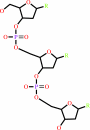 DNA(n)
|
+
|
2'-deoxyribonucleoside 5'-triphosphate
|
=
|
DNA(n+1)
|
+
|
 diphosphate
|
|
|
|
|
|
|
|
|
|
|
|
|
Molecule diagrams generated from .mol files obtained from the
KEGG ftp site
|
|
|
|
|
|
|
|
|
|
|
|
|
|
 |
|
|
|
|
|
|
| |
|
|
| |
|
|
Chem Biol
6:901-908
(1999)
|
|
PubMed id:
|
|
|
|
|
|
| |
|
Structural elucidation of the binding and inhibitory properties of lanthanide (III) ions at the 3'-5' exonucleolytic active site of the Klenow fragment.
|
|
C.A.Brautigam,
K.Aschheim,
T.A.Steitz.
|
|
|
|
|
| |
ABSTRACT
|
|
|
|
| |
|
|
BACKGROUND: Biochemical and biophysical experiments have shown that two
catalytically essential divalent metal ions (termed 'A' and 'B') bind to the
3'-5' exonuclease active site of the Klenow fragment (KF) of Escherichia coli
DNA polymerase I. X-ray crystallographic studies have established the normal
positions in the KF 3'-5' exonuclease (KF exo) active site of the two cations
and the single-stranded DNA substrate. Lanthanide (III) luminescence studies
have demonstrated, however, that only a single europium (III) ion (Eu3+) binds
to the KF exo active site. Furthermore, Eu3+ does not support catalysis by KF
exo or several other two-metal-ion phosphoryl-transfer enzymes. RESULTS: A
crystal structure of KF complexed with both Eu3+ and substrate single-stranded
oligodeoxynucleotide shows that a lone Eu3+ is bound near to metal-ion site A.
Comparison of this structure to a relevant native structure reveals that the
bound Eu3+ causes a number of changes to the KF exo active site. The scissile
phosphate of the substrate is displaced from its normal position by about 1 A
when Eu3+ is bound and the presence of Eu3+ in the active site precludes the
binding of the essential metal ion B. CONCLUSIONS: The substantial,
lanthanide-induced differences in metal-ion and substrate binding to KF exo
account for the inhibition of this enzyme by Eu3+. These changes also explain
the inability of KF exo to bind more than one cation in the presence of
lanthanides. The mechanistic similarity between KF exo and other two-metal-ion
phosphoryl-transfer enzymes suggests that the principles of lanthanide (III) ion
binding and inhibition ascertained from this study will probably apply to most
members of this class of enzymes.
|
|
|
|
|
|
|
|
|
|
|
|
|
|
|
|
|
|
 |
 |
 |
|
Literature references that cite this PDB file's key reference
|
|
|
| |
PubMed id
|
|
Reference
|
|
|
|
|
|
L.Martínez,
T.E.Malliavin,
and
A.Blondel
(2011).
Mechanism of reactant and product dissociation from the anthrax edema factor: A locally enhanced sampling and steered molecular dynamics study.
|
| |
Proteins,
79,
1649-1661.
|
|
|
|
|
|
|
X.C.Su,
and
G.Otting
(2010).
Paramagnetic labelling of proteins and oligonucleotides for NMR.
|
| |
J Biomol NMR,
46,
101-112.
|
|
|
|
|
|
|
M.Brucet,
J.Querol-Audí,
K.Bertlik,
J.Lloberas,
I.Fita,
and
A.Celada
(2008).
Structural and biochemical studies of TREX1 inhibition by metals. Identification of a new active histidine conserved in DEDDh exonucleases.
|
| |
Protein Sci,
17,
2059-2069.
|
|
|
PDB codes:
|
|
|
|
|
|
|
|
D.Chen,
G.Menche,
T.D.Power,
L.Sower,
J.W.Peterson,
and
C.H.Schein
(2007).
Accounting for ligand-bound metal ions in docking small molecules on adenylyl cyclase toxins.
|
| |
Proteins,
67,
593-605.
|
|
|
|
|
|
|
C.Schmitz,
M.John,
A.Y.Park,
N.E.Dixon,
G.Otting,
G.Pintacuda,
and
T.Huber
(2006).
Efficient chi-tensor determination and NH assignment of paramagnetic proteins.
|
| |
J Biomol NMR,
35,
79-87.
|
|
|
|
|
|
|
J.J.Perry,
S.M.Yannone,
L.G.Holden,
C.Hitomi,
A.Asaithamby,
S.Han,
P.K.Cooper,
D.J.Chen,
and
J.A.Tainer
(2006).
WRN exonuclease structure and molecular mechanism imply an editing role in DNA end processing.
|
| |
Nat Struct Mol Biol,
13,
414-422.
|
|
|
PDB codes:
|
|
|
|
|
|
|
|
Y.Shen,
N.L.Zhukovskaya,
Q.Guo,
J.Florián,
and
W.J.Tang
(2005).
Calcium-independent calmodulin binding and two-metal-ion catalytic mechanism of anthrax edema factor.
|
| |
EMBO J,
24,
929-941.
|
|
|
PDB codes:
|
|
|
|
|
|
|
|
Q.Guo,
Y.Shen,
N.L.Zhukovskaya,
J.Florián,
and
W.J.Tang
(2004).
Structural and kinetic analyses of the interaction of anthrax adenylyl cyclase toxin with reaction products cAMP and pyrophosphate.
|
| |
J Biol Chem,
279,
29427-29435.
|
|
|
PDB code:
|
|
|
|
|
|
|
|
Y.G.Ren,
L.A.Kirsebom,
and
A.Virtanen
(2004).
Coordination of divalent metal ions in the active site of poly(A)-specific ribonuclease.
|
| |
J Biol Chem,
279,
48702-48706.
|
|
|
|
|
|
|
L.M.Bowen,
and
C.M.Dupureur
(2003).
Investigation of restriction enzyme cofactor requirements: a relationship between metal ion properties and sequence specificity.
|
| |
Biochemistry,
42,
12643-12653.
|
|
|
|
|
|
The most recent references are shown first.
Citation data come partly from CiteXplore and partly
from an automated harvesting procedure. Note that this is likely to be
only a partial list as not all journals are covered by
either method. However, we are continually building up the citation data
so more and more references will be included with time.
Where a reference describes a PDB structure, the PDB
codes are
shown on the right.
|
|


 Links
Links


