
|
|
|
|
|
 |
Contents |
 |
|
|
|
|
|
|
|
|
* Residue conservation analysis
|
|
|
|
|
|
PDB id:
|
|
|
|
| Name: |
|
DNA binding protein/transferase
|
|
|
Title:
|
|
Crystal structure of herpes simplex ul42 bound to thE C-terminus of hsv pol
|
|
Structure:
|
|
DNA polymerase processivity factor. Chain: a, c, e, g. Fragment: n-terminal domain. Synonym: DNA-binding protein ul42. Engineered: yes. DNA polymerase. Chain: b, d, f, h. Fragment: c-terminal 36 amino acids. Engineered: yes
|
|
Source:
|
|
Human herpesvirus 1. Herpes simplex virus type 1. Organism_taxid: 10298. Expressed in: escherichia coli. Expression_system_taxid: 562.
|
|
Biol. unit:
|
|
 Dimer (from
)
Dimer (from
)
|
|
Resolution:
|
|
|
2.70Å
|
R-factor:
|
0.230
|
R-free:
|
0.281
|
|
|
Authors:
|
|
H.J.Zuccola,D.J.Filman,D.M.Coen,J.M.Hogle
|
Key ref:

|
|
H.J.Zuccola
et al.
(2000).
The crystal structure of an unusual processivity factor, herpes simplex virus UL42, bound to the C terminus of its cognate polymerase.
Mol Cell,
5,
267-278.
PubMed id:
DOI:

|
|
|
Date:
|
|
|
14-Dec-99
|
Release date:
|
15-Mar-00
|
|
|
|
|
|
|
PROCHECK
|

|
|
|
|
|
Headers
|
|
|
|
References
|
|
|
|
|
|
|
|
|
|
|
|
Enzyme class 2:
|
|
Chains A, C, E, G:
E.C.?
|
|
|
|
|
|
|
Enzyme class 3:
|
|
Chains B, D, F, H:
E.C.2.7.7.7
- DNA-directed Dna polymerase.
|
|
|
|
|
|
|
Reaction:
|
|
DNA(n) + a 2'-deoxyribonucleoside 5'-triphosphate = DNA(n+1) + diphosphate
|
|
|
|
|
|
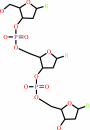 DNA(n)
|
+
|
2'-deoxyribonucleoside 5'-triphosphate
|
=
|
DNA(n+1)
|
+
|
 diphosphate
|
|
|
|
|
|
|
|
|
|
Enzyme class 4:
|
|
Chains B, D, F, H:
E.C.3.1.26.4
- ribonuclease H.
|
|
|
|
|
|
|
Reaction:
|
|
Endonucleolytic cleavage to 5'-phosphomonoester.
|
|
|
|
|
|
|
|
|
Note, where more than one E.C. class is given (as above), each may
correspond to a different protein domain or, in the case of polyprotein
precursors, to a different mature protein.
|
|
|
|
Molecule diagrams generated from .mol files obtained from the
KEGG ftp site
|
|
|
|
|
|
|
|
|
|
|
|
|
|
 |
|
|
|
|
|
|
| |
|
|
| |
|
DOI no:
|
Mol Cell
5:267-278
(2000)
|
|
PubMed id:
|
|
|
|
|
|
| |
|
The crystal structure of an unusual processivity factor, herpes simplex virus UL42, bound to the C terminus of its cognate polymerase.
|
|
H.J.Zuccola,
D.J.Filman,
D.M.Coen,
J.M.Hogle.
|
|
|
|
|
| |
ABSTRACT
|
|
|
|
| |
|
|
Herpes simplex virus DNA polymerase is a heterodimer composed of a catalytic
subunit, Pol, and an unusual processivity subunit, UL42, which, unlike
processivity factors such as PCNA, directly binds DNA. The crystal structure of
a complex of the C-terminal 36 residues of Pol bound to residues 1-319 of UL42
reveals remarkable similarities between UL42 and PCNA despite contrasting
biochemical properties and lack of sequence homology. Moreover, the Pol-UL42
interaction resembles the interaction between the cell cycle regulator p21 and
PCNA. The structure and previous data suggest that the UL42 monomer interacts
with DNA quite differently than does multimeric toroidal PCNA. The details of
the structure lead to a model for the mechanism of UL42, provide the basis for
drug design, and allow modeling of other proteins that lack sequence homology
with UL42 or PCNA.
|
|
|
|
|
|
| |
Selected figure(s)
|
|
|
|
| |
|
|

|
|

|
|
Figure 4.
Figure 4. Interaction of the Pol Peptide with UL42The
peptide is folded into an αβα structure on the front surface
of UL42. (A) Ribbon diagram of UL42 (blue) bound to peptide A
(orange) (UL42 is oriented as in Figure 2). (B) Molecular
surface representation of UL42 with peptide A bound. P1 and P2
denote pockets formed on the surface of the molecule. Labeled
residues belong to the peptide, except for that of UL42 Q171,
which is labeled as a projection on the surface. The side chains
of the peptide are colored as follows: blue, K, R, and H; red, D
and E; yellow, G; magenta, A; cyan, T; and white, L, V, and F.
(C) Schematic representation of the intermolecular hydrogen
bonds between the peptide (orange) and UL42 (blue). Spheres
represent the alpha carbons. The cylinders represent the two
helices of the peptide, and the arrows indicate the region of
Pol and UL42 that form the antiparallel β strands.
|
|
Figure 7.
Figure 7. Regions of Other Herpesvirus Polymerase Accessory
Proteins Predicted to Have PCNA/UL42-like StructuresThe UCLA-DOE
fold recognition server at http://fold.doe-mbi.ucla.edu was sent
the sequences of human cytomegalovirus (HCMV) UL44, human
herpesvirus-6 (HHV-6) p41, Kaposi sarcoma–associated
herpesvirus (human herpesvirus-8, HHV-8) PF-8, and Epstein-Barr
virus (EBV) BMRF1. HCMV and HHV-6 are β herpesviruses, and EBV
and HHV-8 are γ herpesviruses.
|
|
|
|
|
|
| |
The above figures are
reprinted
by permission from Cell Press:
Mol Cell
(2000,
5,
267-278)
copyright 2000.
|
|
| |
Figures were
selected
by an automated process.
|
|
|
|
|
|
|
|
|
|
|
|
|
|
|
|
 |
 |
 |
|
Literature references that cite this PDB file's key reference
|
|
|
| |
PubMed id
|
|
Reference
|
|
|
|
|
|
B.L.Strang,
S.Boulant,
and
D.M.Coen
(2010).
Nucleolin associates with the human cytomegalovirus DNA polymerase accessory subunit UL44 and is necessary for efficient viral replication.
|
| |
J Virol,
84,
1771-1784.
|
|
|
|
|
|
|
Y.E.Kim,
and
J.H.Ahn
(2010).
Role of the specific interaction of UL112-113 p84 with UL44 DNA polymerase processivity factor in promoting DNA replication of human cytomegalovirus.
|
| |
J Virol,
84,
8409-8421.
|
|
|
|
|
|
|
Y.S.Lee,
S.Lee,
B.Demeler,
I.J.Molineux,
K.A.Johnson,
and
Y.W.Yin
(2010).
Each monomer of the dimeric accessory protein for human mitochondrial DNA polymerase has a distinct role in conferring processivity.
|
| |
J Biol Chem,
285,
1490-1499.
|
|
|
|
|
|
|
Z.Zhuang,
and
Y.Ai
(2010).
Processivity factor of DNA polymerase and its expanding role in normal and translesion DNA synthesis.
|
| |
Biochim Biophys Acta,
1804,
1081-1093.
|
|
|
|
|
|
|
A.B.Kochaniak,
S.Habuchi,
J.J.Loparo,
D.J.Chang,
K.A.Cimprich,
J.C.Walter,
and
A.M.van Oijen
(2009).
Proliferating cell nuclear antigen uses two distinct modes to move along DNA.
|
| |
J Biol Chem,
284,
17700-17710.
|
|
|
|
|
|
|
C.Jiang,
G.Komazin-Meredith,
W.Tian,
D.M.Coen,
and
C.B.Hwang
(2009).
Mutations that increase DNA binding by the processivity factor of herpes simplex virus affect virus production and DNA replication fidelity.
|
| |
J Virol,
83,
7573-7580.
|
|
|
|
|
|
|
G.Alvisi,
D.M.Roth,
D.Camozzi,
G.S.Pari,
A.Loregian,
A.Ripalti,
and
D.A.Jans
(2009).
The flexible loop of the human cytomegalovirus DNA polymerase processivity factor ppUL44 is required for efficient DNA binding and replication in cells.
|
| |
J Virol,
83,
9567-9576.
|
|
|
|
|
|
|
J.L.Baltz,
D.J.Filman,
M.Ciustea,
J.E.Silverman,
C.L.Lautenschlager,
D.M.Coen,
R.P.Ricciardi,
and
J.M.Hogle
(2009).
The crystal structure of PF-8, the DNA polymerase accessory subunit from Kaposi's sarcoma-associated herpesvirus.
|
| |
J Virol,
83,
12215-12228.
|
|
|
PDB codes:
|
|
|
|
|
|
|
|
K.Murayama,
S.Nakayama,
M.Kato-Murayama,
R.Akasaka,
N.Ohbayashi,
Y.Kamewari-Hayami,
T.Terada,
M.Shirouzu,
T.Tsurumi,
and
S.Yokoyama
(2009).
Crystal structure of epstein-barr virus DNA polymerase processivity factor BMRF1.
|
| |
J Biol Chem,
284,
35896-35905.
|
|
|
PDB code:
|
|
|
|
|
|
|
|
S.Nakayama,
T.Murata,
K.Murayama,
Y.Yasui,
Y.Sato,
A.Kudoh,
S.Iwahori,
H.Isomura,
T.Kanda,
and
T.Tsurumi
(2009).
Epstein-Barr virus polymerase processivity factor enhances BALF2 promoter transcription as a coactivator for the BZLF1 immediate-early protein.
|
| |
J Biol Chem,
284,
21557-21568.
|
|
|
|
|
|
|
B.Mercorelli,
E.Sinigalia,
A.Loregian,
and
G.Palù
(2008).
Human cytomegalovirus DNA replication: antiviral targets and drugs.
|
| |
Rev Med Virol,
18,
177-210.
|
|
|
|
|
|
|
E.Sinigalia,
G.Alvisi,
B.Mercorelli,
D.M.Coen,
G.S.Pari,
D.A.Jans,
A.Ripalti,
G.Palù,
and
A.Loregian
(2008).
Role of homodimerization of human cytomegalovirus DNA polymerase accessory protein UL44 in origin-dependent DNA replication in cells.
|
| |
J Virol,
82,
12574-12579.
|
|
|
|
|
|
|
G.Komazin-Meredith,
R.J.Petrella,
W.L.Santos,
D.J.Filman,
J.M.Hogle,
G.L.Verdine,
M.Karplus,
and
D.M.Coen
(2008).
The human cytomegalovirus UL44 C clamp wraps around DNA.
|
| |
Structure,
16,
1214-1225.
|
|
|
|
|
|
|
G.Komazin-Meredith,
R.Mirchev,
D.E.Golan,
A.M.van Oijen,
and
D.M.Coen
(2008).
Hopping of a processivity factor on DNA revealed by single-molecule assays of diffusion.
|
| |
Proc Natl Acad Sci U S A,
105,
10721-10726.
|
|
|
|
|
|
|
G.Komazin-Meredith,
W.L.Santos,
D.J.Filman,
J.M.Hogle,
G.L.Verdine,
and
D.M.Coen
(2008).
The positively charged surface of herpes simplex virus UL42 mediates DNA binding.
|
| |
J Biol Chem,
283,
6154-6161.
|
|
|
|
|
|
|
H.Isomura,
M.F.Stinski,
A.Kudoh,
T.Murata,
S.Nakayama,
Y.Sato,
S.Iwahori,
and
T.Tsurumi
(2008).
Noncanonical TATA sequence in the UL44 late promoter of human cytomegalovirus is required for the accumulation of late viral transcripts.
|
| |
J Virol,
82,
1638-1646.
|
|
|
|
|
|
|
A.Loregian,
E.Sinigalia,
B.Mercorelli,
G.Palù,
and
D.M.Coen
(2007).
Binding parameters and thermodynamics of the interaction of the human cytomegalovirus DNA polymerase accessory protein, UL44, with DNA: implications for the processivity mechanism.
|
| |
Nucleic Acids Res,
35,
4779-4791.
|
|
|
|
|
|
|
C.Jiang,
Y.T.Hwang,
J.C.Randell,
D.M.Coen,
and
C.B.Hwang
(2007).
Mutations that decrease DNA binding of the processivity factor of the herpes simplex virus DNA polymerase reduce viral yield, alter the kinetics of viral DNA replication, and decrease the fidelity of DNA replication.
|
| |
J Virol,
81,
3495-3502.
|
|
|
|
|
|
|
H.Isomura,
M.F.Stinski,
A.Kudoh,
S.Nakayama,
S.Iwahori,
Y.Sato,
and
T.Tsurumi
(2007).
The late promoter of the human cytomegalovirus viral DNA polymerase processivity factor has an impact on delayed early and late viral gene products but not on viral DNA synthesis.
|
| |
J Virol,
81,
6197-6206.
|
|
|
|
|
|
|
A.Loregian,
A.Case,
E.Cancellotti,
C.Valente,
H.S.Marsden,
and
G.Palù
(2006).
Cloning, expression, and functional characterization of the equine herpesvirus 1 DNA polymerase and its accessory subunit.
|
| |
J Virol,
80,
6247-6258.
|
|
|
|
|
|
|
B.A.Appleton,
J.Brooks,
A.Loregian,
D.J.Filman,
D.M.Coen,
and
J.M.Hogle
(2006).
Crystal structure of the cytomegalovirus DNA polymerase subunit UL44 in complex with the C terminus from the catalytic subunit. Differences in structure and function relative to unliganded UL44.
|
| |
J Biol Chem,
281,
5224-5232.
|
|
|
PDB code:
|
|
|
|
|
|
|
|
E.S.Stanitsa,
L.Arps,
and
P.Traktman
(2006).
Vaccinia virus uracil DNA glycosylase interacts with the A20 protein to form a heterodimeric processivity factor for the viral DNA polymerase.
|
| |
J Biol Chem,
281,
3439-3451.
|
|
|
|
|
|
|
E.Yakubovskaya,
Z.Chen,
J.A.Carrodeguas,
C.Kisker,
and
D.F.Bogenhagen
(2006).
Functional human mitochondrial DNA polymerase gamma forms a heterotrimer.
|
| |
J Biol Chem,
281,
374-382.
|
|
|
|
|
|
|
S.Liu,
J.D.Knafels,
J.S.Chang,
G.A.Waszak,
E.T.Baldwin,
M.R.Deibel,
D.R.Thomsen,
F.L.Homa,
P.A.Wells,
M.C.Tory,
R.A.Poorman,
H.Gao,
X.Qiu,
and
A.P.Seddon
(2006).
Crystal structure of the herpes simplex virus 1 DNA polymerase.
|
| |
J Biol Chem,
281,
18193-18200.
|
|
|
PDB code:
|
|
|
|
|
|
|
|
A.Loregian,
and
G.Palù
(2005).
Disruption of the interactions between the subunits of herpesvirus DNA polymerases as a novel antiviral strategy.
|
| |
Clin Microbiol Infect,
11,
437-446.
|
|
|
|
|
|
|
A.Loregian,
and
G.Palù
(2005).
Disruption of protein-protein interactions: towards new targets for chemotherapy.
|
| |
J Cell Physiol,
204,
750-762.
|
|
|
|
|
|
|
H.X.Zhou
(2005).
A model for the mediation of processivity of DNA-targeting proteins by nonspecific binding: dependence on DNA length and presence of obstacles.
|
| |
Biophys J,
88,
1608-1615.
|
|
|
|
|
|
|
J.C.Randell,
G.Komazin,
C.Jiang,
C.B.Hwang,
and
D.M.Coen
(2005).
Effects of substitutions of arginine residues on the basic surface of herpes simplex virus UL42 support a role for DNA binding in processive DNA synthesis.
|
| |
J Virol,
79,
12025-12034.
|
|
|
|
|
|
|
K.F.Bryant,
J.C.Cox,
H.Wang,
J.M.Hogle,
A.D.Ellington,
and
D.M.Coen
(2005).
Binding of herpes simplex virus-1 US11 to specific RNA sequences.
|
| |
Nucleic Acids Res,
33,
6090-6100.
|
|
|
|
|
|
|
N.B.Reuven,
and
S.K.Weller
(2005).
Herpes simplex virus type 1 single-strand DNA binding protein ICP8 enhances the nuclease activity of the UL12 alkaline nuclease by increasing its processivity.
|
| |
J Virol,
79,
9356-9358.
|
|
|
|
|
|
|
A.Loregian,
B.A.Appleton,
J.M.Hogle,
and
D.M.Coen
(2004).
Residues of human cytomegalovirus DNA polymerase catalytic subunit UL54 that are necessary and sufficient for interaction with the accessory protein UL44.
|
| |
J Virol,
78,
158-167.
|
|
|
|
|
|
|
A.Loregian,
B.A.Appleton,
J.M.Hogle,
and
D.M.Coen
(2004).
Specific residues in the connector loop of the human cytomegalovirus DNA polymerase accessory protein UL44 are crucial for interaction with the UL54 catalytic subunit.
|
| |
J Virol,
78,
9084-9092.
|
|
|
|
|
|
|
X.Chen,
K.Lin,
and
R.P.Ricciardi
(2004).
Human Kaposi's sarcoma herpesvirus processivity factor-8 functions as a dimer in DNA synthesis.
|
| |
J Biol Chem,
279,
28375-28386.
|
|
|
|
|
|
|
Y.Wang,
D.E.Prosen,
L.Mei,
J.C.Sullivan,
M.Finney,
and
P.B.Vander Horn
(2004).
A novel strategy to engineer DNA polymerases for enhanced processivity and improved performance in vitro.
|
| |
Nucleic Acids Res,
32,
1197-1207.
|
|
|
|
|
|
|
A.Das,
and
V.Bellofatto
(2003).
RNA polymerase II-dependent transcription in trypanosomes is associated with a SNAP complex-like transcription factor.
|
| |
Proc Natl Acad Sci U S A,
100,
80-85.
|
|
|
|
|
|
|
A.J.Oakley,
P.Prosselkov,
G.Wijffels,
J.L.Beck,
M.C.Wilce,
and
N.E.Dixon
(2003).
Flexibility revealed by the 1.85 A crystal structure of the beta sliding-clamp subunit of Escherichia coli DNA polymerase III.
|
| |
Acta Crystallogr D Biol Crystallogr,
59,
1192-1199.
|
|
|
PDB code:
|
|
|
|
|
|
|
|
A.Loregian,
R.Rigatti,
M.Murphy,
E.Schievano,
G.Palu,
and
H.S.Marsden
(2003).
Inhibition of human cytomegalovirus DNA polymerase by C-terminal peptides from the UL54 subunit.
|
| |
J Virol,
77,
8336-8344.
|
|
|
|
|
|
|
D.M.Coen,
and
P.A.Schaffer
(2003).
Antiherpesvirus drugs: a promising spectrum of new drugs and drug targets.
|
| |
Nat Rev Drug Discov,
2,
278-288.
|
|
|
|
|
|
|
P.M.Krosky,
M.C.Baek,
W.J.Jahng,
I.Barrera,
R.J.Harvey,
K.K.Biron,
D.M.Coen,
and
P.B.Sethna
(2003).
The human cytomegalovirus UL44 protein is a substrate for the UL97 protein kinase.
|
| |
J Virol,
77,
7720-7727.
|
|
|
|
|
|
|
S.J.Advani,
R.R.Weichselbaum,
and
B.Roizman
(2003).
Herpes simplex virus 1 activates cdc2 to recruit topoisomerase II alpha for post-DNA synthesis expression of late genes.
|
| |
Proc Natl Acad Sci U S A,
100,
4825-4830.
|
|
|
|
|
|
|
A.Loregian,
H.S.Marsden,
and
G.Palù
(2002).
Protein-protein interactions as targets for antiviral chemotherapy.
|
| |
Rev Med Virol,
12,
239-262.
|
|
|
|
|
|
|
M.Chaudhuri,
and
D.S.Parris
(2002).
Evidence against a simple tethering model for enhancement of herpes simplex virus DNA polymerase processivity by accessory protein UL42.
|
| |
J Virol,
76,
10270-10281.
|
|
|
|
|
|
|
B.P.Dalrymple,
K.Kongsuwan,
G.Wijffels,
N.E.Dixon,
and
P.A.Jennings
(2001).
A universal protein-protein interaction motif in the eubacterial DNA replication and repair systems.
|
| |
Proc Natl Acad Sci U S A,
98,
11627-11632.
|
|
|
|
|
|
|
J.A.Carrodeguas,
K.Theis,
D.F.Bogenhagen,
and
C.Kisker
(2001).
Crystal structure and deletion analysis show that the accessory subunit of mammalian DNA polymerase gamma, Pol gamma B, functions as a homodimer.
|
| |
Mol Cell,
7,
43-54.
|
|
|
PDB codes:
|
|
|
|
|
|
|
|
K.G.Bridges,
C.S.Chow,
and
D.M.Coen
(2001).
Identification of crucial hydrogen-bonding residues for the interaction of herpes simplex virus DNA polymerase subunits via peptide display, mutational, and calorimetric approaches.
|
| |
J Virol,
75,
4990-4998.
|
|
|
|
|
|
|
N.Klemperer,
W.McDonald,
K.Boyle,
B.Unger,
and
P.Traktman
(2001).
The A20R protein is a stoichiometric component of the processive form of vaccinia virus DNA polymerase.
|
| |
J Virol,
75,
12298-12307.
|
|
|
|
|
|
|
R.Kaur,
C.F.Kostrub,
and
T.Enoch
(2001).
Structure-function analysis of fission yeast Hus1-Rad1-Rad9 checkpoint complex.
|
| |
Mol Biol Cell,
12,
3744-3758.
|
|
|
|
|
|
|
S.C.Alley,
M.A.Trakselis,
M.U.Mayer,
F.T.Ishmael,
A.D.Jones,
and
S.J.Benkovic
(2001).
Building a replisome solution structure by elucidation of protein-protein interactions in the bacteriophage T4 DNA polymerase holoenzyme.
|
| |
J Biol Chem,
276,
39340-39349.
|
|
|
|
|
|
|
S.J.Advani,
R.R.Weichselbaum,
and
B.Roizman
(2001).
cdc2 cyclin-dependent kinase binds and phosphorylates herpes simplex virus 1 U(L)42 DNA synthesis processivity factor.
|
| |
J Virol,
75,
10326-10333.
|
|
|
|
|
|
|
V.Ellison,
and
B.Stillman
(2001).
Opening of the clamp: an intimate view of an ATP-driven biological machine.
|
| |
Cell,
106,
655-660.
|
|
|
|
|
|
|
W.A.Breyer,
and
B.W.Matthews
(2001).
A structural basis for processivity.
|
| |
Protein Sci,
10,
1699-1711.
|
|
|
|
|
|
|
A.F.Neuwald,
and
A.Poleksic
(2000).
PSI-BLAST searches using hidden markov models of structural repeats: prediction of an unusual sliding DNA clamp and of beta-propellers in UV-damaged DNA-binding protein.
|
| |
Nucleic Acids Res,
28,
3570-3580.
|
|
|
|
|
|
|
C.Venclovas,
and
M.P.Thelen
(2000).
Structure-based predictions of Rad1, Rad9, Hus1 and Rad17 participation in sliding clamp and clamp-loading complexes.
|
| |
Nucleic Acids Res,
28,
2481-2493.
|
|
|
|
|
|
|
S.R.Chan,
and
B.Chandran
(2000).
Characterization of human herpesvirus 8 ORF59 protein (PF-8) and mapping of the processivity and viral DNA polymerase-interacting domains.
|
| |
J Virol,
74,
10920-10929.
|
|
|
|
|
|
The most recent references are shown first.
Citation data come partly from CiteXplore and partly
from an automated harvesting procedure. Note that this is likely to be
only a partial list as not all journals are covered by
either method. However, we are continually building up the citation data
so more and more references will be included with time.
Where a reference describes a PDB structure, the PDB
codes are
shown on the right.
|
 |


 Links
Links


