 |
PDBsum entry 6bbv

|
|
|
|
|
|

|

|

|

|
|

|
|

|
|

|
|

|
|

|
|
|
 |

|

|
|
|
|
|
|
|
|
|
|
|
|
|
|
|
|
|
|
|
|
|
|
|
|
|
|
|
|
|
|
|
|
|
|
Transferase/transferase inhibitor
|
PDB id
|
|
|
|
6bbv
|
|
|
|
|
|
|
|
|
|
|
|
|
|
|

|

|

|
|
|
|
|
|
|
|
|
Enzyme class:
|
|
E.C.2.7.10.2
- non-specific protein-tyrosine kinase.
|
|
|
|
|
|
|
Reaction:
|
|
L-tyrosyl-[protein] + ATP = O-phospho-L-tyrosyl-[protein] + ADP + H+
|
|
|
|
|
|
L-tyrosyl-[protein]
|
+
|
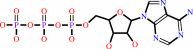 ATP
ATP
|
=
|
O-phospho-L-tyrosyl-[protein]
|
+
|
 ADP
ADP
|
+
|
H(+)
|
|
|
|
|
|
|
|
|
|
|
|
|
Molecule diagrams generated from .mol files obtained from the
KEGG ftp site
|
|
|
|
|
|
|
|
|
|
|
|
|
|
 |
|
|
|
|
|
|
| |
|
|
| |
|
DOI no:
|
J Med Chem
61:1130-1152
(2018)
|
|
PubMed id:
|
|
|
|
|
|
| |
|
Identification of N-{cis-3-[Methyl(7H-pyrrolo[2,3-d]pyrimidin-4-yl)amino]cyclobutyl}propane-1-sulfonamide (PF-04965842): A Selective JAK1 Clinical Candidate for the Treatment of Autoimmune Diseases.
|
|
M.L.Vazquez,
N.Kaila,
J.W.Strohbach,
J.D.Trzupek,
M.F.Brown,
M.E.Flanagan,
M.J.Mitton-Fry,
T.A.Johnson,
R.E.TenBrink,
E.P.Arnold,
A.Basak,
S.E.Heasley,
S.Kwon,
J.Langille,
M.D.Parikh,
S.H.Griffin,
J.M.Casavant,
B.A.Duclos,
A.E.Fenwick,
T.M.Harris,
S.Han,
N.Caspers,
M.E.Dowty,
X.Yang,
M.E.Banker,
M.Hegen,
P.T.Symanowicz,
L.Li,
L.Wang,
T.H.Lin,
J.Jussif,
J.D.Clark,
J.B.Telliez,
R.P.Robinson,
R.Unwalla.
|
|
|
|
|
| |
ABSTRACT
|
|
|
|
| |
|
|
Janus kinases (JAKs) are intracellular tyrosine kinases that mediate the
signaling of numerous cytokines and growth factors involved in the regulation of
immunity, inflammation, and hematopoiesis. As JAK1 pairs with JAK2, JAK3, and
TYK2, a JAK1-selective inhibitor would be expected to inhibit many cytokines
involved in inflammation and immune function while avoiding inhibition of the
JAK2 homodimer regulating erythropoietin and thrombopoietin signaling. Our
efforts began with tofacitinib, an oral JAK inhibitor approved for the treatment
of rheumatoid arthritis. Through modification of the 3-aminopiperidine linker in
tofacitinib, we discovered highly selective JAK1 inhibitors with nanomolar
potency in a human whole blood assay. Improvements in JAK1 potency and
selectivity were achieved via structural modifications suggested by X-ray
crystallographic analysis. After demonstrating efficacy in a rat
adjuvant-induced arthritis (rAIA) model, PF-04965842 (25) was nominated as a
clinical candidate for the treatment of JAK1-mediated autoimmune diseases.
|
|
|
|
|
|
|
|
|
|
|
|
|
|
|
|
|
|
 |
 |
 |
|


 Links
Links


