 |
PDBsum entry 5w2c
 |
|
|
|
|
|
|
Enzyme class:
|
|
E.C.2.7.7.7
- DNA-directed Dna polymerase.
|
|
|
|
|
|
|
Reaction:
|
|
DNA(n) + a 2'-deoxyribonucleoside 5'-triphosphate = DNA(n+1) + diphosphate
|
|
|
|
|
|
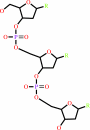 DNA(n)
|
+
|
2'-deoxyribonucleoside 5'-triphosphate
|
=
|
DNA(n+1)
|
+
|
 diphosphate
|
|
|
|
|
|
|
|
|
|
|
|
|
Molecule diagrams generated from .mol files obtained from the
KEGG ftp site
|
|
|
|
|
|
|
|
|
|
|
|
|
|
 |
|
|
|
|
|
|
| |
|
|
| |
|
|
Chem Res Toxicol
30:2023-2032
(2017)
|
|
PubMed id:
|
|
|
|
|
|
| |
|
Mechanism of Error-Free DNA Replication Past Lucidin-Derived DNA Damage by Human DNA Polymerase κ.
|
|
O.P.Yockey,
V.Jha,
P.P.Ghodke,
T.Xu,
W.Xu,
H.Ling,
P.I.Pradeepkumar,
L.Zhao.
|
|
|
|
|
| |
ABSTRACT
|
|
|
|
| |
|
|
DNA damage impinges on genetic information flow and has significant implications
in human disease and aging. Lucidin-3-O-primeveroside (LuP) is an anthraquinone
derivative present in madder root, which has been used as a coloring agent and
food additive. LuP can be metabolically converted to genotoxic compound lucidin,
which subsequently forms lucidin-specific N2-2'-deoxyguanosine
(N2-dG) and N6-2'-deoxyadenosine (N6-dA) DNA
adducts. Lucidin is mutagenic and carcinogenic in rodents but has low
carcinogenic risks in humans. To understand the molecular mechanism of low
carcinogenicity of lucidin in humans, we performed DNA replication assays using
site-specifically modified oligodeoxynucleotides containing a structural
analogue (LdG) of lucidin-N2-dG DNA adduct and determined the crystal
structures of DNA polymerase (pol) κ in complex with LdG-bearing DNA and an
incoming nucleotide. We examined four human pols (pol η, pol ι, pol κ, and
Rev1) in their efficiency and accuracy during DNA replication with LdG; these
pols are key players in translesion DNA synthesis. Our results demonstrate that
pol κ efficiently and accurately replicates past the LdG adduct, whereas DNA
replication by pol η, pol ι is compromised to different extents. Rev1 retains
its ability to incorporate dCTP opposite the lesion albeit with decreased
efficiency. Two ternary crystal structures of pol κ illustrate that the LdG
adduct is accommodated by pol κ at the enzyme active site during insertion and
postlesion-extension steps. The unique open active site of pol κ allows the
adducted DNA to adopt a standard B-form for accurate DNA replication.
Collectively, these biochemical and structural data provide mechanistic insights
into the low carcinogenic risk of lucidin in humans.
|
|
|
|
|
|
|
|
|
|
|
|
|
|
|
|
|
|
 |
 |
 |
|


 Links
Links


