|
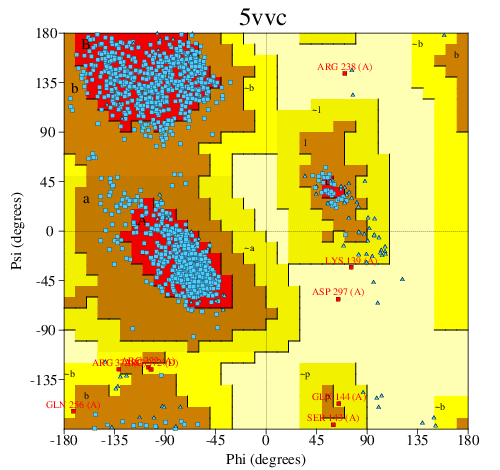
PDBsum entry 5vvc

|
|
|
|
|
|

|
|

|
|

|
|

|
|

|
|

|
|

|
|

|
|

|
|
|
 |

|

|
|
|
|
|
|
|
|
|
|
|
|
|
|
|
|
|
|
|
|
|
|
|
|
|
|
|
|
|
|
|
|
|
|
Oxidoreductase/oxidoreductase inhibitor
|
PDB id
|
|
|
|
5vvc
|
|
|
|
|
|
|
|
|
|
|
|
|
|
|

|

|

|
|
|
|
|
|
References listed in PDB file
|
|
|
Key reference
|
|
|
Title
|
|
Hydrophilic, Potent, And selective 7-Substituted 2-Aminoquinolines as improved human neuronal nitric oxide synthase inhibitors.
|
|
|
Authors
|
|
A.V.Pensa,
M.A.Cinelli,
H.Li,
G.Chreifi,
P.Mukherjee,
L.J.Roman,
P.Martásek,
T.L.Poulos,
R.B.Silverman.
|
|
|
Ref.
|
|
J Med Chem, 2017,
60,
7146-7165.
|
|
|
PubMed id
|
|
|
|
|
|
Abstract
|
|
|
Neuronal nitric oxide synthase (nNOS) is a target for development of
antineurodegenerative agents. Most nNOS inhibitors mimic l-arginine and have
poor bioavailability. 2-Aminoquinolines showed promise as bioavailable nNOS
inhibitors but suffered from low human nNOS inhibition, low selectivity versus
human eNOS, and significant binding to other CNS targets. We aimed to improve
human nNOS potency and selectivity and reduce off-target binding by (a)
truncating the original scaffold or (b) introducing a hydrophilic group to
interrupt the lipophilic, promiscuous pharmacophore and promote interaction with
human nNOS-specific His342. We synthesized both truncated and polar
2-aminoquinoline derivatives and assayed them against recombinant NOS enzymes.
Although aniline and pyridine derivatives interact with His342, benzonitriles
conferred the best rat and human nNOS inhibition. Both introduction of a
hydrophobic substituent next to the cyano group and aminoquinoline methylation
considerably improved isoform selectivity. Most importantly, these modifications
preserved Caco-2 permeability and reduced off-target CNS binding.
|
|
|
|
|
|
|