 |
PDBsum entry 5d2d

|
|
|
|
|
|

|

|

|

|
|

|
|

|
|

|
|

|
|

|
|

|
|
|
 |

|

|
|
|
|
|
|
|
|
|
|
|
|
|
|
|
|
|
|
|
|
|
|
|
|
|
|
|
|
|
|
|
|
|
|
|
Peptide binding protein
|
PDB id
|
|
|
|
5d2d
|
|
|
|
|
|
|
|
|
|
|
|
|
|
|

|

|

|
|
|
|
|
|
|
|
|
|
|
Enzyme class:
|
|
Chain C:
E.C.5.6.1.6
- channel-conductance-controlling ATPase.
|
|
|
|
|
|
|
Reaction:
|
|
ATP + H2O + closed Cl- channel = ADP + phosphate + open Cl- channel
|
|
|
|
|
|
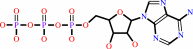 ATP
ATP
|
+
|
H2O
|
+
|
closed Cl(-) channel
|
=
|
 ADP
ADP
|
+
|
 phosphate
|
+
|
open Cl(-) channel
|
|
|
|
|
|
|
|
|
|
|
|
|
Molecule diagrams generated from .mol files obtained from the
KEGG ftp site
|
|
|
|
|
|
|
|
|
|
|
|
|
|
 |
|
|
|
|
|
|
| |
|
|
| |
|
DOI no:
|
Proc Natl Acad Sci U S A
113:E1152
(2016)
|
|
PubMed id:
|
|
|
|
|
|
| |
|
Characterization and small-molecule stabilization of the multisite tandem binding between 14-3-3 and the R domain of CFTR.
|
|
L.M.Stevers,
C.V.Lam,
S.F.Leysen,
F.A.Meijer,
D.S.van Scheppingen,
R.M.de Vries,
G.W.Carlile,
L.G.Milroy,
D.Y.Thomas,
L.Brunsveld,
C.Ottmann.
|
|
|
|
|
| |
ABSTRACT
|
|
|
|
| |
|
|
Cystic fibrosis is a fatal genetic disease, most frequently caused by the
retention of the CFTR (cystic fibrosis transmembrane conductance regulator)
mutant protein in the endoplasmic reticulum (ER). The binding of the 14-3-3
protein to the CFTR regulatory (R) domain has been found to enhance CFTR
trafficking to the plasma membrane. To define the mechanism of action of this
protein-protein interaction, we have examined the interaction in vitro. The
disordered multiphosphorylated R domain contains nine different 14-3-3 binding
motifs. Furthermore, the 14-3-3 protein forms a dimer containing two amphipathic
grooves that can potentially bind these phosphorylated motifs. This results in a
number of possible binding mechanisms between these two proteins. Using multiple
biochemical assays and crystal structures, we show that the interaction between
them is governed by two binding sites: The key binding site of CFTR (pS768)
occupies one groove of the 14-3-3 dimer, and a weaker, secondary binding site
occupies the other binding groove. We show that fusicoccin-A, a natural-product
tool compound used in studies of 14-3-3 biology, can stabilize the interaction
between 14-3-3 and CFTR by selectively interacting with a secondary binding
motif of CFTR (pS753). The stabilization of this interaction stimulates the
trafficking of mutant CFTR to the plasma membrane. This definition of the
druggability of the 14-3-3-CFTR interface might offer an approach for cystic
fibrosis therapeutics.
|
|
|
|
|
|
|
|
|
|
|
|
|
|
|
|
|
|
 |
 |
 |
|
|


 Links
Links


