 |
PDBsum entry 4q0c
|
|

|
|
PDB id:
|
|
|
|
| Name: |
|
Transferase
|
|
|
Title:
|
|
3.1 a resolution crystal structure of the b. Pertussis bvgs periplasmic domain
|
|
Structure:
|
|
Virulence sensor protein bvgs. Chain: a, b, c, d. Fragment: periplasmic domain. Engineered: yes
|
|
Source:
|
|
Bordetella pertussis. Organism_taxid: 257313. Strain: tohamai. Gene: bp1877, bvgs, bvgs (bp1877). Expressed in: escherichia coli. Expression_system_taxid: 562.
|
|
Resolution:
|
|
|
3.10Å
|
R-factor:
|
0.183
|
R-free:
|
0.245
|
|
|
Authors:
|
|
E.Dupre,J.Herrou,M.F.Lensink,R.Wintjens,A.Lebedev,S.Crosson, V.Villeret,C.Locht,R.Antoine,F.Jacob-Dubuisson
|
|
Key ref:
|
|
E.Dupré
et al.
(2015).
Virulence regulation with Venus flytrap domains: structure and function of the periplasmic moiety of the sensor-kinase BvgS.
Plos Pathog,
11,
e1004700.
PubMed id:
DOI:
|
|
|
Date:
|
|
|
01-Apr-14
|
Release date:
|
11-Feb-15
|
|
|
|
|
|
|
PROCHECK
|

|
|
|
|
|
Headers
|
|
|
|
References
|
|
|
|
|
|

|
|
P16575
(BVGS_BORPE) -
Virulence sensor protein BvgS from Bordetella pertussis (strain Tohama I / ATCC BAA-589 / NCTC 13251)
|
|
|
|
Seq:
Struc:
|
|
|
|
1238 a.a.
513 a.a.*
|
|

|

|
|
|
|
|
|
|
|
|
|
|
|
Key: |
 |
PfamA domain |
|
|
 |
Secondary structure |
|
 |
CATH domain |
|
|
*
PDB and UniProt seqs differ
at 1 residue position (black
cross)
|
|
|
|
|
|
|
|
|
|
|
|
|
Enzyme class:
|
|
E.C.2.7.13.3
- histidine kinase.
|
|
|
|
|
|
|
Reaction:
|
|
ATP + protein L-histidine = ADP + protein N-phospho-L-histidine
|
|
|
|
|
|
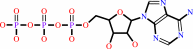 ATP
ATP
|
+
|
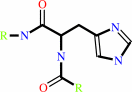 protein L-histidine
|
=
|
 ADP
ADP
|
+
|
protein N-phospho-L-histidine
|
|
|
|
|
|
|
|
|
|
|
|
|
Molecule diagrams generated from .mol files obtained from the
KEGG ftp site
|
|
|
|
|
|
|
|
|
|
|
|
|
|
 |
|
|
|
|
|
|
| |
|
|
| |
|
DOI no:
|
Plos Pathog
11:e1004700
(2015)
|
|
PubMed id:
|
|
|
|
|
|
| |
|
Virulence regulation with Venus flytrap domains: structure and function of the periplasmic moiety of the sensor-kinase BvgS.
|
|
E.Dupré,
J.Herrou,
M.F.Lensink,
R.Wintjens,
A.Vagin,
A.Lebedev,
S.Crosson,
V.Villeret,
C.Locht,
R.Antoine,
F.Jacob-Dubuisson.
|
|
|
|
|
| |
ABSTRACT
|
|
|
|
| |
|
|
Two-component systems (TCS) represent major signal-transduction pathways for
adaptation to environmental conditions, and regulate many aspects of bacterial
physiology. In the whooping cough agent Bordetella pertussis, the TCS BvgAS
controls the virulence regulon, and is therefore critical for pathogenicity.
BvgS is a prototypical TCS sensor-kinase with tandem periplasmic Venus flytrap
(VFT) domains. VFT are bi-lobed domains that typically close around specific
ligands using clamshell motions. We report the X-ray structure of the
periplasmic moiety of BvgS, an intricate homodimer with a novel architecture. By
combining site-directed mutagenesis, functional analyses and molecular modeling,
we show that the conformation of the periplasmic moiety determines the state of
BvgS activity. The intertwined structure of the periplasmic portion and the
different conformation and dynamics of its mobile, membrane-distal VFT1 domains,
and closed, membrane-proximal VFT2 domains, exert a conformational strain onto
the transmembrane helices, which sets the cytoplasmic moiety in a kinase-on
state by default corresponding to the virulent phase of the bacterium. Signaling
the presence of negative signals perceived by the periplasmic domains implies a
shift of BvgS to a distinct state of conformation and activity, corresponding to
the avirulent phase. The response to negative modulation depends on the
integrity of the periplasmic dimer, indicating that the shift to the kinase-off
state implies a concerted conformational transition. This work lays the bases to
understand virulence regulation in Bordetella. As homologous sensor-kinases
control virulence features of diverse bacterial pathogens, the BvgS structure
and mechanism may pave the way for new modes of targeted therapeutic
interventions.
|
|
|
|
|
|
|
|
|
|
|
|
|
|
|
|
|
|
 |
 |
 |
|


 Links
Links


