 |
PDBsum entry 3v0q
|
|

|
|
PDB id:
|
|
|
|
| Name: |
|
Transferase
|
|
|
Title:
|
|
Crystal structure of the fucosylgalactoside alpha n- acetylgalactosaminyltransferase (gta, cisab mutant l266g, g268a) in complex with udp and h-antigen acceptor
|
|
Structure:
|
|
Histo-blood group abo system transferase. Chain: a, b. Fragment: extracellular catalytic domain. Synonym: fucosylglycoprotein 3-alpha-galactosyltransferase, fucosylglycoprotein alpha-n-acetylgalactosaminyltransferase, glycoprotein-fucosylgalactoside alpha-n- acetylgalactosaminyltransferase, glycoprotein-fucosylgalactoside alpha-galactosyltransferase, histo-blood group a transferase, a transferase, histo-blood group b transferase, b transferase, nagat,
|
|
Source:
|
|
Homo sapiens. Human. Organism_taxid: 9606. Gene: ab0, abo. Expressed in: escherichia coli. Expression_system_taxid: 511693.
|
|
Resolution:
|
|
|
1.80Å
|
R-factor:
|
0.152
|
R-free:
|
0.191
|
|
|
Authors:
|
|
M.M.Palcic,R.Jorgensen
|
|
Key ref:
|
|
R.Jørgensen
et al.
(2013).
Base-modified donor analogues reveal novel dynamic features of a glycosyltransferase.
J Biol Chem,
288,
26201-26208.
PubMed id:
DOI:
|
|
|
Date:
|
|
|
08-Dec-11
|
Release date:
|
23-Jan-13
|
|
|
|
|
|
|
PROCHECK
|

|
|
|
|
|
Headers
|
|
|
|
References
|
|
|
|
|
|

|
|
P16442
(BGAT_HUMAN) -
Histo-blood group ABO system transferase from Homo sapiens
|
|
|
|
Seq:
Struc:
|
|
|
|
354 a.a.
297 a.a.*
|
|

|

|

|
|
|
|
|
|
|
|
|
|
|
Key: |
|
 |
Secondary structure |
|
 |
CATH domain |
|
|
*
PDB and UniProt seqs differ
at 8 residue positions (black
crosses)
|
|
|
|
|
|
|
|
|
|
|
|
|
Enzyme class 1:
|
|
E.C.2.4.1.37
- fucosylgalactoside 3-alpha-galactosyltransferase.
|
|
|
|
|
|
|
Reaction:
|
|
an alpha-L-fucosyl-(1->2)-beta-D-galactosyl derivative + UDP-alpha-D- galactose = an alpha-D-galactosyl-(1->3)-[alpha-L-fucosyl-(1->2)]-beta-D- galactosyl derivative + UDP + H+
|
|
|
|
|
|
alpha-L-fucosyl-(1->2)-beta-D-galactosyl derivative
|
+
|
UDP-alpha-D- galactose
|
=
|
alpha-D-galactosyl-(1->3)-[alpha-L-fucosyl-(1->2)]-beta-D- galactosyl derivative
|
+
|
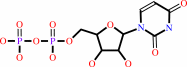 UDP
UDP
|
+
|
H(+)
Bound ligand (Het Group name = )
corresponds exactly
|
|
|
|
|
|
|
|
|
|
Enzyme class 2:
|
|
E.C.2.4.1.40
- glycoprotein-fucosylgalactoside alpha-N-acetylgalactosaminyltransferase.
|
|
|
|
|
|
|
Reaction:
|
|
an alpha-L-fucosyl-(1->2)-beta-D-galactosyl derivative + UDP-N-acetyl- alpha-D-galactosamine = an N-acetyl-alpha-D-galactosaminyl-(1->3)-[alpha- L-fucosyl-(1->2)]-beta-D-galactosyl derivative + UDP + H+
|
|
|
|
|
|
alpha-L-fucosyl-(1->2)-beta-D-galactosyl derivative
|
+
|
UDP-N-acetyl- alpha-D-galactosamine
|
=
|
N-acetyl-alpha-D-galactosaminyl-(1->3)-[alpha- L-fucosyl-(1->2)]-beta-D-galactosyl derivative
|
+
|
UDP
|
+
|
H(+)
Bound ligand (Het Group name = )
corresponds exactly
|
|
|
|
|
|
|
|
|
|
|
|
|
Note, where more than one E.C. class is given (as above), each may
correspond to a different protein domain or, in the case of polyprotein
precursors, to a different mature protein.
|
|
|
|
Molecule diagrams generated from .mol files obtained from the
KEGG ftp site
|
|
|
|
|
|
|
|
|
|
|
|
|
|
 |
|
|
|
|
|
|
| |
|
|
| |
|
DOI no:
|
J Biol Chem
288:26201-26208
(2013)
|
|
PubMed id:
|
|
|
|
|
|
| |
|
Base-modified donor analogues reveal novel dynamic features of a glycosyltransferase.
|
|
R.Jørgensen,
T.Pesnot,
H.J.Lee,
M.M.Palcic,
G.K.Wagner.
|
|
|
|
|
| |
ABSTRACT
|
|
|
|
| |
|
|
Glycosyltransferases (GTs) are enzymes that are involved, as Nature's
"glycosylation reagents," in many fundamental biological processes
including cell adhesion and blood group biosynthesis. Although of similar
importance to that of other large enzyme families such as protein kinases and
proteases, the undisputed potential of GTs for chemical biology and drug
discovery has remained largely unrealized to date. This is due, at least in
part, to a relative lack of GT inhibitors and tool compounds for structural,
mechanistic, and cellular studies. In this study, we have used a novel class of
GT donor analogues to obtain new structural and enzymological information for a
representative blood group GT. These analogues interfere with the folding of an
internal loop and the C terminus, which are essential for catalysis. Our
experiments have led to the discovery of an entirely new active site folding
mode for this enzyme family, which can be targeted in inhibitor development,
similar to the DFG motif in protein kinases. Taken together, our results provide
new insights into substrate binding, dynamics, and utilization in this important
enzyme family, which can very likely be harnessed for the rational development
of new GT inhibitors and probes.
|
|
|
|
|
|
|
|
|
|
|
|
|
|
|
|
|
|
 |
 |
 |
|


 Links
Links


