|
|

|
|
PDB id:
|
|
|
|
| Name: |
|
Fluorescent protein
|
|
|
Title:
|
|
Calcium-free gcamp2 (calcium binding deficient mutant)
|
|
Structure:
|
|
Myosin light chain kinase, green fluorescent protein, calmodulin chimera. Chain: a. Engineered: yes. Mutation: yes
|
|
Source:
|
|
Artificial gene, aequorea victoria, rattus norvegicus. Jellyfish, rat. Organism_taxid: 32630, 6100, 10116. Gene: gfp, calm1, calm, cam, cam1, cami. Expressed in: escherichia coli. Expression_system_taxid: 469008.
|
|
Resolution:
|
|
|
2.80Å
|
R-factor:
|
0.213
|
R-free:
|
0.280
|
|
|
Authors:
|
|
J.Akerboom,J.D.Velez Rivera,L.L.Looger,E.R.Schreiter
|
Key ref:

|
|
J.Akerboom
et al.
(2009).
Crystal structures of the GCaMP calcium sensor reveal the mechanism of fluorescence signal change and aid rational design.
J Biol Chem,
284,
6455-6464.
PubMed id:
DOI:

|
|
|
Date:
|
|
|
19-Sep-08
|
Release date:
|
16-Dec-08
|
|
|
|
|
|
|
PROCHECK
|

|
|
|
|
|
Headers
|
|
|
|
References
|
|
|
|
|
|

|
|
P0DP29
(CALM1_RAT) -
Calmodulin-1 from Rattus norvegicus
|
|
|
|
Seq:
Struc:
|
|
|
|
149 a.a.
302 a.a.*
|
|

|

|

|
|
|
|
|
|
|
|
|
|
|
|
|
|
|
|
|
Enzyme class:
|
|
E.C.2.7.11.18
- [myosin light-chain] kinase.
|
|
|
|
|
|
|
Reaction:
|
|
|
1.
|
L-seryl-[myosin light chain] + ATP = O-phospho-L-seryl-[myosin light chain] + ADP + H+
|
|
2.
|
L-threonyl-[myosin light chain] + ATP = O-phospho-L-threonyl-[myosin light chain] + ADP + H+
|
|
|
|
|
|
|
L-seryl-[myosin light chain]
|
+
|
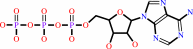 ATP
ATP
|
=
|
O-phospho-L-seryl-[myosin light chain]
|
+
|
 ADP
ADP
|
+
|
H(+)
|
|
|
|
|
|
|
L-threonyl-[myosin light chain]
|
+
|
ATP
|
=
|
O-phospho-L-threonyl-[myosin light chain]
|
+
|
ADP
|
+
|
H(+)
|
|
|
|
|
|
|
|
|
|
Cofactor:
|
|
Ca(2+)
|
|
|
|
|
|
|
|
|
Molecule diagrams generated from .mol files obtained from the
KEGG ftp site
|
|
|
|
|
|
|
|
|
|
|
|
|
|
 |
|
|
|
|
|
|
| |
|
|
| |
|
DOI no:
|
J Biol Chem
284:6455-6464
(2009)
|
|
PubMed id:
|
|
|
|
|
|
| |
|
Crystal structures of the GCaMP calcium sensor reveal the mechanism of fluorescence signal change and aid rational design.
|
|
J.Akerboom,
J.D.Rivera,
M.M.Guilbe,
E.C.Malavé,
H.H.Hernandez,
L.Tian,
S.A.Hires,
J.S.Marvin,
L.L.Looger,
E.R.Schreiter.
|
|
|
|
|
| |
ABSTRACT
|
|
|
|
| |
|
|
The genetically encoded calcium indicator GCaMP2 shows promise for neural
network activity imaging, but is currently limited by low signal-to-noise ratio.
We describe x-ray crystal structures as well as solution biophysical and
spectroscopic characterization of GCaMP2 in the calcium-free dark state, and in
two calcium-bound bright states: a monomeric form that dominates at
intracellular concentrations observed during imaging experiments and an
unexpected domain-swapped dimer with decreased fluorescence. This series of
structures provides insight into the mechanism of Ca2+-induced fluorescence
change. Upon calcium binding, the calmodulin (CaM) domain wraps around the M13
peptide, creating a new domain interface between CaM and the circularly permuted
enhanced green fluorescent protein domain. Residues from CaM alter the chemical
environment of the circularly permuted enhanced green fluorescent protein
chromophore and, together with flexible inter-domain linkers, block solvent
access to the chromophore. Guided by the crystal structures, we engineered a
series of GCaMP2 point mutants to probe the mechanism of GCaMP2 function and
characterized one mutant with significantly improved signal-to-noise. The
mutation is located at a domain interface and its effect on sensor function
could not have been predicted in the absence of structural data.
|
|
|
|
|
|
| |
Selected figure(s)
|
|
|
|
| |
|
|

|
|

|
|
Figure 3.
Stereoview of the structures of Ca^2^+-saturated GCaMP2-K387W
monomer (red), Ca^2^+-saturated GCaMP2 dimer (yellow), and
Ca^2^+-free 8EF-GCaMP2 (blue) superimposed using the cpEGFP
domain. The proteins are represented as ribbons with the cpEGFP
chromophore represented as sticks.
|
|
Figure 5.
A rationally designed, improved GCaMP2 variant. A,
fluorescence excitation (solid lines) and emission (dashed
lines) spectra of Ca^2+-saturated GCaMP2 T116V (red) and
T116V/D381Y (blue), as well as their calcium-free forms (gray
and black, respectively). Normalized absorbance spectra of each
are shown in the inset. B, close-up stereo view of the
Ca^2+-saturated monomeric GCaMP2 structure, showing the location
of aspartate 381 (D381) of CaM at the CaM/cpEGFP domain
interface. GCaMP2 is displayed as ribbons colored by domain. The
side chain of Asp^381 and the cpEGFP chromophore are displayed
as sticks. A model of a tyrosine side chain at position 381 is
shown in semitransparent sticks to represent a possible
conformation of the D381Y mutant and to illustrate the proximity
of this side chain to the chromophore.
|
|
|
|
|
|
| |
The above figures are
reprinted
from an Open Access publication published by the ASBMB:
J Biol Chem
(2009,
284,
6455-6464)
copyright 2009.
|
|
| |
Figures were
selected
by an automated process.
|
|
|
|
|
|
|
|
|
|
|
|
|
|
|
|
 |
 |
 |
|
Literature references that cite this PDB file's key reference
|
|
|
| |
PubMed id
|
|
Reference
|
|
|
|
|
|
A.E.Palmer,
Y.Qin,
J.G.Park,
and
J.E.McCombs
(2011).
Design and application of genetically encoded biosensors.
|
| |
Trends Biotechnol,
29,
144-152.
|
|
|
|
|
|
|
A.Muto,
M.Ohkura,
T.Kotani,
S.Higashijima,
J.Nakai,
and
K.Kawakami
(2011).
Genetic visualization with an improved GCaMP calcium indicator reveals spatiotemporal activation of the spinal motor neurons in zebrafish.
|
| |
Proc Natl Acad Sci U S A,
108,
5425-5430.
|
|
|
|
|
|
|
A.Kirchhofer,
J.Helma,
K.Schmidthals,
C.Frauer,
S.Cui,
A.Karcher,
M.Pellis,
S.Muyldermans,
C.S.Casas-Delucchi,
M.C.Cardoso,
H.Leonhardt,
K.P.Hopfner,
and
U.Rothbauer
(2010).
Modulation of protein properties in living cells using nanobodies.
|
| |
Nat Struct Mol Biol,
17,
133-138.
|
|
|
PDB codes:
|
|
|
|
|
|
|
|
H.J.Carlson,
D.W.Cotton,
and
R.E.Campbell
(2010).
Circularly permuted monomeric red fluorescent proteins with new termini in the beta-sheet.
|
| |
Protein Sci,
19,
1490-1499.
|
|
|
|
|
|
|
N.Suzuki,
M.Hiraki,
Y.Yamada,
N.Matsugaki,
N.Igarashi,
R.Kato,
I.Dikic,
D.Drew,
S.Iwata,
S.Wakatsuki,
and
M.Kawasaki
(2010).
Crystallization of small proteins assisted by green fluorescent protein.
|
| |
Acta Crystallogr D Biol Crystallogr,
66,
1059-1066.
|
|
|
PDB codes:
|
|
|
|
|
|
|
|
S.Okumoto
(2010).
Imaging approach for monitoring cellular metabolites and ions using genetically encoded biosensors.
|
| |
Curr Opin Biotechnol,
21,
45-54.
|
|
|
|
|
|
|
A.E.Granstedt,
M.L.Szpara,
B.Kuhn,
S.S.Wang,
and
L.W.Enquist
(2009).
Fluorescence-based monitoring of in vivo neural activity using a circuit-tracing pseudorabies virus.
|
| |
PLoS One,
4,
e6923.
|
|
|
|
|
|
|
A.Perron,
H.Mutoh,
T.Launey,
and
T.Knöpfel
(2009).
Red-shifted voltage-sensitive fluorescent proteins.
|
| |
Chem Biol,
16,
1268-1277.
|
|
|
|
|
|
|
C.D.Wilms,
and
M.Häusser
(2009).
Lighting up neural networks using a new generation of genetically encoded calcium sensors.
|
| |
Nat Methods,
6,
871-872.
|
|
|
|
|
|
|
L.Tian,
S.A.Hires,
T.Mao,
D.Huber,
M.E.Chiappe,
S.H.Chalasani,
L.Petreanu,
J.Akerboom,
S.A.McKinney,
E.R.Schreiter,
C.I.Bargmann,
V.Jayaraman,
K.Svoboda,
and
L.L.Looger
(2009).
Imaging neural activity in worms, flies and mice with improved GCaMP calcium indicators.
|
| |
Nat Methods,
6,
875-881.
|
|
|
|
|
|
|
W.B.Frommer,
M.W.Davidson,
and
R.E.Campbell
(2009).
Genetically encoded biosensors based on engineered fluorescent proteins.
|
| |
Chem Soc Rev,
38,
2833-2841.
|
|
|
|
|
|
The most recent references are shown first.
Citation data come partly from CiteXplore and partly
from an automated harvesting procedure. Note that this is likely to be
only a partial list as not all journals are covered by
either method. However, we are continually building up the citation data
so more and more references will be included with time.
Where a reference describes a PDB structure, the PDB
codes are
shown on the right.
|
 |
|


 Links
Links


