
|
|
|
|
|
 |
Contents |
 |
|
|
|
|
|
|
|
|
|
|
|


 229 a.a.
|
|
|
|
|
|
|
|
|
|
|

 1119 a.a.
|
|
|
|
|
|
|
|
|
|
|

 1321 a.a.
|
|
|
|
|
|
|
|
|
|
|

 95 a.a.
|
|
|
|
|
|
|
|
|
|
|

 345 a.a.
|
|
|
|
|
|
|
|
|
|
|
|
|
* Residue conservation analysis
|
|
|
|
|
|
PDB id:
|
|
|
|
| Name: |
|
Transferase
|
|
|
Title:
|
|
Crystal structure of the t. Thermophilus RNA polymerase holoenzyme in complex with antibiotic myxopyronin
|
|
Structure:
|
|
DNA-directed RNA polymerase subunit alpha. Chain: a, b, k, l. Synonym: rnap subunit alpha, transcriptase subunit alpha, RNA polymerase subunit alpha. DNA-directed RNA polymerase subunit beta. Chain: c, m. Synonym: rnap subunit beta, transcriptase subunit beta, RNA polymerase subunit beta. DNA-directed RNA polymerase subunit beta'.
|
|
Source:
|
|
Thermus thermophilus. Organism_taxid: 274. Organism_taxid: 274
|
|
Resolution:
|
|
|
2.70Å
|
R-factor:
|
0.240
|
R-free:
|
0.270
|
|
|
Authors:
|
|
D.G.Vassylyev,M.N.Vassylyeva,I.Artsimovitch
|
Key ref:

|
|
G.A.Belogurov
et al.
(2009).
Transcription inactivation through local refolding of the RNA polymerase structure.
Nature,
457,
332-335.
PubMed id:
DOI:

|
|
|
Date:
|
|
|
30-Sep-08
|
Release date:
|
28-Oct-08
|
|
|
|
|
|
|
PROCHECK
|

|
|
|
|
|
Headers
|
|
|
|
References
|
|
|
|
|
|

|
|
Q9Z9H6
(RPOA_THETH) -
DNA-directed RNA polymerase subunit alpha from Thermus thermophilus
|
|
|
|
Seq:
Struc:
|
|
|
|
315 a.a.
229 a.a.
|
|

|

|

|
|
|
|
|
|
|
|
|
|
|
|

|
|
Q8RQE9
(RPOB_THET8) -
DNA-directed RNA polymerase subunit beta from Thermus thermophilus (strain ATCC 27634 / DSM 579 / HB8)
|
|
|
|
Seq:
Struc:
|
|
|
|
1119 a.a.
1119 a.a.
|
|
|

|
|
|
|
|
|
|
|
|
|
|
|
|

|
|
Q8RQE8
(RPOC_THET8) -
DNA-directed RNA polymerase subunit beta' from Thermus thermophilus (strain ATCC 27634 / DSM 579 / HB8)
|
|
|
|
Seq:
Struc:
|
|
|
|
1524 a.a.
1321 a.a.
|
|
|

|
|
|
|
|
|
|
|
|
|
|
|
|
|
|
|
|
|
Enzyme class:
|
|
Chains A, B, C, D, E, K, L, M, N, O:
E.C.2.7.7.6
- DNA-directed Rna polymerase.
|
|
|
|
|
|
|
Reaction:
|
|
RNA(n) + a ribonucleoside 5'-triphosphate = RNA(n+1) + diphosphate
|
|
|
|
|
|
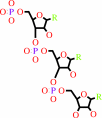 RNA(n)
|
+
|
ribonucleoside 5'-triphosphate
|
=
|
RNA(n+1)
|
+
|
 diphosphate
|
|
|
|
|
|
|
|
|
|
|
|
|
Molecule diagrams generated from .mol files obtained from the
KEGG ftp site
|
|
|
|
|
|
|
|
|
|
|
|
|
|
 |
|
|
|
|
|
|
| |
|
|
| |
|
DOI no:
|
Nature
457:332-335
(2009)
|
|
PubMed id:
|
|
|
|
|
|
| |
|
Transcription inactivation through local refolding of the RNA polymerase structure.
|
|
G.A.Belogurov,
M.N.Vassylyeva,
A.Sevostyanova,
J.R.Appleman,
A.X.Xiang,
R.Lira,
S.E.Webber,
S.Klyuyev,
E.Nudler,
I.Artsimovitch,
D.G.Vassylyev.
|
|
|
|
|
| |
ABSTRACT
|
|
|
|
| |
|
|
Structural studies of antibiotics not only provide a shortcut to medicine
allowing for rational structure-based drug design, but may also capture
snapshots of dynamic intermediates that become 'frozen' after inhibitor binding.
Myxopyronin inhibits bacterial RNA polymerase (RNAP) by an unknown mechanism.
Here we report the structure of dMyx-a desmethyl derivative of myxopyronin
B-complexed with a Thermus thermophilus RNAP holoenzyme. The antibiotic binds to
a pocket deep inside the RNAP clamp head domain, which interacts with the DNA
template in the transcription bubble. Notably, binding of dMyx stabilizes
refolding of the beta'-subunit switch-2 segment, resulting in a configuration
that might indirectly compromise binding to, or directly clash with, the melted
template DNA strand. Consistently, footprinting data show that the antibiotic
binding does not prevent nucleation of the promoter DNA melting but instead
blocks its propagation towards the active site. Myxopyronins are thus, to our
knowledge, a first structurally characterized class of antibiotics that target
formation of the pre-catalytic transcription initiation complex-the decisive
step in gene expression control. Notably, mutations designed in switch-2 mimic
the dMyx effects on promoter complexes in the absence of antibiotic. Overall,
our results indicate a plausible mechanism of the dMyx action and a stepwise
pathway of open complex formation in which core enzyme mediates the final stage
of DNA melting near the transcription start site, and that switch-2 might act as
a molecular checkpoint for DNA loading in response to regulatory signals or
antibiotics. The universally conserved switch-2 may have the same role in all
multisubunit RNAPs.
|
|
|
|
|
|
| |
Selected figure(s)
|
|
|
|
| |
|
|

|
|

|
|
Figure 3.
Figure 3: A mechanism of the dMyx action. a, Myx alters the
contacts between RNAP and  P[R]
promoter DNA. A linear DNA fragment encompassing positions -81
to +70 of the P[R]
promoter was generated by polymerase chain reaction (PCR); the
non-template DNA strand was end-labelled with [^32P]- P[R]
promoter DNA. A linear DNA fragment encompassing positions -81
to +70 of the P[R]
promoter was generated by polymerase chain reaction (PCR); the
non-template DNA strand was end-labelled with [^32P]-  ATP
(see Methods). The sequence from -44 to +23 is shown. The -35
and -10 hexamers are indicated by black boxes, the start site
(+1) is shown by a black dot. The top panel shows probing of the
non-template strand by piperidine-induced cleavage of the
permanganate-modified T residues. Reactivities of -10, -4, -3
and +2 residues (quantification described in Methods) are shown
to the left of the gel and summarized above the promoter
sequence where black and white arrows indicate high and low
reactivity, respectively. The bottom panel shows protection of
the non-template DNA strand from DNaseI digestion. The footprint
boundaries in the promoter region shown are indicated on the gel
and by black (RNAP alone) and white (RNAP with the inhibitor)
bars below the promoter sequence; the dideoxy-sequencing ladder
is shown for reference. In the gels shown, independent reaction
repeats were analysed for consistency. b, Schematic drawing of
the putative mechanism of the dMyx action. dwDNA, downstream DNA. ATP
(see Methods). The sequence from -44 to +23 is shown. The -35
and -10 hexamers are indicated by black boxes, the start site
(+1) is shown by a black dot. The top panel shows probing of the
non-template strand by piperidine-induced cleavage of the
permanganate-modified T residues. Reactivities of -10, -4, -3
and +2 residues (quantification described in Methods) are shown
to the left of the gel and summarized above the promoter
sequence where black and white arrows indicate high and low
reactivity, respectively. The bottom panel shows protection of
the non-template DNA strand from DNaseI digestion. The footprint
boundaries in the promoter region shown are indicated on the gel
and by black (RNAP alone) and white (RNAP with the inhibitor)
bars below the promoter sequence; the dideoxy-sequencing ladder
is shown for reference. In the gels shown, independent reaction
repeats were analysed for consistency. b, Schematic drawing of
the putative mechanism of the dMyx action. dwDNA, downstream DNA.
|
|
Figure 4.
Figure 4: Mutations in switch-2 affect the open complex
formation. Accessibility of the non-template DNA strand
residues to permanganate modification probed as in Fig. 3a.
Wild-type and mutant RNAPs differ in their patterns of
reactivity in the absence of dMyx (top traces) but are nearly
identical in the presence of 10  M
dMyx (bottom traces). Notably, M
dMyx (bottom traces). Notably,  ' '
 309–325
that removes the entire rudder loop (which is inserted in the
same helix as switch-2, but is unlikely to interfere with the
nucleic acids) has no effect on DNA melting, suggesting that a
melting defect of a different rudder deletion^19 might be due to
changes in the adjacent switch-2 instead. 309–325
that removes the entire rudder loop (which is inserted in the
same helix as switch-2, but is unlikely to interfere with the
nucleic acids) has no effect on DNA melting, suggesting that a
melting defect of a different rudder deletion^19 might be due to
changes in the adjacent switch-2 instead.
|
|
|
|
|
|
| |
The above figures are
reprinted
from an Open Access publication published by Macmillan Publishers Ltd:
Nature
(2009,
457,
332-335)
copyright 2009.
|
|
| |
Figures were
selected
by an automated process.
|
|
|
|
|
|
|
|
|
|
|
|
|
|
|
|
 |
 |
 |
|
Literature references that cite this PDB file's key reference
|
|
|
| |
PubMed id
|
|
Reference
|
|
|
|
|
|
K.Brodolin
(2011).
Antibiotics trapping transcription initiation intermediates: To melt or to bend, what's first?
|
| |
Transcription,
2,
60-65.
|
|
|
|
|
|
|
T.I.Moy,
A.Daniel,
C.Hardy,
A.Jackson,
O.Rehrauer,
Y.S.Hwang,
D.Zou,
K.Nguyen,
J.A.Silverman,
Q.Li,
and
C.Murphy
(2011).
Evaluating the activity of the RNA polymerase inhibitor myxopyronin B against Staphylococcus aureus.
|
| |
FEMS Microbiol Lett,
319,
176-179.
|
|
|
|
|
|
|
A.Sevostyanova,
and
I.Artsimovitch
(2010).
Functional analysis of Thermus thermophilus transcription factor NusG.
|
| |
Nucleic Acids Res,
38,
7432-7445.
|
|
|
|
|
|
|
A.Tupin,
M.Gualtieri,
J.P.Leonetti,
and
K.Brodolin
(2010).
The transcription inhibitor lipiarmycin blocks DNA fitting into the RNA polymerase catalytic site.
|
| |
EMBO J,
29,
2527-2537.
|
|
|
|
|
|
|
D.Pupov,
N.Miropolskaya,
A.Sevostyanova,
I.Bass,
I.Artsimovitch,
and
A.Kulbachinskiy
(2010).
Multiple roles of the RNA polymerase {beta}' SW2 region in transcription initiation, promoter escape, and RNA elongation.
|
| |
Nucleic Acids Res,
38,
5784-5796.
|
|
|
|
|
|
|
K.J.Weissman,
and
R.Müller
(2010).
Myxobacterial secondary metabolites: bioactivities and modes-of-action.
|
| |
Nat Prod Rep,
27,
1276-1295.
|
|
|
|
|
|
|
O.Erol,
T.F.Schäberle,
A.Schmitz,
S.Rachid,
C.Gurgui,
M.El Omari,
F.Lohr,
S.Kehraus,
J.Piel,
R.Müller,
and
G.M.König
(2010).
Biosynthesis of the myxobacterial antibiotic corallopyronin A.
|
| |
Chembiochem,
11,
1253-1265.
|
|
|
|
|
|
|
P.C.Burrows,
N.Joly,
and
M.Buck
(2010).
A prehydrolysis state of an AAA+ ATPase supports transcription activation of an enhancer-dependent RNA polymerase.
|
| |
Proc Natl Acad Sci U S A,
107,
9376-9381.
|
|
|
|
|
|
|
T.J.Gries,
W.S.Kontur,
M.W.Capp,
R.M.Saecker,
and
M.T.Record
(2010).
One-step DNA melting in the RNA polymerase cleft opens the initiation bubble to form an unstable open complex.
|
| |
Proc Natl Acad Sci U S A,
107,
10418-10423.
|
|
|
|
|
|
|
W.J.Lane,
and
S.A.Darst
(2010).
Molecular evolution of multisubunit RNA polymerases: structural analysis.
|
| |
J Mol Biol,
395,
686-704.
|
|
|
|
|
|
|
A.Rogozina,
E.Zaychikov,
M.Buckle,
H.Heumann,
and
B.Sclavi
(2009).
DNA melting by RNA polymerase at the T7A1 promoter precedes the rate-limiting step at 37 degrees C and results in the accumulation of an off-pathway intermediate.
|
| |
Nucleic Acids Res,
37,
5390-5404.
|
|
|
|
|
|
|
A.Tupin,
M.Gualtieri,
K.Brodolin,
and
J.P.Leonetti
(2009).
Myxopyronin: a punch in the jaws of bacterial RNA polymerase.
|
| |
Future Microbiol,
4,
145-149.
|
|
|
|
|
|
|
J.W.Kozarich
(2009).
The biochemistry of disease: desperately seeking syzygy.
|
| |
Annu Rev Biochem,
78,
55-63.
|
|
|
|
|
|
|
S.T.Rutherford,
C.L.Villers,
J.H.Lee,
W.Ross,
and
R.L.Gourse
(2009).
Allosteric control of Escherichia coli rRNA promoter complexes by DksA.
|
| |
Genes Dev,
23,
236-248.
|
|
|
|
|
|
The most recent references are shown first.
Citation data come partly from CiteXplore and partly
from an automated harvesting procedure. Note that this is likely to be
only a partial list as not all journals are covered by
either method. However, we are continually building up the citation data
so more and more references will be included with time.
|

| |


 Links
Links


