 |
PDBsum entry 2zbe

|
|
|
|
|
 |
Contents |
 |
|
|
|
|
|
|
|
|
|
|
|
|
* Residue conservation analysis
|
|
|
|
|
|
PDB id:
|
|
|
|
| Name: |
|
Hydrolase
|
|
|
Title:
|
|
Calcium pump crystal structure with bound bef3 in the absence of calcium and tg
|
|
Structure:
|
|
Sarcoplasmic/endoplasmic reticulum calcium atpase 1. Chain: a, b. Synonym: calcium pump 1, serca1, sr ca(2+)-atpase 1, calcium- transporting atpase sarcoplasmic reticulum type, fast twitch skeletal muscle isoform, endoplasmic reticulum class 1/2 ca(2+) atpase. Ec: 3.6.3.8
|
|
Source:
|
|
Oryctolagus cuniculus. Rabbit. Organism_taxid: 9986. Tissue: skeletal muscle (white)
|
|
Resolution:
|
|
|
3.80Å
|
R-factor:
|
0.293
|
R-free:
|
0.327
|
|
|
Authors:
|
|
C.Toyoshima,H.Ogawa,Y.Norimatsu
|
Key ref:

|
|
C.Toyoshima
et al.
(2007).
How processing of aspartylphosphate is coupled to lumenal gating of the ion pathway in the calcium pump.
Proc Natl Acad Sci U S A,
104,
19831-19836.
PubMed id:
DOI:

|
|
|
Date:
|
|
|
20-Oct-07
|
Release date:
|
11-Dec-07
|
|
|
|
|
|
|
PROCHECK
|

|
|
|
|
|
Headers
|
|
|
|
References
|
|
|
|
|
|

|
|
P04191
(AT2A1_RABIT) -
Sarcoplasmic/endoplasmic reticulum calcium ATPase 1 from Oryctolagus cuniculus
|
|
|
|
Seq:
Struc:
|
|
|
|
1001 a.a.
994 a.a.*
|
|

|

|

|
|
|
|
|
|
|
|
|
|
|
Key: |
 |
PfamA domain |
|
|
 |
Secondary structure |
|
 |
CATH domain |
|
|
*
PDB and UniProt seqs differ
at 1 residue position (black
cross)
|
|
|
|
|
|
|
|
|
|
|
|
|
Enzyme class:
|
|
E.C.7.2.2.10
- P-type Ca(2+) transporter.
|
|
|
|
|
|
|
Reaction:
|
|
Ca2+(in) + ATP + H2O = Ca2+(out) + ADP + phosphate + H+
|
|
|
|
|
|
Ca(2+)(in)
|
+
|
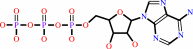 ATP
ATP
|
+
|
H2O
|
=
|
Ca(2+)(out)
|
+
|
 ADP
ADP
|
+
|
 phosphate
|
+
|
H(+)
|
|
|
|
|
|
|
|
|
|
Cofactor:
|
|
Mg(2+)
|
|
|
|
|
|
|
|
|
Molecule diagrams generated from .mol files obtained from the
KEGG ftp site
|
|
|
|
|
|
|
|
|
|
|
|
|
|
 |
|
|
|
|
|
|
| |
|
|
| |
|
DOI no:
|
Proc Natl Acad Sci U S A
104:19831-19836
(2007)
|
|
PubMed id:
|
|
|
|
|
|
| |
|
How processing of aspartylphosphate is coupled to lumenal gating of the ion pathway in the calcium pump.
|
|
C.Toyoshima,
Y.Norimatsu,
S.Iwasawa,
T.Tsuda,
H.Ogawa.
|
|
|
|
|
| |
ABSTRACT
|
|
|
|
| |
|
|
Ca(2+)-ATPase of skeletal muscle sarcoplasmic reticulum is the best-studied
member of the P-type or E1/E2 type ion transporting ATPases. It has been
crystallized in seven different states that cover nearly the entire reaction
cycle. Here we describe the structure of this ATPase complexed with phosphate
analogs BeF(3)(-) and AlF(4)(-) in the absence of Ca(2+), which correspond to
the E2P ground state and E2 approximately P transition state, respectively. The
luminal gate is open with BeF(3)(-) and closed with AlF(4)(-). These and the E1
approximately P.ADP analog crystal structures show that a two-step rotation of
the cytoplasmic A-domain opens and closes the luminal gate through the movements
of the M1-M4 transmembrane helices. There are several conformational switches
coupled to the rotation, and the one in the cytoplasmic part of M2 has critical
importance. In the second step of rotation, positioning of one water molecule
couples the hydrolysis of aspartylphosphate to closing of the gate.
|
|
|
|
|
|
| |
Selected figure(s)
|
|
|
|
| |
|
|

|
|

|
|
Figure 3.
Fig. 3. Cross-sections of the transmembrane region of
Ca^2+-ATPase. van der Waals surfaces of E1·AlF  ·ADP
(a) and E2·BeF ·ADP
(a) and E2·BeF  (–TG)
(b). Red colors represent acidic residues. Dotted circles in b
indicate the positions of Ca^2+ observed in E1·AlF ·ADP
(a). The images shown were prepared with PyMol (34). (–TG)
(b). Red colors represent acidic residues. Dotted circles in b
indicate the positions of Ca^2+ observed in E1·AlF ·ADP
(a). The images shown were prepared with PyMol (34).
|
|
Figure 7.
Fig. 7. A cartoon illustrating two-step rotation in the
processing of aspartylphosphate and gating of the ion pathway.
Small arrows indicate the movements of the TM helices. The
M1–M4 (green) and A1–A3 (yellow) helices are numbered.
P-D351 refers to phosphorylated Asp-351.
|
|
|
|
| |
Figures were
selected
by an automated process.
|
|
|
|
|
|
|
|
|
|
|
|
|
|
|
|
 |
 |
 |
|
Literature references that cite this PDB file's key reference
|
|
|
| |
PubMed id
|
|
Reference
|
|
|
|
|
|
C.Toyoshima,
S.Yonekura,
J.Tsueda,
and
S.Iwasawa
(2011).
Trinitrophenyl derivatives bind differently from parent adenine nucleotides to Ca2+-ATPase in the absence of Ca2+.
|
| |
Proc Natl Acad Sci U S A,
108,
1833-1838.
|
|
|
PDB codes:
|
|
|
|
|
|
|
|
D.H.Maclennan,
and
E.Zvaritch
(2011).
Mechanistic models for muscle diseases and disorders originating in the sarcoplasmic reticulum.
|
| |
Biochim Biophys Acta,
1813,
948-964.
|
|
|
|
|
|
|
J.P.Morth,
B.P.Pedersen,
M.J.Buch-Pedersen,
J.P.Andersen,
B.Vilsen,
M.G.Palmgren,
and
P.Nissen
(2011).
A structural overview of the plasma membrane Na+,K+-ATPase and H+-ATPase ion pumps.
|
| |
Nat Rev Mol Cell Biol,
12,
60-70.
|
|
|
|
|
|
|
K.Abe,
K.Tani,
and
Y.Fujiyoshi
(2011).
Conformational rearrangement of gastric H(+),K(+)-ATPase induced by an acid suppressant.
|
| |
Nat Commun,
2,
155.
|
|
|
PDB code:
|
|
|
|
|
|
|
|
H.Suzuki,
K.Yamasaki,
T.Daiho,
and
S.Danko
(2010).
Mechanism of ca(2+) pump as revealed by mutations, development of stable analogs of phosphorylated intermediates, and their structural analyses.
|
| |
Yakugaku Zasshi,
130,
179-189.
|
|
|
|
|
|
|
J.V.Møller,
C.Olesen,
A.M.Winther,
and
P.Nissen
(2010).
The sarcoplasmic Ca2+-ATPase: design of a perfect chemi-osmotic pump.
|
| |
Q Rev Biophys,
43,
501-566.
|
|
|
|
|
|
|
M.Bublitz,
H.Poulsen,
J.P.Morth,
and
P.Nissen
(2010).
In and out of the cation pumps: P-type ATPase structure revisited.
|
| |
Curr Opin Struct Biol,
20,
431-439.
|
|
|
|
|
|
|
N.Vedovato,
and
D.C.Gadsby
(2010).
The two C-terminal tyrosines stabilize occluded Na/K pump conformations containing Na or K ions.
|
| |
J Gen Physiol,
136,
63-82.
|
|
|
|
|
|
|
Y.Sugita,
M.Ikeguchi,
and
C.Toyoshima
(2010).
Relationship between Ca2+-affinity and shielding of bulk water in the Ca2+-pump from molecular dynamics simulations.
|
| |
Proc Natl Acad Sci U S A,
107,
21465-21469.
|
|
|
|
|
|
|
A.Takeuchi,
N.Reyes,
P.Artigas,
and
D.C.Gadsby
(2009).
Visualizing the mapped ion pathway through the Na,K-ATPase pump.
|
| |
Channels (Austin),
3,
383-386.
|
|
|
|
|
|
|
C.Völlmecke,
C.Kötting,
K.Gerwert,
and
M.Lübben
(2009).
Spectroscopic investigation of the reaction mechanism of CopB-B, the catalytic fragment from an archaeal thermophilic ATP-driven heavy metal transporter.
|
| |
FEBS J,
276,
6172-6186.
|
|
|
|
|
|
|
D.C.Gadsby
(2009).
Ion channels versus ion pumps: the principal difference, in principle.
|
| |
Nat Rev Mol Cell Biol,
10,
344-352.
|
|
|
|
|
|
|
H.Ogawa,
T.Shinoda,
F.Cornelius,
and
C.Toyoshima
(2009).
Crystal structure of the sodium-potassium pump (Na+,K+-ATPase) with bound potassium and ouabain.
|
| |
Proc Natl Acad Sci U S A,
106,
13742-13747.
|
|
|
PDB code:
|
|
|
|
|
|
|
|
K.O.Håkansson,
and
A.Curović
(2009).
Crystallization and data collection of the nucleotide-binding domain of Mg-ATPase.
|
| |
Acta Crystallogr Sect F Struct Biol Cryst Commun,
65,
223-225.
|
|
|
|
|
|
|
R.D.Peluffo,
R.M.González-Lebrero,
S.B.Kaufman,
S.Kortagere,
B.Orban,
R.C.Rossi,
and
J.R.Berlin
(2009).
Quaternary benzyltriethylammonium ion binding to the Na,K-ATPase: a tool to investigate extracellular K+ binding reactions.
|
| |
Biochemistry,
48,
8105-8119.
|
|
|
|
|
|
|
S.Danko,
T.Daiho,
K.Yamasaki,
X.Liu,
and
H.Suzuki
(2009).
Formation of the stable structural analog of ADP-sensitive phosphoenzyme of Ca2+-ATPase with occluded Ca2+ by beryllium fluoride: structural changes during phosphorylation and isomerization.
|
| |
J Biol Chem,
284,
22722-22735.
|
|
|
|
|
|
|
X.Liu,
T.Daiho,
K.Yamasaki,
G.Wang,
S.Danko,
and
H.Suzuki
(2009).
Roles of interaction between actuator and nucleotide binding domains of sarco(endo)plasmic reticulum Ca(2+)-ATPase as revealed by single and swap mutational analyses of serine 186 and glutamate 439.
|
| |
J Biol Chem,
284,
25190-25198.
|
|
|
|
|
|
|
Y.Hatori,
D.Lewis,
C.Toyoshima,
and
G.Inesi
(2009).
Reaction cycle of Thermotoga maritima copper ATPase and conformational characterization of catalytically deficient mutants.
|
| |
Biochemistry,
48,
4871-4880.
|
|
|
|
|
|
|
A.Takeuchi,
N.Reyes,
P.Artigas,
and
D.C.Gadsby
(2008).
The ion pathway through the opened Na(+),K(+)-ATPase pump.
|
| |
Nature,
456,
413-416.
|
|
|
|
|
|
|
K.Yamasaki,
G.Wang,
T.Daiho,
S.Danko,
and
H.Suzuki
(2008).
Roles of Tyr122-hydrophobic cluster and K+ binding in Ca2+ -releasing process of ADP-insensitive phosphoenzyme of sarcoplasmic reticulum Ca2+ -ATPase.
|
| |
J Biol Chem,
283,
29144-29155.
|
|
|
|
|
|
The most recent references are shown first.
Citation data come partly from CiteXplore and partly
from an automated harvesting procedure. Note that this is likely to be
only a partial list as not all journals are covered by
either method. However, we are continually building up the citation data
so more and more references will be included with time.
Where a reference describes a PDB structure, the PDB
codes are
shown on the right.
|
|


 Links
Links


