 |
PDBsum entry 2yn8
 |
|
|
|
|
|
|
Enzyme class:
|
|
E.C.2.7.10.1
- receptor protein-tyrosine kinase.
|
|
|
|
|
|
|
Reaction:
|
|
L-tyrosyl-[protein] + ATP = O-phospho-L-tyrosyl-[protein] + ADP + H+
|
|
|
|
|
|
L-tyrosyl-[protein]
|
+
|
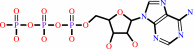 ATP
ATP
|
=
|
O-phospho-L-tyrosyl-[protein]
|
+
|
 ADP
ADP
|
+
|
H(+)
|
|
|
|
|
|
|
|
|
|
|
|
|
Molecule diagrams generated from .mol files obtained from the
KEGG ftp site
|
|
|
|
|
|
|
|
|
|
|
|
|
|
 |
|
|
|
|
|
|
| |
|
|
| |
|
DOI no:
|
Protein Eng Des Sel
26:695-704
(2013)
|
|
PubMed id:
|
|
|
|
|
|
| |
|
Stability and solubility engineering of the EphB4 tyrosine kinase catalytic domain using a rationally designed synthetic library.
|
|
R.C.Overman,
I.Green,
C.M.Truman,
J.A.Read,
K.J.Embrey,
M.S.McAlister,
T.K.Attwood.
|
|
|
|
|
| |
ABSTRACT
|
|
|
|
| |
|
|
The inability to generate soluble, correctly folded recombinant protein is often
a barrier to successful structural and functional studies. Access to affordable
synthetic genes has, however, made it possible to design, make and test many
more variants of a target protein to identify suitable constructs. We have used
rational design and gene synthesis to create a controlled randomised library of
the EphB4 receptor tyrosine kinase, with the aim of obtaining soluble,
purifiable and active catalytic domain material at multi-milligram levels in
Escherichia coli. Three main parameters were tested in designing the
library-construct length, functional mutations and stability grafting. These
variables were combined to generate a total of 9720 possible variants. The
screening of 480 clones generated a 3% hit rate, with a purifiable solubility of
up to 15 mg/L for some EphB4 constructs that was largely independent of
construct length. Sequencing of the positive clones revealed a pair of
hydrophobic core mutations that were key to obtaining soluble material. A
minimal kinase domain construct containing these two mutations exhibited a
+4.5°C increase in thermal stability over the wild-type protein. These
approaches will be broadly applicable for solubility engineering of many
different protein target classes. Atomic coordinates and structural factors have
been deposited in PDB under the accession 2yn8 (EphB4 HP + staurosporine).
|
|
|
|
|
|
|
|
|
|
|
|
|
|
|
|
|
|
 |
 |
 |
|


 Links
Links


