 |
PDBsum entry 2v0u

|
|
|
|
|
 |
Contents |
 |
|
|
|
|
|
|
|
|
|
|
|
|
* Residue conservation analysis
|
|
|
|
|
|
|
|
|
|
|
Enzyme class:
|
|
E.C.2.7.11.1
- non-specific serine/threonine protein kinase.
|
|
|
|
|
|
|
Reaction:
|
|
|
1.
|
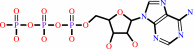
L-seryl-[protein] + ATP = O-phospho-L-seryl-[protein] + ADP + H+
|
|
2.
|
L-threonyl-[protein] + ATP = O-phospho-L-threonyl-[protein] + ADP + H+
|
|
|
|
|
|
|
L-seryl-[protein]
|
+
|
 ATP
ATP
|
=
|
O-phospho-L-seryl-[protein]
|
+
|
 ADP
ADP
|
+
|
H(+)
|
|
|
|
|
|
|
L-threonyl-[protein]
|
+
|
ATP
|
=
|
O-phospho-L-threonyl-[protein]
|
+
|
ADP
|
+
|
H(+)
|
|
|
|
|
|
|
|
|
|
|
|
|
Molecule diagrams generated from .mol files obtained from the
KEGG ftp site
|
|
|
|
|
|
|
|
|
|
|
|
|
|
 |
|
|
|
|
|
|
| |
|
|
| |
|
|
Biochemistry
46:14001-14009
(2007)
|
|
PubMed id:
|
|
|
|
|
|
| |
|
N- and C-terminal flanking regions modulate light-induced signal transduction in the LOV2 domain of the blue light sensor phototropin 1 from Avena sativa.
|
|
A.S.Halavaty,
K.Moffat.
|
|
|
|
|
| |
ABSTRACT
|
|
|
|
| |
|
|
Light sensing by photoreceptors controls phototropism, chloroplast movement,
stomatal opening, and leaf expansion in plants. Understanding the molecular
mechanism by which these processes are regulated requires a quantitative
description of photoreceptor dynamics. We focus on a light-driven signal
transduction mechanism in the LOV2 domain (LOV, light, oxygen, voltage) of the
blue light photoreceptor phototropin 1 from Avena sativa (oat). High-resolution
crystal structures of the dark and light states of an oat LOV2 construct
including residues Leu404 through Leu546 (LOV2 (404-546)) have been determined
at 105 and 293 K. In all four structures, LOV2 (404-546) exhibits the typical
Per-ARNT-Sim (PAS) fold, flanked by an additional conserved N-terminal
turn-helix-turn motif and a C-terminal flanking region containing an amphipathic
Jalpha helix. These regions dock on the LOV2 core domain and bury several
hydrophobic residues of the central beta-sheet of the core domain that would
otherwise be exposed to solvent. Light structures of LOV2 (404-546) reveal that
formation of the covalent bond between Cys450 and the C4a atom of the flavin
mononucleotide (FMN) results in local rearrangement of the hydrogen-bonding
network in the FMN binding pocket. These rearrangements are associated with
disruption of the Asn414-Asp515 hydrogen bond on the surface of the protein and
displacement of the N- and C-terminal flanking regions of LOV2 (404-546), both
of which constitute a structural signal.
|
|
|
|
|
|
|
|
|
|
|
|
|
|
|
|
|
|
 |
 |
 |
|
Literature references that cite this PDB file's key reference
|
|
|
| |
PubMed id
|
|
Reference
|
|
|
|
|
|
A.Losi,
and
W.Gärtner
(2011).
Old chromophores, new photoactivation paradigms, trendy applications: flavins in blue light-sensing photoreceptors.
|
| |
Photochem Photobiol,
87,
491-510.
|
|
|
|
|
|
|
I.H.van Stokkum,
M.Gauden,
S.Crosson,
R.van Grondelle,
K.Moffat,
and
J.T.Kennis
(2011).
The primary photophysics of the Avena sativa phototropin 1 LOV2 domain observed with time-resolved emission spectroscopy.
|
| |
Photochem Photobiol,
87,
534-541.
|
|
|
|
|
|
|
J.Herrou,
and
S.Crosson
(2011).
Function, structure and mechanism of bacterial photosensory LOV proteins.
|
| |
Nat Rev Microbiol,
9,
713-723.
|
|
|
|
|
|
|
K.Park,
and
D.Kim
(2011).
Modeling allosteric signal propagation using protein structure networks.
|
| |
BMC Bioinformatics,
12,
S23.
|
|
|
|
|
|
|
U.Krauss,
T.Drepper,
and
K.E.Jaeger
(2011).
Enlightened enzymes: strategies to create novel photoresponsive proteins.
|
| |
Chemistry,
17,
2552-2560.
|
|
|
|
|
|
|
A.Möglich,
and
K.Moffat
(2010).
Engineered photoreceptors as novel optogenetic tools.
|
| |
Photochem Photobiol Sci,
9,
1286-1300.
|
|
|
|
|
|
|
A.Möglich,
X.Yang,
R.A.Ayers,
and
K.Moffat
(2010).
Structure and function of plant photoreceptors.
|
| |
Annu Rev Plant Biol,
61,
21-47.
|
|
|
|
|
|
|
A.Rana,
and
R.E.Dolmetsch
(2010).
Using light to control signaling cascades in live neurons.
|
| |
Curr Opin Neurobiol,
20,
617-622.
|
|
|
|
|
|
|
D.Strickland,
X.Yao,
G.Gawlak,
M.K.Rosen,
K.H.Gardner,
and
T.R.Sosnick
(2010).
Rationally improving LOV domain-based photoswitches.
|
| |
Nat Methods,
7,
623-626.
|
|
|
|
|
|
|
E.Peter,
B.Dick,
and
S.A.Baeurle
(2010).
Mechanism of signal transduction of the LOV2-Jα photosensor from Avena sativa.
|
| |
Nat Commun,
1,
122.
|
|
|
|
|
|
|
Y.Tang,
Z.Cao,
E.Livoti,
U.Krauss,
K.E.Jaeger,
W.Gärtner,
and
A.Losi
(2010).
Interdomain signalling in the blue-light sensing and GTP-binding protein YtvA: a mutagenesis study uncovering the importance of specific protein sites.
|
| |
Photochem Photobiol Sci,
9,
47-56.
|
|
|
|
|
|
|
A.K.Hendrischk,
J.Moldt,
S.W.Frühwirth,
and
G.Klug
(2009).
Characterization of an unusual LOV domain protein in the alpha-proteobacterium Rhodobacter sphaeroides.
|
| |
Photochem Photobiol,
85,
1254-1259.
|
|
|
|
|
|
|
A.Möglich,
R.A.Ayers,
and
K.Moffat
(2009).
Structure and signaling mechanism of Per-ARNT-Sim domains.
|
| |
Structure,
17,
1282-1294.
|
|
|
|
|
|
|
A.Yamamoto,
T.Iwata,
Y.Sato,
D.Matsuoka,
S.Tokutomi,
and
H.Kandori
(2009).
Light signal transduction pathway from flavin chromophore to the J alpha helix of Arabidopsis phototropin1.
|
| |
Biophys J,
96,
2771-2778.
|
|
|
|
|
|
|
E.Demarsy,
and
C.Fankhauser
(2009).
Higher plants use LOV to perceive blue light.
|
| |
Curr Opin Plant Biol,
12,
69-74.
|
|
|
|
|
|
|
M.T.Alexandre,
R.van Grondelle,
K.J.Hellingwerf,
and
J.T.Kennis
(2009).
Conformational heterogeneity and propagation of structural changes in the LOV2/Jalpha domain from Avena sativa phototropin 1 as recorded by temperature-dependent FTIR spectroscopy.
|
| |
Biophys J,
97,
238-247.
|
|
|
|
|
|
|
M.T.Alexandre,
T.Domratcheva,
C.Bonetti,
L.J.van Wilderen,
R.van Grondelle,
M.L.Groot,
K.J.Hellingwerf,
and
J.T.Kennis
(2009).
Primary reactions of the LOV2 domain of phototropin studied with ultrafast mid-infrared spectroscopy and quantum chemistry.
|
| |
Biophys J,
97,
227-237.
|
|
|
|
|
|
|
N.Halabi,
O.Rivoire,
S.Leibler,
and
R.Ranganathan
(2009).
Protein sectors: evolutionary units of three-dimensional structure.
|
| |
Cell,
138,
774-786.
|
|
|
|
|
|
|
Y.I.Wu,
D.Frey,
O.I.Lungu,
A.Jaehrig,
I.Schlichting,
B.Kuhlman,
and
K.M.Hahn
(2009).
A genetically encoded photoactivatable Rac controls the motility of living cells.
|
| |
Nature,
461,
104-108.
|
|
|
PDB codes:
|
|
|
|
|
|
|
|
A.I.Nash,
W.H.Ko,
S.M.Harper,
and
K.H.Gardner
(2008).
A conserved glutamine plays a central role in LOV domain signal transmission and its duration.
|
| |
Biochemistry,
47,
13842-13849.
|
|
|
|
|
|
|
D.Strickland,
K.Moffat,
and
T.R.Sosnick
(2008).
Light-activated DNA binding in a designed allosteric protein.
|
| |
Proc Natl Acad Sci U S A,
105,
10709-10714.
|
|
|
|
|
|
|
J.Lee,
M.Natarajan,
V.C.Nashine,
M.Socolich,
T.Vo,
W.P.Russ,
S.J.Benkovic,
and
R.Ranganathan
(2008).
Surface sites for engineering allosteric control in proteins.
|
| |
Science,
322,
438-442.
|
|
|
|
|
|
|
M.Nakasako,
M.Hirata,
N.Shimizu,
S.Hosokawa,
D.Matsuoka,
T.Oka,
M.Yamamoto,
and
S.Tokutomi
(2008).
Crystallization and preliminary X-ray diffraction analysis [correction of anaylsis] of the LOV1 domains of phototropin 1 and 2 from Arabidopsis thaliana.
|
| |
Acta Crystallogr Sect F Struct Biol Cryst Commun,
64,
617-621.
|
|
|
|
|
|
|
M.T.Alexandre,
R.van Grondelle,
K.J.Hellingwerf,
B.Robert,
and
J.T.Kennis
(2008).
Perturbation of the ground-state electronic structure of FMN by the conserved cysteine in phototropin LOV2 domains.
|
| |
Phys Chem Chem Phys,
10,
6693-6702.
|
|
|
|
|
|
|
X.Yao,
M.K.Rosen,
and
K.H.Gardner
(2008).
Estimation of the available free energy in a LOV2-J alpha photoswitch.
|
| |
Nat Chem Biol,
4,
491-497.
|
|
|
|
|
|
The most recent references are shown first.
Citation data come partly from CiteXplore and partly
from an automated harvesting procedure. Note that this is likely to be
only a partial list as not all journals are covered by
either method. However, we are continually building up the citation data
so more and more references will be included with time.
Where a reference describes a PDB structure, the PDB
codes are
shown on the right.
|
|


 Links
Links


