
|
|
|
|
|
 |
Contents |
 |
|
|
|
|
|
|
|
|
|
|
|
 273 a.a.
|
|
|
|
|
|
|
|
|
|
|
 255 a.a.
|
|
|
|
|
|
|
|
|
|
|
 236 a.a.
|
|
|
|
|
|
|
|
|
|
|
 40 a.a.
|
|
|
|
|
|
|
|
|
|
|
* Residue conservation analysis
|
|
|
|
|
|
PDB id:
|
|
|
|
| Name: |
|
Virus
|
|
|
Title:
|
|
Structural analysis of antiviral agents that interact with the capsid of human rhinoviruses
|
|
Structure:
|
|
Human rhinovirus 14 coat protein (subunit vp1). Chain: 1. Engineered: yes. Human rhinovirus 14 coat protein (subunit vp2). Chain: 2. Engineered: yes. Human rhinovirus 14 coat protein (subunit vp3). Chain: 3. Engineered: yes.
|
|
Source:
|
|
Human rhinovirus 14. Organism_taxid: 12131. Expressed in: homo sapiens. Expression_system_taxid: 9606. Expression_system_cell_line: hela cells. Expression_system_cell_line: hela cells
|
|
Resolution:
|
|
|
3.00Å
|
R-factor:
|
not given
|
|
|
Authors:
|
|
J.Badger,T.J.Smith,M.G.Rossmann
|
|
Key ref:
|
|
J.Badger
et al.
(1989).
Structural analysis of antiviral agents that interact with the capsid of human rhinoviruses.
Proteins,
6,
1.
PubMed id:
|
|
|
Date:
|
|
|
03-Oct-88
|
Release date:
|
15-Jan-90
|
|
|
Supersedes:
|
|
|
|
|
|
|
|
PROCHECK
|

|
|
|
|
|
Headers
|
|
|
|
References
|
|
|
|
|
|

|
|
P03303
(POLG_HRV14) -
Genome polyprotein from Human rhinovirus 14
|
|
|
|
Seq:
Struc:
|
|
|
|
2179 a.a.
273 a.a.
|
|

|

|
|
|
|
|
|
|
|
|
|
|
|
|

|
|
P03303
(POLG_HRV14) -
Genome polyprotein from Human rhinovirus 14
|
|
|
|
Seq:
Struc:
|
|
|
|
2179 a.a.
255 a.a.*
|
|
|

|
|
|
|
|
|
|
|
|
|
|
|
|
|
|
|
|
|
Enzyme class 2:
|
|
Chains 1, 2, 3, 4:
E.C.2.7.7.48
- RNA-directed Rna polymerase.
|
|
|
|
|
|
|
Reaction:
|
|
RNA(n) + a ribonucleoside 5'-triphosphate = RNA(n+1) + diphosphate
|
|
|
|
|
|
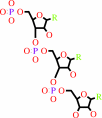 RNA(n)
|
+
|
ribonucleoside 5'-triphosphate
|
=
|
RNA(n+1)
|
+
|
 diphosphate
|
|
|
|
|
|
|
|
|
|
Enzyme class 3:
|
|
Chains 1, 2, 3, 4:
E.C.3.4.22.28
- picornain 3C.
|
|
|
|
|
|
|
Reaction:
|
|
Selective cleavage of Gln-|-Gly bond in the poliovirus polyprotein. In other picornavirus reactions Glu may be substituted for Gln, and Ser or Thr for Gly.
|
|
|
|
|
|
Enzyme class 4:
|
|
Chains 1, 2, 3, 4:
E.C.3.4.22.29
- picornain 2A.
|
|
|
|
|
|
|
Reaction:
|
|
Selective cleavage of Tyr-|-Gly bond in the picornavirus polyprotein. In other picornavirus reactions Glu may be substituted for Gln, and Ser or Thr for Gly.
|
|
|
|
|
|
Enzyme class 5:
|
|
Chains 1, 2, 3, 4:
E.C.3.6.1.15
- nucleoside-triphosphate phosphatase.
|
|
|
|
|
|
|
Reaction:
|
|
a ribonucleoside 5'-triphosphate + H2O = a ribonucleoside 5'-diphosphate + phosphate + H+
|
|
|
|
|
|
ribonucleoside 5'-triphosphate
|
+
|
H2O
|
=
|
ribonucleoside 5'-diphosphate
|
+
|
 phosphate
|
+
|
H(+)
|
|
|
|
|
|
|
|
|
|
|
|
|
Note, where more than one E.C. class is given (as above), each may
correspond to a different protein domain or, in the case of polyprotein
precursors, to a different mature protein.
|
|
|
|
Molecule diagrams generated from .mol files obtained from the
KEGG ftp site
|
|
|
|
|
|
|
|
|
|
|
|
|
|
 |
|
|
|
|
|
|
| |
|
|
| |
|
|
Proteins
6:1
(1989)
|
|
PubMed id:
|
|
|
|
|
|
| |
|
Structural analysis of antiviral agents that interact with the capsid of human rhinoviruses.
|
|
J.Badger,
I.Minor,
M.A.Oliveira,
T.J.Smith,
M.G.Rossmann.
|
|
|
|
|
| |
ABSTRACT
|
|
|
|
| |
|
|
X-Ray diffraction data have been obtained for nine related antiviral agents
("WIN compounds") while bound to human rhinovirus 14 (HRV14). These compounds
can inhibit both viral attachment to host cells and uncoating. To calculate
interpretable electron density maps it was necessary to account for (1) the low
(approximately 60%) occupancies of these compounds in the crystal, (2) the large
(up to 7.9 A) conformational changes induced at the attachment site, and (3) the
incomplete diffraction data. Application of a density difference map technique,
which exploits the 20-fold noncrystallographic redundancy in HRV14, resulted in
clear images of the HRV14:WIN complexes. A real-space refinement procedure was
used to fit atomic models to these maps. The binding site of WIN compounds in
HRV14 is a hydrophobic pocket composed mainly from residues that form the
beta-barrel of VP1. Among rhinoviruses, the residues associated with the binding
pocket are far more conserved than external residues and are mostly contained
within regular secondary structural elements. Molecular dynamics simulations of
three HRV14:WIN complexes suggest that portions of the WIN compounds and viral
protein near the entrance of the binding pocket are more flexible than portions
deeper within the beta-barrel.
|
|
|
|
|
|
|
|
|
|
|
|
|
|
|
|
|
|
 |
 |
 |
|
Literature references that cite this PDB file's key reference
|
|
|
| |
PubMed id
|
|
Reference
|
|
|
|
|
|
J.M.Rollinger,
and
M.Schmidtke
(2011).
The human rhinovirus: human-pathological impact, mechanisms of antirhinoviral agents, and strategies for their discovery.
|
| |
Med Res Rev,
31,
42-92.
|
|
|
|
|
|
|
S.L.Chan,
and
P.Labute
(2010).
Training a scoring function for the alignment of small molecules.
|
| |
J Chem Inf Model,
50,
1724-1735.
|
|
|
|
|
|
|
K.H.Kim
(2007).
Outliers in SAR and QSAR: is unusual binding mode a possible source of outliers?
|
| |
J Comput Aided Mol Des,
21,
63-86.
|
|
|
|
|
|
|
L.Wang,
and
D.L.Smith
(2005).
Capsid structure and dynamics of a human rhinovirus probed by hydrogen exchange mass spectrometry.
|
| |
Protein Sci,
14,
1661-1672.
|
|
|
|
|
|
|
B.B.Goldman,
and
W.T.Wipke
(2000).
QSD quadratic shape descriptors. 2. Molecular docking using quadratic shape descriptors (QSDock).
|
| |
Proteins,
38,
79-94.
|
|
|
|
|
|
|
A.T.Hadfield,
G.D.Diana,
and
M.G.Rossmann
(1999).
Analysis of three structurally related antiviral compounds in complex with human rhinovirus 16.
|
| |
Proc Natl Acad Sci U S A,
96,
14730-14735.
|
|
|
PDB codes:
|
|
|
|
|
|
|
|
P.R.Kolatkar,
J.Bella,
N.H.Olson,
C.M.Bator,
T.S.Baker,
and
M.G.Rossmann
(1999).
Structural studies of two rhinovirus serotypes complexed with fragments of their cellular receptor.
|
| |
EMBO J,
18,
6249-6259.
|
|
|
PDB codes:
|
|
|
|
|
|
|
|
D.Joseph-McCarthy,
J.M.Hogle,
and
M.Karplus
(1997).
Use of the multiple copy simultaneous search (MCSS) method to design a new class of picornavirus capsid binding drugs.
|
| |
Proteins,
29,
32-58.
|
|
|
|
|
|
|
M.W.Wien,
S.Curry,
D.J.Filman,
and
J.M.Hogle
(1997).
Structural studies of poliovirus mutants that overcome receptor defects.
|
| |
Nat Struct Biol,
4,
666-674.
|
|
|
PDB codes:
|
|
|
|
|
|
|
|
J.K.Muckelbauer,
M.Kremer,
I.Minor,
G.Diana,
F.J.Dutko,
J.Groarke,
D.C.Pevear,
and
M.G.Rossmann
(1995).
The structure of coxsackievirus B3 at 3.5 A resolution.
|
| |
Structure,
3,
653-667.
|
|
|
|
|
|
|
R.A.Grant,
C.N.Hiremath,
D.J.Filman,
R.Syed,
K.Andries,
and
J.M.Hogle
(1994).
Structures of poliovirus complexes with anti-viral drugs: implications for viral stability and drug design.
|
| |
Curr Biol,
4,
784-797.
|
|
|
PDB codes:
|
|
|
|
|
|
|
|
M.A.Oliveira,
R.Zhao,
W.M.Lee,
M.J.Kremer,
I.Minor,
R.R.Rueckert,
G.D.Diana,
D.C.Pevear,
F.J.Dutko,
and
M.A.McKinlay
(1993).
The structure of human rhinovirus 16.
|
| |
Structure,
1,
51-68.
|
|
|
PDB codes:
|
|
|
|
|
|
|
|
M.D.Walkinshaw
(1992).
Protein targets for structure-based drug design.
|
| |
Med Res Rev,
12,
317-372.
|
|
|
|
|
|
The most recent references are shown first.
Citation data come partly from CiteXplore and partly
from an automated harvesting procedure. Note that this is likely to be
only a partial list as not all journals are covered by
either method. However, we are continually building up the citation data
so more and more references will be included with time.
Where a reference describes a PDB structure, the PDB
codes are
shown on the right.
|

| |


 Links
Links


