 |
PDBsum entry 2ppf

|
|
|
|
|
|

|

|

|

|
|

|
|

|
|

|
|

|
|

|
|

|
|
|
 |

|

|
|
|
|
|
|
|
|
|
|
|
|
|
|
|
|
|
|
|
|
|
|
|
|
|
|
|
|
|
|
|
|
|
|
|
Oxidoreductase
|
PDB id
|
|
|
|
2ppf
|
|
|
|
|
|
|
|
|
|
|
|
|
|
|

|

|

|
|
|
|
|
|
|
|
 |
Contents |
 |
|
|
|
|
|
|
|
|
|
|
|
|
|
|
* Residue conservation analysis
|
|
|
|
|
|
|
|
|
|
|
Enzyme class:
|
|
E.C.1.7.2.1
- nitrite reductase (NO-forming).
|
|
|
|
|
|
|
Reaction:
|
|
nitric oxide + Fe(III)-[cytochrome c] + H2O = Fe(II)-[cytochrome c] + nitrite + 2 H+
|
|
|
|
|
|
 nitric oxide
|
+
|
Fe(III)-[cytochrome c]
|
+
|
H2O
Bound ligand (Het Group name = )
corresponds exactly
|
=
|
Fe(II)-[cytochrome c]
|
+
|
 nitrite
|
+
|
2
×
H(+)
|
|
|
|
|
|
|
|
|
|
Cofactor:
|
|
Cu cation or Fe cation; FAD
|
|
|
|
|
|
Cu cation
|
or
|
Fe cation
|
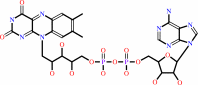 FAD
FAD
|
|
|
|
|
|
|
Molecule diagrams generated from .mol files obtained from the
KEGG ftp site
|
|
|
|
|
|
|
|
|
|
|
|
|
|
 |
|
|
|
|
|
|
| |
|
|
| |
|
|
Biochemistry
46:12366-12374
(2007)
|
|
PubMed id:
|
|
|
|
|
|
| |
|
Stable copper-nitrosyl formation by nitrite reductase in either oxidation state.
|
|
E.I.Tocheva,
F.I.Rosell,
A.G.Mauk,
M.E.Murphy.
|
|
|
|
|
| |
ABSTRACT
|
|
|
|
| |
|
|
Nitrite reductase (NiR) is an enzyme that uses type 1 and type 2 copper sites to
reduce nitrite to nitric oxide during bacterial denitrification. A
copper-nitrosyl intermediate is a proposed, yet poorly characterized feature of
the NiR catalytic cycle. This intermediate is formally described as Cu(I)-NO+
and is proposed to be formed at the type 2 copper site after nitrite binding and
electron transfer from the type 1 copper site. In this study, copper-nitrosyl
complexes were formed by prolonged exposure of exogenous NO to crystals of
wild-type and two variant forms of NiR from Alcaligenes faecalis (AfNiR), and
the structures were determined to 1.8 A or better resolution. Exposing oxidized
wild-type crystals to NO results in the reverse reaction and formation of
nitrite that remains bound at the active site. In a type 1 copper site mutant
(H145A) that is incapable of electron transfer to the type 2 site, the reverse
reaction is not observed. Instead, in both oxidized and reduced H145A crystals,
NO is observed bound in a side-on manner to the type 2 copper. In AfNiR, Asp98
forms hydrogen bonds to both substrate and product bound to the type 2 Cu. In
the D98N variant, NO is bound side-on but is more disordered when observed for
the wild-type enzyme. The solution EPR spectra of the crystallographically
characterized NiR-NO complexes indicate the presence of an oxidized type 2
copper site and thus are interpreted as resulting from stable copper-nitrosyls
and formally assigned as Cu(II)-NO-. A reaction scheme in which a second NO
molecule is oxidized to nitrite can account for the formation of a Cu(II)-NO-
species after exposure of the oxidized H145A variant to NO gas.
|
|
|
|
|
|
|
|
|
|
|
|
|
|
|
|
|
|
 |
 |
 |
|


 Links
Links


