|
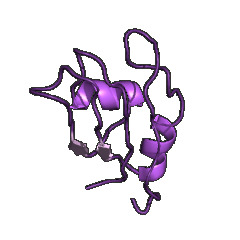
PDBsum entry 2hgn

|
|
|
|
|
|

|

|

|

|
|

|
|

|
|
|
 |

|

|
|
|
|
|
|
|
|
|
|
|
|
|
|
|
|
|
|
|
|
|
|
|
|
|
|
|
|
|
|
|
RNA binding protein
|
PDB id
|
|
|
|
2hgn
|
|
|
|
|
|
|
|
|
|
|
|
|
|
|

|

|

|
|
|
|
|
|
|
|
 |
Contents |
 |
|
|
|
|
|
|
|
|
* Residue conservation analysis
|
|
|
|
|
|
|
|
|
|
|
|
|
|
|
 |
|
|
|
|
|
|
| |
|
|
Nucleic Acids Res
34:3634-3645
(2006)
|
|
PubMed id:
|
|
|
|
|
|
| |
|
NMR structure of the three quasi RNA recognition motifs (qRRMs) of human hnRNP F and interaction studies with Bcl-x G-tract RNA: a novel mode of RNA recognition.
|
|
C.Dominguez,
F.H.Allain.
|
|
|
|
|
| |
ABSTRACT
|
|
|
|
| |
|
|
The heterogeneous nuclear ribonucleoprotein (hnRNP) F belongs to the hnRNP H
family involved in the regulation of alternative splicing and polyadenylation
and specifically recognizes poly(G) sequences (G-tracts). In particular, hnRNP F
binds a G-tract of the Bcl-x RNA and regulates its alternative splicing, leading
to two isoforms, Bcl-x(S) and Bcl-x(L), with antagonist functions. In order to
gain insight into G-tract recognition by hnRNP H members, we initiated an NMR
study of human hnRNP F. We present the solution structure of the three quasi RNA
recognition motifs (qRRMs) of hnRNP F and identify the residues that are
important for the interaction with the Bcl-x RNA by NMR chemical shift
perturbation and mutagenesis experiments. The three qRRMs exhibit the canonical
betaalphabetabetaalphabeta RRM fold but additional secondary structure elements
are present in the two N-terminal qRRMs of hnRNP F. We show that qRRM1 and qRRM2
but not qRRM3 are responsible for G-tract recognition and that the residues of
qRRM1 and qRRM2 involved in G-tract interaction are not on the beta-sheet
surface as observed for the classical RRM but are part of a short beta-hairpin
and two adjacent loops. These regions define a novel interaction surface for RNA
recognition by RRMs.
|
|
|
|
|
|
|
|
|
|
|
|
|
|
|
|
|
|
 |
 |
 |
|
Literature references that cite this PDB file's key reference
|
|
|
| |
PubMed id
|
|
Reference
|
|
|
|
|
|
C.Dominguez,
M.Schubert,
O.Duss,
S.Ravindranathan,
and
F.H.Allain
(2011).
Structure determination and dynamics of protein-RNA complexes by NMR spectroscopy.
|
| |
Prog Nucl Magn Reson Spectrosc,
58,
1.
|
|
|
|
|
|
|
C.Dominguez,
J.F.Fisette,
B.Chabot,
and
F.H.Allain
(2010).
Structural basis of G-tract recognition and encaging by hnRNP F quasi-RRMs.
|
| |
Nat Struct Mol Biol,
17,
853-861.
|
|
|
PDB codes:
|
|
|
|
|
|
|
|
C.M.Van Dusen,
L.Yee,
L.M.McNally,
and
M.T.McNally
(2010).
A glycine-rich domain of hnRNP H/F promotes nucleocytoplasmic shuttling and nuclear import through an interaction with transportin 1.
|
| |
Mol Cell Biol,
30,
2552-2562.
|
|
|
|
|
|
|
J.Rauch,
E.O'Neill,
B.Mack,
C.Matthias,
M.Munz,
W.Kolch,
and
O.Gires
(2010).
Heterogeneous nuclear ribonucleoprotein H blocks MST2-mediated apoptosis in cancer cells by regulating A-Raf transcription.
|
| |
Cancer Res,
70,
1679-1688.
|
|
|
|
|
|
|
M.A.Bayfield,
R.Yang,
and
R.J.Maraia
(2010).
Conserved and divergent features of the structure and function of La and La-related proteins (LARPs).
|
| |
Biochim Biophys Acta,
1799,
365-378.
|
|
|
|
|
|
|
N.Dreumont,
S.Hardy,
I.Behm-Ansmant,
L.Kister,
C.Branlant,
J.Stévenin,
and
C.F.Bourgeois
(2010).
Antagonistic factors control the unproductive splicing of SC35 terminal intron.
|
| |
Nucleic Acids Res,
38,
1353-1366.
|
|
|
|
|
|
|
S.P.Han,
Y.H.Tang,
and
R.Smith
(2010).
Functional diversity of the hnRNPs: past, present and perspectives.
|
| |
Biochem J,
430,
379-392.
|
|
|
|
|
|
|
A.Eulalio,
F.Tritschler,
R.Büttner,
O.Weichenrieder,
E.Izaurralde,
and
V.Truffault
(2009).
The RRM domain in GW182 proteins contributes to miRNA-mediated gene silencing.
|
| |
Nucleic Acids Res,
37,
2974-2983.
|
|
|
PDB code:
|
|
|
|
|
|
|
|
C.Bousquet-Antonelli,
and
J.M.Deragon
(2009).
A comprehensive analysis of the La-motif protein superfamily.
|
| |
RNA,
15,
750-764.
|
|
|
|
|
|
|
C.Netter,
G.Weber,
H.Benecke,
and
M.C.Wahl
(2009).
Functional stabilization of an RNA recognition motif by a noncanonical N-terminal expansion.
|
| |
RNA,
15,
1305-1313.
|
|
|
PDB code:
|
|
|
|
|
|
|
|
J.L.Kabat,
S.Barberan-Soler,
and
A.M.Zahler
(2009).
HRP-2, the Caenorhabditis elegans homolog of mammalian heterogeneous nuclear ribonucleoproteins Q and R, is an alternative splicing factor that binds to UCUAUC splicing regulatory elements.
|
| |
J Biol Chem,
284,
28490-28497.
|
|
|
|
|
|
|
M.A.Panaro,
A.Cianciulli,
R.Calvello,
M.Saccia,
M.Sisto,
A.Acquafredda,
and
V.Mitolo
(2009).
An analysis of the human chemokine CXC receptor 4 gene.
|
| |
Immunopharmacol Immunotoxicol,
31,
88-93.
|
|
|
|
|
|
|
M.G.Rudolph,
and
D.Klostermeier
(2009).
The Thermus thermophilus DEAD box helicase Hera contains a modified RNA recognition motif domain loosely connected to the helicase core.
|
| |
RNA,
15,
1993-2001.
|
|
|
PDB codes:
|
|
|
|
|
|
|
|
M.Huranová,
J.A.Jablonski,
A.Benda,
M.Hof,
D.Stanek,
and
M.Caputi
(2009).
In vivo detection of RNA-binding protein interactions with cognate RNA sequences by fluorescence resonance energy transfer.
|
| |
RNA,
15,
2063-2071.
|
|
|
|
|
|
|
X.Xiao,
Z.Wang,
M.Jang,
R.Nutiu,
E.T.Wang,
and
C.B.Burge
(2009).
Splice site strength-dependent activity and genetic buffering by poly-G runs.
|
| |
Nat Struct Mol Biol,
16,
1094-1100.
|
|
|
|
|
|
|
A.Cléry,
M.Blatter,
and
F.H.Allain
(2008).
RNA recognition motifs: boring? Not quite.
|
| |
Curr Opin Struct Biol,
18,
290-298.
|
|
|
|
|
|
|
C.Ghigna,
C.Valacca,
and
G.Biamonti
(2008).
Alternative splicing and tumor progression.
|
| |
Curr Genomics,
9,
556-570.
|
|
|
|
|
|
|
D.M.Mauger,
C.Lin,
and
M.A.Garcia-Blanco
(2008).
hnRNP H and hnRNP F complex with Fox2 to silence fibroblast growth factor receptor 2 exon IIIc.
|
| |
Mol Cell Biol,
28,
5403-5419.
|
|
|
|
|
|
|
K.Kuwasako,
N.Dohmae,
M.Inoue,
M.Shirouzu,
S.Taguchi,
P.Güntert,
B.Séraphin,
Y.Muto,
and
S.Yokoyama
(2008).
Complex assembly mechanism and an RNA-binding mode of the human p14-SF3b155 spliceosomal protein complex identified by NMR solution structure and functional analyses.
|
| |
Proteins,
71,
1617-1636.
|
|
|
|
|
|
|
S.Barberan-Soler,
and
A.M.Zahler
(2008).
Alternative splicing regulation during C. elegans development: splicing factors as regulated targets.
|
| |
PLoS Genet,
4,
e1000001.
|
|
|
|
|
|
|
Y.Hai,
W.Cao,
G.Liu,
S.P.Hong,
S.A.Elela,
R.Klinck,
J.Chu,
and
J.Xie
(2008).
A G-tract element in apoptotic agents-induced alternative splicing.
|
| |
Nucleic Acids Res,
36,
3320-3331.
|
|
|
|
|
|
|
Z.Wang,
and
C.B.Burge
(2008).
Splicing regulation: from a parts list of regulatory elements to an integrated splicing code.
|
| |
RNA,
14,
802-813.
|
|
|
|
|
|
|
B.M.Lunde,
C.Moore,
and
G.Varani
(2007).
RNA-binding proteins: modular design for efficient function.
|
| |
Nat Rev Mol Cell Biol,
8,
479-490.
|
|
|
|
|
|
The most recent references are shown first.
Citation data come partly from CiteXplore and partly
from an automated harvesting procedure. Note that this is likely to be
only a partial list as not all journals are covered by
either method. However, we are continually building up the citation data
so more and more references will be included with time.
Where a reference describes a PDB structure, the PDB
codes are
shown on the right.
|
|


 Links
Links