 |
PDBsum entry 2esl

|
|
|
|
|
|

|

|

|

|
|

|
|

|
|

|
|

|
|

|
|

|
|
|
 |

|

|
|
|
|
|
|
|
|
|
|
|
|
|
|
|
|
|
|
|
|
|
|
|
|
|
|
|
|
|
|
|
|
|
|
|
Isomerase/immunosuppressant
|
PDB id
|
|
|
|
2esl
|
|
|
|
|
|
|
|
|
|
|
|
|
|
|

|

|

|
|
|
|
|
|
|
|
 |
Contents |
 |
|
|
|
|
|
|
|
|
|
|
|


 (+ 0 more)
181 a.a.
(+ 0 more)
181 a.a.
|
|
|
|
|
|
|
|
|
|
|


 (+ 0 more)
11 a.a.
(+ 0 more)
11 a.a.
|
|
|
|
|
|
|
|
|
|
|
|
|
* Residue conservation analysis
|
|
|
|
|
|
PDB id:
|
|
|
|
| Name: |
|
Isomerase/immunosuppressant
|
|
|
Title:
|
|
Human cyclophilin c in complex with cyclosporin a
|
|
Structure:
|
|
Peptidyl-prolyl cis-trans isomerasE C. Chain: a, b, c, d, e, f. Fragment: residues 24-212. Synonym: ppiasE C,cyclophilin c,rotamasE C. Engineered: yes. Cyclosporin a. Chain: i, j, k, l, m, n. Engineered: yes
|
|
Source:
|
|
Homo sapiens. Human. Organism_taxid: 9606. Gene: ppic, cypc. Expressed in: escherichia coli bl21(de3). Expression_system_taxid: 469008. Synthetic: yes. Tolypocladium inflatum. Organism_taxid: 29910
|
|
Biol. unit:
|
|
Dodecamer (from
)
|
|
Resolution:
|
|
|
1.90Å
|
R-factor:
|
0.180
|
R-free:
|
0.225
|
|
|
Authors:
|
|
J.R.Walker,T.Davis,E.M.Newman,P.J.Finerty Jr.,F.Mackenzie,J.Weigelt, M.Sundstrom,C.Arrowsmith,A.Edwards,A.Bochkarev,S.Dhe-Paganon, Structural Genomics Consortium (Sgc)
|
|
Key ref:
|
|
T.L.Davis
et al.
(2010).
Structural and biochemical characterization of the human cyclophilin family of peptidyl-prolyl isomerases.
Plos Biol,
8,
e1000439.
PubMed id:
|
|
|
Date:
|
|
|
26-Oct-05
|
Release date:
|
13-Dec-05
|
|
|
|
|
|
|
PROCHECK
|

|
|
|
|
|
Headers
|
|
|
|
References
|
|
|
|
|
|
|
|
|
|
|
|
Enzyme class:
|
|
Chains A, B, C, D, E, F:
E.C.5.2.1.8
- peptidylprolyl isomerase.
|
|
|
|
|
|
|
Reaction:
|
|
[protein]-peptidylproline (omega=180) = [protein]-peptidylproline (omega=0)
|
|
|
|
|
|
 Peptidylproline (omega=180)
|
=
|
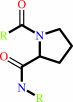 peptidylproline (omega=0)
|
|
|
|
|
|
|
|
|
|
|
|
|
Molecule diagrams generated from .mol files obtained from the
KEGG ftp site
|
|
|
|
|
|
|
|
|
|
|
|
|
|
 |
|
|
|
|
|
|
| |
|
|
| |
|
|
Plos Biol
8:e1000439
(2010)
|
|
PubMed id:
|
|
|
|
|
|
| |
|
Structural and biochemical characterization of the human cyclophilin family of peptidyl-prolyl isomerases.
|
|
T.L.Davis,
J.R.Walker,
V.Campagna-Slater,
P.J.Finerty,
R.Paramanathan,
G.Bernstein,
F.MacKenzie,
W.Tempel,
H.Ouyang,
W.H.Lee,
E.Z.Eisenmesser,
S.Dhe-Paganon.
|
|
|
|
|
| |
ABSTRACT
|
|
|
|
| |
|
|
Peptidyl-prolyl isomerases catalyze the conversion between cis and trans isomers
of proline. The cyclophilin family of peptidyl-prolyl isomerases is well known
for being the target of the immunosuppressive drug cyclosporin, used to combat
organ transplant rejection. There is great interest in both the substrate
specificity of these enzymes and the design of isoform-selective ligands for
them. However, the dearth of available data for individual family members
inhibits attempts to design drug specificity; additionally, in order to define
physiological functions for the cyclophilins, definitive isoform
characterization is required. In the current study, enzymatic activity was
assayed for 15 of the 17 human cyclophilin isomerase domains, and binding to the
cyclosporin scaffold was tested. In order to rationalize the observed isoform
diversity, the high-resolution crystallographic structures of seven cyclophilin
domains were determined. These models, combined with seven previously solved
cyclophilin isoforms, provide the basis for a family-wide structure:function
analysis. Detailed structural analysis of the human cyclophilin isomerase
explains why cyclophilin activity against short peptides is correlated with an
ability to ligate cyclosporin and why certain isoforms are not competent for
either activity. In addition, we find that regions of the isomerase domain
outside the proline-binding surface impart isoform specificity for both in vivo
substrates and drug design. We hypothesize that there is a well-defined
molecular surface corresponding to the substrate-binding S2 position that is a
site of diversity in the cyclophilin family. Computational simulations of
substrate binding in this region support our observations. Our data indicate
that unique isoform determinants exist that may be exploited for development of
selective ligands and suggest that the currently available small-molecule and
peptide-based ligands for this class of enzyme are insufficient for isoform
specificity.
|
|
|
|
|
|
|
|
|
|
|
|
|
|
|
|
|
|
 |
 |
 |
|
|


 Links
Links


