 |
PDBsum entry 2b4t

|
|
|
|
|
|

|

|

|

|
|

|
|

|
|

|
|

|
|

|
|

|
|
|
 |

|

|
|
|
|
|
|
|
|
|
|
|
|
|
|
|
|
|
|
|
|
|
|
|
|
|
|
|
|
|
|
|
|
|
|
|
Oxidoreductase
|
PDB id
|
|
|
|
2b4t
|
|
|
|
|
|
|
|
|
|
|
|
|
|
|

|

|

|
|
|
|
|
|
|
|
 |
Contents |
 |
|
|
|
|
|
|
|
|
|
|
|
|
* Residue conservation analysis
|
|
|
|
|
|
|
|
|
|
|
Enzyme class:
|
|
E.C.1.2.1.12
- glyceraldehyde-3-phosphate dehydrogenase (phosphorylating).
|
|
|
|
|
|
|
Pathway:
|
|
Glyceraldehyde-3-phosphate Dehydrogenase (phosphorylating)
|
|
|
|
|
|
Reaction:
|
|
D-glyceraldehyde 3-phosphate + phosphate + NAD+ = (2R)-3-phospho- glyceroyl phosphate + NADH + H+
|
|
|
|
|
|
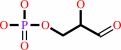 D-glyceraldehyde 3-phosphate
|
+
|
phosphate
Bound ligand (Het Group name = )
corresponds exactly
|
+
|
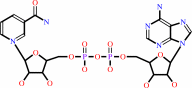 NAD(+)
|
=
|
(2R)-3-phospho- glyceroyl phosphate
|
+
|
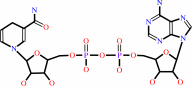 NADH
NADH
|
+
|
H(+)
|
|
|
|
|
|
|
|
|
|
|
|
|
Molecule diagrams generated from .mol files obtained from the
KEGG ftp site
|
|
|
|
|
|
|
|
|
|
|
|
|
|
 |
|
|
|
|
|
|
| |
|
|
| |
|
DOI no:
|
Proteins
62:570-577
(2006)
|
|
PubMed id:
|
|
|
|
|
|
| |
|
Crystal structure of glyceraldehyde-3-phosphate dehydrogenase from Plasmodium falciparum at 2.25 A resolution reveals intriguing extra electron density in the active site.
|
|
M.A.Robien,
J.Bosch,
F.S.Buckner,
W.C.Van Voorhis,
E.A.Worthey,
P.Myler,
C.Mehlin,
E.E.Boni,
O.Kalyuzhniy,
L.Anderson,
A.Lauricella,
S.Gulde,
J.R.Luft,
G.DeTitta,
J.M.Caruthers,
K.O.Hodgson,
M.Soltis,
F.Zucker,
C.L.Verlinde,
E.A.Merritt,
L.W.Schoenfeld,
W.G.Hol.
|
|
|
|
|
| |
ABSTRACT
|
|
|
|
| |
|
|
The crystal structure of D-glyceraldehyde-3-phosphate dehydrogenase (PfGAPDH)
from the major malaria parasite Plasmodium falciparum is solved at 2.25 A
resolution. The structure of PfGAPDH is of interest due to the dependence of the
malaria parasite in infected human erythrocytes on the glycolytic pathway for
its energy generation. Recent evidence suggests that PfGAPDH may also be
required for other critical activities such as apical complex formation. The
cofactor NAD(+) is bound to all four subunits of the tetrameric enzyme
displaying excellent electron densities. In addition, in all four subunits a
completely unexpected large island of extra electron density in the active site
is observed, approaching closely the nicotinamide ribose of the NAD(+). This
density is most likely the protease inhibitor AEBSF, found in maps from two
different crystals. This putative AEBSF molecule is positioned in a crucial
location and hence our structure, with expected and unexpected ligands bound,
can be of assistance in lead development and design of novel antimalarials.
|
|
|
|
|
|
| |
Selected figure(s)
|
|
|
|
| |
|
|

|
|

|
|
Figure 1.
Figure 1. (A) The PfGAPDH monomer. The NAD^+-binding domain is
shown in blue, the meandering S-loop in red, and the remainder
of the catalytic domain in green. NAD^+ is shown as a
ball-and-stick model, together with two strictly conserved
catalytic residues, Cys153 and His180 (where carbon is gold,
nitrogen is blue, oxygen is red, phosphate is purple, and
sulphur is green). In simple black stick model are represented:
Met38 and Lys194-Gly195, identified as potentially significant
based on a previous analysis of differences between the
experimental rabbit structure and a PfGAPDH homology model.[8]
In purple is depicted the position of AEBSF which has been
modeled into the islands of extra density (See Fig. 2). (B) The
PfGAPDH tetramer. The PfGAPDH tetramer shows the deep grooves
between the O-R and the P-Q NAD^+-binding sites. The S-loops are
colored red, showing the raised plateau these loops form between
adjacent pairs of the NAD^+-binding sites. The secondary
structure elements of the C-terminal domain are depicted with
thinner helices and strands than in the catalytic domain to help
distinguish the two domains. The O and P subunits are shown in
lighter colors for contrast with the Q and R subunits. NAD^+ is
shown in CPK representation. The additional unknown compound is
shown as a smaller ball-and-stick model in purple, labeled
ligand. (C) Electrostatic environment of the NAD^+ binding
groove. Comparison of the electrostatic surface[43-45]
representation of the NAD^+ binding groove: PfGAPDH versus
HumanGAPDH. In PfGAPDH, the walls and the roof of the
NAD^+-binding cavity are more closed and there is a small bulge
due to the - KG - insertion.
|
|
Figure 2.
Figure 2. The extra density found near active site of PfGAPDH.
The stereo view of the additional electron density shows the
excellent correspondence between the difference density (green,
contour level +3 sigma) prior to refinement with the AEBSF and
the Sigma-A weighted electron density after placement and
refinement with AEBSF (blue, contour level +1 sigma). PfGAPDH,
the associated NAD^+, and the AEBSF are shown with carbon in
gold, oxygen in red, nitrogen in blue, phosphorous in magenta,
and sulfur in green. A superimposed region of the human GAPDH
structure (PDB: 1ZNQ, shown in gray) shows the structural
similarity of the active site, with the exception of a threonine
found at the site corresponding to PfGAPDH Asn185. Hydrogen
bonds or other favorable electronstatic interactions between the
PfGAPDH and the AEBSF, or the NAD^+ and the AEBSF are shown in
dashed lines.
|
|
|
|
|
|
| |
The above figures are
reprinted
by permission from John Wiley & Sons, Inc.:
Proteins
(2006,
62,
570-577)
copyright 2006.
|
|
| |
Figures were
selected
by an automated process.
|
|
|
|
|
|
|
|
|
|
|
|
|
|
|
|
 |
 |
 |
|
Literature references that cite this PDB file's key reference
|
|
|
| |
PubMed id
|
|
Reference
|
|
|
|
|
|
I.P.Bhowmick,
N.Kumar,
S.Sharma,
I.Coppens,
and
G.K.Jarori
(2009).
Plasmodium falciparum enolase: stage-specific expression and sub-cellular localization.
|
| |
Malar J,
8,
179.
|
|
|
|
|
|
|
N.Sturm,
E.Jortzik,
B.M.Mailu,
S.Koncarevic,
M.Deponte,
K.Forchhammer,
S.Rahlfs,
and
K.Becker
(2009).
Identification of proteins targeted by the thioredoxin superfamily in Plasmodium falciparum.
|
| |
PLoS Pathog,
5,
e1000383.
|
|
|
|
|
|
|
J.Weigelt,
L.D.McBroom-Cerajewski,
M.Schapira,
Y.Zhao,
C.H.Arrowsmith,
and
C.H.Arrowmsmith
(2008).
Structural genomics and drug discovery: all in the family.
|
| |
Curr Opin Chem Biol,
12,
32-39.
|
|
|
|
|
|
|
K.Goyal,
and
S.C.Mande
(2008).
Exploiting 3D structural templates for detection of metal-binding sites in protein structures.
|
| |
Proteins,
70,
1206-1218.
|
|
|
|
|
|
|
P.Gayathri,
H.Balaram,
and
M.R.Murthy
(2007).
Structural biology of plasmodial proteins.
|
| |
Curr Opin Struct Biol,
17,
744-754.
|
|
|
|
|
|
|
F.Ferreira-da-Silva,
P.J.Pereira,
L.Gales,
M.Roessle,
D.I.Svergun,
P.Moradas-Ferreira,
and
A.M.Damas
(2006).
The crystal and solution structures of glyceraldehyde-3-phosphate dehydrogenase reveal different quaternary structures.
|
| |
J Biol Chem,
281,
33433-33440.
|
|
|
PDB code:
|
|
|
|
|
|
|
The most recent references are shown first.
Citation data come partly from CiteXplore and partly
from an automated harvesting procedure. Note that this is likely to be
only a partial list as not all journals are covered by
either method. However, we are continually building up the citation data
so more and more references will be included with time.
Where a reference describes a PDB structure, the PDB
code is
shown on the right.
|
|


 Links
Links


