 |
PDBsum entry 2f2f

|
|
|
|
|
 |
Contents |
 |
|
|
|
|
|
|
|
|
|
|
|

 153 a.a.
|
|
|
|
|
|
|
|
|
|
|

 261 a.a.
|
|
|
|
|
|
|
|
|
|
|

 154 a.a.
|
|
|
|
|
|
|
|
|
* Residue conservation analysis
|
|
|
|
|
|
PDB id:
|
|
|
|
| Name: |
|
Toxin
|
|
|
Title:
|
|
Crystal structure of cytolethal distending toxin (cdt) from actinobacillus actinomycetemcomitans
|
|
Structure:
|
|
Cytolethal distending toxin a. Chain: a, d. Synonym: cdt a. Engineered: yes. Cytolethal distending toxin b. Chain: b, e. Synonym: cdt b. Engineered: yes. Cytolethal distending toxin c.
|
|
Source:
|
|
Aggregatibacter actinomycetemcomitans. Organism_taxid: 714. Gene: cdta. Expressed in: escherichia coli. Expression_system_taxid: 562. Gene: cdtb. Gene: cdtc.
|
|
Biol. unit:
|
|
 Trimer (from
)
Trimer (from
)
|
|
Resolution:
|
|
|
2.40Å
|
R-factor:
|
0.221
|
R-free:
|
0.251
|
|
|
Authors:
|
|
T.Yamada,J.Komoto,K.Saiki,K.Konishi,F.Takusagawa
|
Key ref:

|
|
T.Yamada
et al.
(2006).
Variation of loop sequence alters stability of cytolethal distending toxin (CDT): crystal structure of CDT from Actinobacillus actinomycetemcomitans.
Protein Sci,
15,
362-372.
PubMed id:
DOI:

|
|
|
Date:
|
|
|
16-Nov-05
|
Release date:
|
28-Mar-06
|
|
|
|
|
|
|
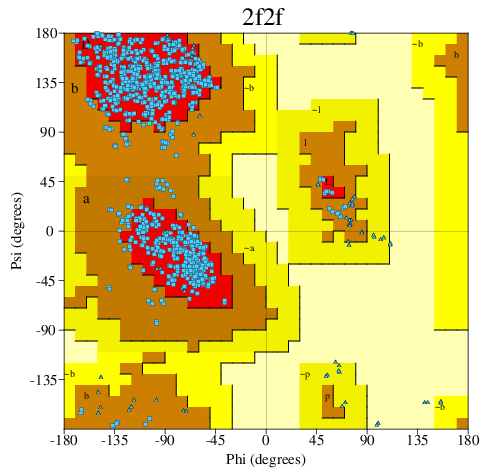
PROCHECK
|
|
|
|
|
|
Headers
|
|
|
|
References
|
|
|
|
|
|

|
|
O87120
(CDTA_AGGAC) -
Cytolethal distending toxin subunit A from Aggregatibacter actinomycetemcomitans
|
|
|
|
Seq:
Struc:
|
|
|
|
222 a.a.
153 a.a.
|
|

|

|
|
|
|
|
|
|
|
|
|
|
|
|
|
|
|
|
|
|
|
|
|
 |
|
|
|
|
|
|
| |
|
DOI no:
|
Protein Sci
15:362-372
(2006)
|
|
PubMed id:
|
|
|
|
|
|
| |
|
Variation of loop sequence alters stability of cytolethal distending toxin (CDT): crystal structure of CDT from Actinobacillus actinomycetemcomitans.
|
|
T.Yamada,
J.Komoto,
K.Saiki,
K.Konishi,
F.Takusagawa.
|
|
|
|
|
| |
ABSTRACT
|
|
|
|
| |
|
|
Cytolethal distending toxin (CDT) secreted by Actinobacillus
actinomycetemcomitans induces cell cycle arrest of cultured cells in the G2
phase. The crystal structure of the natural form of A. actinomycetemcomitans DCT
(aCDT) has been determined at 2.4 A resolution. aCDT is a heterotrimer
consisting of the three subunits, aCdtA, aCdtB, and aCdtC. Two
crystallographically independent aCDTs form a dimer through interactions of the
aCdtB subunits. The primary structure of aCDT has 94.3% identity with that of
Haemophilus ducreyi CDT (hCDT), and the structure of aCDT is quite similar to
that of hCDT reconstituted from the three subunits determined recently. However,
the molecular packings in the crystal structures of aCDT and hCDT are quite
different. A careful analysis of molecular packing suggests that variation of
the amino acid residues in a nonconserved loop (181TSSPSSPERRGY192 of aCdtB and
181NSSSSPPERRVY192 of hCdtB) is responsible for the different oligomerization of
very similar CDTs. The loop of aCdtB has a conformation to form a dimer, while
the loop conformation of hCdtB prevents hCDT from forming a dimer. Although
dimerization of aCDT does not affect toxic activity, it changes the stability of
protein. aCDT rapidly aggregates and loses toxic activity in the absence of
sucrose in a buffered solution, while hCDT is stable and retains toxic activity.
Another analysis of crystal structures of aCDT and hCDT suggests that the
receptor contact area is in the deep groove between CdtA and CdtC, and the
characteristic "aromatic patch" on CdtA.
|
|
|
|
|
|
| |
Selected figure(s)
|
|
|
|
| |
|
|

|
|

|
|
Figure 1.
(A) Heterotrimeric aCDT. The CdtA, CdtB, and CdtC subunits
are shown by aquamarine, yellow, and light pink colors,
respectively. (B) An elongated dimeric aCDT. Loop B3 and B5 of
aCdtB are shown with thicker coils in magenta. The detail
interactions between loop B3 and B5 are illustrated in Figure 5A
5A Figure 5.- . .
|
|
Figure 6.
Intermolecular contacts seen in aCDT-1 (A), aCDT-2 (B), and
hCDT (C). Amino acid residues that contact holotoxin within 7 A
are illustrated with a ball-and-stick presentation. The common
intermolecular contact areas around residues 141 and 187 are
shown by large yellow circles.
|
|
|
|
|
|
| |
The above figures are
reprinted
from an Open Access publication published by the Protein Society:
Protein Sci
(2006,
15,
362-372)
copyright 2006.
|
|
| |
Figures were
selected
by an automated process.
|
|
|
|
|
|
|
|
|
|
|
|
|
|
|
|
 |
 |
 |
|
Literature references that cite this PDB file's key reference
|
|
|
| |
PubMed id
|
|
Reference
|
|
|
|
|
|
H.Hemmi,
A.Kuno,
S.Ito,
R.Suzuki,
T.Hasegawa,
and
J.Hirabayashi
(2009).
NMR studies on the interaction of sugars with the C-terminal domain of an R-type lectin from the earthworm Lumbricus terrestris.
|
| |
FEBS J,
276,
2095-2105.
|
|
|
|
|
|
|
K.Boesze-Battaglia,
A.Brown,
L.Walker,
D.Besack,
A.Zekavat,
S.Wrenn,
C.Krummenacher,
and
B.J.Shenker
(2009).
Cytolethal Distending Toxin-induced Cell Cycle Arrest of Lymphocytes Is Dependent upon Recognition and Binding to Cholesterol.
|
| |
J Biol Chem,
284,
10650-10658.
|
|
|
|
|
|
|
L.Cao,
G.Bandelac,
A.Volgina,
J.Korostoff,
and
J.M.DiRienzo
(2008).
Role of aromatic amino acids in receptor binding activity and subunit assembly of the cytolethal distending toxin of Aggregatibacter actinomycetemcomitans.
|
| |
Infect Immun,
76,
2812-2821.
|
|
|
|
|
|
|
L.Cao,
A.Volgina,
J.Korostoff,
and
J.M.DiRienzo
(2006).
Role of intrachain disulfides in the activities of the CdtA and CdtC subunits of the cytolethal distending toxin of Actinobacillus actinomycetemcomitans.
|
| |
Infect Immun,
74,
4990-5002.
|
|
|
|
|
|
The most recent references are shown first.
Citation data come partly from CiteXplore and partly
from an automated harvesting procedure. Note that this is likely to be
only a partial list as not all journals are covered by
either method. However, we are continually building up the citation data
so more and more references will be included with time.
|
|
| |


 Links
Links





