 |
PDBsum entry 1t3d

|
|
|
|
|
 |
Contents |
 |
|
|
|
|
|
|
|
|
|
|
|
|
* Residue conservation analysis
|
|
|
|
|
|
PDB id:
|
|
|
|
| Name: |
|
Transferase
|
|
|
Title:
|
|
Crystal structure of serine acetyltransferase from e.Coli at 2.2a
|
|
Structure:
|
|
Serine acetyltransferase. Chain: a, b, c. Synonym: sat. Engineered: yes
|
|
Source:
|
|
Escherichia coli. Organism_taxid: 562. Gene: cyse, b3607, c4429, z5034, ecs4485, sf3646, s4122. Expressed in: escherichia coli. Expression_system_taxid: 562.
|
|
Biol. unit:
|
|
 Hexamer (from PDB file)
|
|
Resolution:
|
|
|
2.20Å
|
R-factor:
|
0.175
|
R-free:
|
0.177
|
|
|
Authors:
|
|
V.E.Pye,A.P.Tingey,R.L.Robson,P.C.E.Moody
|
Key ref:

|
|
V.E.Pye
et al.
(2004).
The structure and mechanism of serine acetyltransferase from Escherichia coli.
J Biol Chem,
279,
40729-40736.
PubMed id:
DOI:

|
|
|
Date:
|
|
|
26-Apr-04
|
Release date:
|
13-Jul-04
|
|
|
|
|
|
|
PROCHECK
|

|
|
|
|
|
Headers
|
|
|
|
References
|
|
|
|
|
|

|
|
P0A9D4
(CYSE_ECOLI) -
Serine acetyltransferase from Escherichia coli (strain K12)
|
|
|
|
Seq:
Struc:
|
|
|
|
273 a.a.
262 a.a.
|
|

|

|

|
|
|
|
|
|
|
|
|
|
|
Key: |
 |
PfamA domain |
|
|
 |
Secondary structure |
|
 |
CATH domain |
|
|
|
|
|
|
|
|
|
|
|
|
|
Enzyme class:
|
|
E.C.2.3.1.30
- serine O-acetyltransferase.
|
|
|
|
|
|
|
Reaction:
|
|
L-serine + acetyl-CoA = O-acetyl-L-serine + CoA
|
|
|
|
|
|
 L-serine
|
+
|
acetyl-CoA
Bound ligand (Het Group name = )
matches with 75.00% similarity
|
=
|
 O-acetyl-L-serine
|
+
|
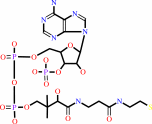 CoA
CoA
|
|
|
|
|
|
|
|
|
|
|
|
|
Molecule diagrams generated from .mol files obtained from the
KEGG ftp site
|
|
|
|
|
|
|
|
|
|
|
|
|
|
 |
|
|
|
|
|
|
| |
|
|
| |
|
DOI no:
|
J Biol Chem
279:40729-40736
(2004)
|
|
PubMed id:
|
|
|
|
|
|
| |
|
The structure and mechanism of serine acetyltransferase from Escherichia coli.
|
|
V.E.Pye,
A.P.Tingey,
R.L.Robson,
P.C.Moody.
|
|
|
|
|
| |
ABSTRACT
|
|
|
|
| |
|
|
Serine acetyltransferase (SAT) catalyzes the first step of cysteine synthesis in
microorganisms and higher plants. Here we present the 2.2 A crystal structure of
SAT from Escherichia coli, which is a dimer of trimers, in complex with
cysteine. The SAT monomer consists of an amino-terminal alpha-helical domain and
a carboxyl-terminal left-handed beta-helix. We identify His(158) and Asp(143) as
essential residues that form a catalytic triad with the substrate for acetyl
transfer. This structure shows the mechanism by which cysteine inhibits SAT
activity and thus controls its own synthesis. Cysteine is found to bind at the
serine substrate site and not the acetyl-CoA site that had been reported
previously. On the basis of the geometry around the cysteine binding site, we
are able to suggest a mechanism for the O-acetylation of serine by SAT. We also
compare the structure of SAT with other left-handed beta-helical structures.
|
|
|
|
|
|
| |
Selected figure(s)
|
|
|
|
| |
|
|

|
|

|
|
Figure 3.
FIG. 3. The cysteine binding site and proposed mechanism.
a, ball-and-stick representation of the cysteine (pink) binding
pocket and key residues (one subunit, orange; adjacent subunit,
blue). The main chain is solid-colored, and side chains are
transparent; water molecules are represented as cyan spheres,
and hydrogen bonds are represented as red dotted lines. b,
stereoview of cysteine and water omit map (red) and 2Fo-Fc map
of key residues, contoured at 1.2  . c, schematic
representation of the proposed mechanism for O-acetylation of
serine. . c, schematic
representation of the proposed mechanism for O-acetylation of
serine.
|
|
Figure 4.
FIG. 4. Comparison of left-handed  -helical structures with
SAT. a, serine acetytransferase; b, xenobiotic acetyltransferase
(39% identity over 51 aa; Protein Data Bank code 2XAT [PDB]
); c, galactoside O-acetyltransferase (30% identity over 49 aa;
Protein Data Bank code 1KRR [PDB]
); d, carbonic anhydrase (34.8% identity over 23 aa; Protein
Data Bank code 1QRE [PDB]
); e, tetrahydrodipicilinate N-succinyltransferase (26% identity
over 80 aa; Protein Data Bank code 3TDT [PDB]
); f, UDP-N-acetylglucosamine acyltransferase (32.1% identity
over 53 aa; Protein Data Bank code 1J2Z [PDB]
). Structures are illustrated as C -helical structures with
SAT. a, serine acetytransferase; b, xenobiotic acetyltransferase
(39% identity over 51 aa; Protein Data Bank code 2XAT [PDB]
); c, galactoside O-acetyltransferase (30% identity over 49 aa;
Protein Data Bank code 1KRR [PDB]
); d, carbonic anhydrase (34.8% identity over 23 aa; Protein
Data Bank code 1QRE [PDB]
); e, tetrahydrodipicilinate N-succinyltransferase (26% identity
over 80 aa; Protein Data Bank code 3TDT [PDB]
); f, UDP-N-acetylglucosamine acyltransferase (32.1% identity
over 53 aa; Protein Data Bank code 1J2Z [PDB]
). Structures are illustrated as C  traces colored from
amino terminus (red) to carboxyl terminus (blue). traces colored from
amino terminus (red) to carboxyl terminus (blue).
|
|
|
|
|
|
| |
The above figures are
reprinted
by permission from the ASBMB:
J Biol Chem
(2004,
279,
40729-40736)
copyright 2004.
|
|
| |
Figures were
selected
by an automated process.
|
|
|
|
|
|
|
|
|
|
|
|
|
|
|
|
 |
 |
 |
|
Literature references that cite this PDB file's key reference
|
|
|
| |
PubMed id
|
|
Reference
|
|
|
|
|
|
H.Takahashi,
S.Kopriva,
M.Giordano,
K.Saito,
and
R.Hell
(2011).
Sulfur assimilation in photosynthetic organisms: molecular functions and regulations of transporters and assimilatory enzymes.
|
| |
Annu Rev Plant Biol,
62,
157-184.
|
|
|
|
|
|
|
J.F.Trempe,
S.Shenker,
G.Kozlov,
and
K.Gehring
(2011).
Self-association studies of the bifunctional N-acetylglucosamine-1-phosphate uridyltransferase from Escherichia coli.
|
| |
Protein Sci,
20,
745-752.
|
|
|
|
|
|
|
E.J.Rackham,
S.Grüschow,
A.E.Ragab,
S.Dickens,
and
R.J.Goss
(2010).
Pacidamycin biosynthesis: identification and heterologous expression of the first uridyl peptide antibiotic gene cluster.
|
| |
Chembiochem,
11,
1700-1709.
|
|
|
|
|
|
|
E.Salsi,
A.S.Bayden,
F.Spyrakis,
A.Amadasi,
B.Campanini,
S.Bettati,
T.Dodatko,
P.Cozzini,
G.E.Kellogg,
P.F.Cook,
S.L.Roderick,
and
A.Mozzarelli
(2010).
Design of O-acetylserine sulfhydrylase inhibitors by mimicking nature.
|
| |
J Med Chem,
53,
345-356.
|
|
|
PDB codes:
|
|
|
|
|
|
|
|
S.Kumaran,
H.Yi,
H.B.Krishnan,
and
J.M.Jez
(2009).
Assembly of the cysteine synthase complex and the regulatory role of protein-protein interactions.
|
| |
J Biol Chem,
284,
10268-10275.
|
|
|
|
|
|
|
C.M.Bartling,
and
C.R.Raetz
(2008).
Steady-state kinetics and mechanism of LpxD, the N-acyltransferase of lipid A biosynthesis.
|
| |
Biochemistry,
47,
5290-5302.
|
|
|
|
|
|
|
K.C.Kunes,
S.C.Clark,
D.L.Cox,
and
R.R.Singh
(2008).
Left handed beta helix models for mammalian prion fibrils.
|
| |
Prion,
2,
81-90.
|
|
|
|
|
|
|
N.B.Olivier,
and
B.Imperiali
(2008).
Crystal structure and catalytic mechanism of PglD from Campylobacter jejuni.
|
| |
J Biol Chem,
283,
27937-27946.
|
|
|
PDB codes:
|
|
|
|
|
|
|
|
R.Pinto,
J.S.Harrison,
T.Hsu,
W.R.Jacobs,
and
T.S.Leyh
(2007).
Sulfite reduction in mycobacteria.
|
| |
J Bacteriol,
189,
6714-6722.
|
|
|
|
|
|
|
M.Wada,
and
H.Takagi
(2006).
Metabolic pathways and biotechnological production of L-cysteine.
|
| |
Appl Microbiol Biotechnol,
73,
48-54.
|
|
|
|
|
|
|
M.Wirtz,
and
R.Hell
(2006).
Functional analysis of the cysteine synthase protein complex from plants: structural, biochemical and regulatory properties.
|
| |
J Plant Physiol,
163,
273-286.
|
|
|
|
|
|
|
B.Campanini,
F.Speroni,
E.Salsi,
P.F.Cook,
S.L.Roderick,
B.Huang,
S.Bettati,
and
A.Mozzarelli
(2005).
Interaction of serine acetyltransferase with O-acetylserine sulfhydrylase active site: evidence from fluorescence spectroscopy.
|
| |
Protein Sci,
14,
2115-2124.
|
|
|
|
|
|
|
B.Huang,
M.W.Vetting,
and
S.L.Roderick
(2005).
The active site of O-acetylserine sulfhydrylase is the anchor point for bienzyme complex formation with serine acetyltransferase.
|
| |
J Bacteriol,
187,
3201-3205.
|
|
|
PDB code:
|
|
|
|
|
|
|
|
M.Wirtz,
and
M.Droux
(2005).
Synthesis of the sulfur amino acids: cysteine and methionine.
|
| |
Photosynth Res,
86,
345-362.
|
|
|
|
|
|
The most recent references are shown first.
Citation data come partly from CiteXplore and partly
from an automated harvesting procedure. Note that this is likely to be
only a partial list as not all journals are covered by
either method. However, we are continually building up the citation data
so more and more references will be included with time.
Where a reference describes a PDB structure, the PDB
codes are
shown on the right.
|
|


 Links
Links


