
|
|
|
|
|
 |
Contents |
 |
|
|
|
|
|
|
|
|
* Residue conservation analysis
|
|
|
|
|
|
PDB id:
|
|
|
|
| Name: |
|
Gene regulation
|
|
|
Title:
|
|
Hp1 chromo shadow domain in complex with pxvxl motif of caf-1
|
|
Structure:
|
|
Chromobox protein homolog 1. Chain: a, b. Fragment: chromo shadow domain. Synonym: heterochromatin protein 1 homolog beta, hp1 beta, modifier 1 protein, m31, heterochromatin protein p25. Engineered: yes. Chromatin assembly factor 1 subunit a. Chain: c. Fragment: chromatin assembly factor 1.
|
|
Source:
|
|
Mus musculus. House mouse. Organism_taxid: 10090. Gene: cbx1, cbx. Expressed in: escherichia coli bl21. Expression_system_taxid: 511693. Gene: chaf1a, caip150.
|
|
NMR struc:
|
|
25 models
|
|
|
Authors:
|
|
A.Thiru,D.Nietlispach,H.R.Mott,M.Okuwaki,D.Lyon,P.R.Nielsen, M.Hirshberg,A.Verreault,N.V.Murzina,E.D.Laue
|
Key ref:

|
|
A.Thiru
et al.
(2004).
Structural basis of HP1/PXVXL motif peptide interactions and HP1 localisation to heterochromatin.
EMBO J,
23,
489-499.
PubMed id:
DOI:

|
|
|
Date:
|
|
|
19-Jan-04
|
Release date:
|
23-Mar-04
|
|
|
|
|
|
|
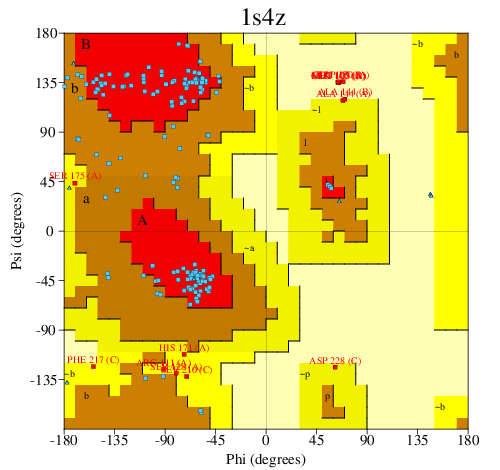
PROCHECK
|
|
|
|
|
|
Headers
|
|
|
|
References
|
|
|
|
|
|
|
|
|
|
|
|
Enzyme class:
|
|
Chains A, B, C:
E.C.?
|
|
|
|
|
|
|
|
|
|
|
|
|
|
|
|
|
|
|
 |
|
|
|
|
|
|
| |
|
DOI no:
|
EMBO J
23:489-499
(2004)
|
|
PubMed id:
|
|
|
|
|
|
| |
|
Structural basis of HP1/PXVXL motif peptide interactions and HP1 localisation to heterochromatin.
|
|
A.Thiru,
D.Nietlispach,
H.R.Mott,
M.Okuwaki,
D.Lyon,
P.R.Nielsen,
M.Hirshberg,
A.Verreault,
N.V.Murzina,
E.D.Laue.
|
|
|
|
|
| |
ABSTRACT
|
|
|
|
| |
|
|
HP1 family proteins are adaptor molecules, containing two related chromo domains
that are required for chromatin packaging and gene silencing. Here we present
the structure of the chromo shadow domain from mouse HP1beta bound to a peptide
containing a consensus PXVXL motif found in many HP1 binding partners. The
shadow domain exhibits a novel mode of peptide recognition, where the peptide
binds across the dimer interface, sandwiched in a beta-sheet between strands
from each monomer. The structure allows us to predict which other shadow domains
bind similar PXVXL motif-containing peptides and provides a framework for
predicting the sequence specificity of the others. We show that targeting of
HP1beta to heterochromatin requires shadow domain interactions with
PXVXL-containing proteins in addition to chromo domain recognition of
Lys-9-methylated histone H3. Interestingly, it also appears to require the
simultaneous recognition of two Lys-9-methylated histone H3 molecules. This
finding implies a further complexity to the histone code for regulation of
chromatin structure and suggests how binding of HP1 family proteins may lead to
its condensation.
|
|
|
|
|
|
| |
Selected figure(s)
|
|
|
|
| |
|
|

|
|

|
|
Figure 2.
Figure 2 Structure of the HP1  shadow
domain/CAF-1 complex. (A) The backbone of residues 110 -172 of
HP1 and
214 -232 of CAF-1 from the 25 lowest energy structures (out of
72 that converged from the 100 computed). The structure has good
covalent geometry and nonbonded contacts (Table 1). The peptide
backbone around residues Asp-214 -Glu-219 of CAF-1 is not well
defined in the structure because only the Phe-217 and Ile-218
side chains interact with the shadow domain. 15N relaxation
studies show that the peptide backbone in this region has
increased mobility within the complex when compared to residues
in the PXVXL motif (Figure 1A). (B) The structure closest to the
mean, rotated by 90° about the z-axis, compared to the
orientation shown in (A). This structure is compared with that
of the free shadow domain (PDB code: 1DZ1; Brasher et al, 2000)
and the chromo domain/histone H3 complex (PDB code: 1GUW;
Nielsen et al, 2002). In the structure of the free shadow
domain, the side chains of Trp-170, which stabilise the position
of the C-terminal tails, are shown. (C) Stereoview of the
structure closest to the mean showing side chains of residues
involved in the HP1 /CAF-1
peptide interface. (D, E) Close-up views of the interactions
made by (D) Val-224 (position 0) and (E) Pro-222 and Leu-226
(positions -2/+2), Phe-217/Ile-218 (-7/-6 positions) and
Ile-229/Leu-230 (+5/+6 positions). In (A -D), the HP1 monomers
are coloured blue and magenta and the CAF-1 peptide is coloured
green. (Note: Trp-170 is not shown on monomer A because it does
not interact with Leu-226 at the +2 position.) shadow
domain/CAF-1 complex. (A) The backbone of residues 110 -172 of
HP1 and
214 -232 of CAF-1 from the 25 lowest energy structures (out of
72 that converged from the 100 computed). The structure has good
covalent geometry and nonbonded contacts (Table 1). The peptide
backbone around residues Asp-214 -Glu-219 of CAF-1 is not well
defined in the structure because only the Phe-217 and Ile-218
side chains interact with the shadow domain. 15N relaxation
studies show that the peptide backbone in this region has
increased mobility within the complex when compared to residues
in the PXVXL motif (Figure 1A). (B) The structure closest to the
mean, rotated by 90° about the z-axis, compared to the
orientation shown in (A). This structure is compared with that
of the free shadow domain (PDB code: 1DZ1; Brasher et al, 2000)
and the chromo domain/histone H3 complex (PDB code: 1GUW;
Nielsen et al, 2002). In the structure of the free shadow
domain, the side chains of Trp-170, which stabilise the position
of the C-terminal tails, are shown. (C) Stereoview of the
structure closest to the mean showing side chains of residues
involved in the HP1 /CAF-1
peptide interface. (D, E) Close-up views of the interactions
made by (D) Val-224 (position 0) and (E) Pro-222 and Leu-226
(positions -2/+2), Phe-217/Ile-218 (-7/-6 positions) and
Ile-229/Leu-230 (+5/+6 positions). In (A -D), the HP1 monomers
are coloured blue and magenta and the CAF-1 peptide is coloured
green. (Note: Trp-170 is not shown on monomer A because it does
not interact with Leu-226 at the +2 position.) 
|
|
Figure 3.
Figure 3 Shadow domain alignment in which the residues involved
in complex formation are highlighted (numbering is for mouse HP1
).
Residues important for recognition of the PXVXL motif are
highlighted in yellow (Val-224) and red (Pro-222/Leu-226 at the
-2/+2 positions). Residues that form the hydrophobic patch that
interacts with the flanking N- and C-terminal sequences
(Phe-217/Ile-218 and Ile-229/Leu-230 at the -6/-7 and +5/+6
positions, respectively) are highlighted in blue. Residues that
are not conserved and are predicted to alter specificity are
boxed. Conserved residues that define the fold of the shadow
domain are highlighted in grey, while residues important for
dimerisation are indicated by blue triangles. Phe-163 (indicated
by a green dot) is important for both the structure of the
shadow domain and peptide binding. The positions of secondary
structure elements in mouse HP1 are
indicated by purple arrows ( -strands)
and cylinders (  -helices)--the
dots indicate the positions of the conserved bulges in the first
strand. Sequences are labelled by species name (Mm--Mus
musculus, Hs--Homo sapiens, Gg--Gallus gallus, Xl--Xenopus
laevis, Dm--Drosophila melanogaster, Dv--Drosophila virilis,
Os--Oryza sativa, Zm--Zea mays, At--Arabidopsis thaliana,
Dc--Daucus carota, Sp--Schizosaccharomyces pombe,
Ec--Encephalitozoon cuniculi, Ce--Caenorhabditis elegans,
Le--Lycopersicon esculentum). -helices)--the
dots indicate the positions of the conserved bulges in the first
strand. Sequences are labelled by species name (Mm--Mus
musculus, Hs--Homo sapiens, Gg--Gallus gallus, Xl--Xenopus
laevis, Dm--Drosophila melanogaster, Dv--Drosophila virilis,
Os--Oryza sativa, Zm--Zea mays, At--Arabidopsis thaliana,
Dc--Daucus carota, Sp--Schizosaccharomyces pombe,
Ec--Encephalitozoon cuniculi, Ce--Caenorhabditis elegans,
Le--Lycopersicon esculentum).
|
|
|
|
|
|
| |
The above figures are
reprinted
from an Open Access publication published by Macmillan Publishers Ltd:
EMBO J
(2004,
23,
489-499)
copyright 2004.
|
|
| |
Figures were
selected
by the author.
|
|
|
|
|
|
|
|
|
|
|
|
|
|
|
|
 |
 |
 |
|
Literature references that cite this PDB file's key reference
|
|
|
| |
PubMed id
|
|
Reference
|
|
|
|
|
|
A.Stein,
A.Céol,
and
P.Aloy
(2011).
3did: identification and classification of domain-based interactions of known three-dimensional structure.
|
| |
Nucleic Acids Res,
39,
D718-D723.
|
|
|
|
|
|
|
C.Baldeyron,
G.Soria,
D.Roche,
A.J.Cook,
and
G.Almouzni
(2011).
HP1alpha recruitment to DNA damage by p150CAF-1 promotes homologous recombination repair.
|
| |
J Cell Biol,
193,
81-95.
|
|
|
|
|
|
|
D.L.Mendez,
D.Kim,
M.Chruszcz,
G.E.Stephens,
W.Minor,
S.Khorasanizadeh,
and
S.C.Elgin
(2011).
The HP1a disordered C terminus and chromo shadow domain cooperate to select target peptide partners.
|
| |
Chembiochem,
12,
1084-1096.
|
|
|
PDB code:
|
|
|
|
|
|
|
|
D.Latrasse,
S.Germann,
N.Houba-Hérin,
E.Dubois,
D.Bui-Prodhomme,
D.Hourcade,
T.Juul-Jensen,
C.Le Roux,
A.Majira,
N.Simoncello,
F.Granier,
L.Taconnat,
J.P.Renou,
and
V.Gaudin
(2011).
Control of Flowering and Cell Fate by LIF2, an RNA Binding Partner of the Polycomb Complex Component LHP1.
|
| |
PLoS One,
6,
e16592.
|
|
|
|
|
|
|
I.Olsson,
and
P.Bjerling
(2011).
Advancing our understanding of functional genome organisation through studies in the fission yeast.
|
| |
Curr Genet,
57,
1.
|
|
|
|
|
|
|
K.Mosch,
H.Franz,
S.Soeroes,
P.B.Singh,
and
W.Fischle
(2011).
HP1 recruits activity-dependent neuroprotective protein to H3K9me3 marked pericentromeric heterochromatin for silencing of major satellite repeats.
|
| |
PLoS One,
6,
e15894.
|
|
|
|
|
|
|
N.J.Brideau,
and
D.A.Barbash
(2011).
Functional conservation of the Drosophila hybrid incompatibility gene Lhr.
|
| |
BMC Evol Biol,
11,
57.
|
|
|
|
|
|
|
P.C.Li,
L.Chretien,
J.Côté,
T.J.Kelly,
and
S.L.Forsburg
(2011).
S. pombe replication protein Cdc18 (Cdc6) interacts with Swi6 (HP1) heterochromatin protein: region specific effects and replication timing in the centromere.
|
| |
Cell Cycle,
10,
323-336.
|
|
|
|
|
|
|
P.Voigt,
and
D.Reinberg
(2011).
Histone tails: ideal motifs for probing epigenetics through chemical biology approaches.
|
| |
Chembiochem,
12,
236-252.
|
|
|
|
|
|
|
S.Eustermann,
J.C.Yang,
M.J.Law,
R.Amos,
L.M.Chapman,
C.Jelinska,
D.Garrick,
D.Clynes,
R.J.Gibbons,
D.Rhodes,
D.R.Higgs,
and
D.Neuhaus
(2011).
Combinatorial readout of histone H3 modifications specifies localization of ATRX to heterochromatin.
|
| |
Nat Struct Mol Biol,
18,
777-782.
|
|
|
PDB code:
|
|
|
|
|
|
|
|
S.H.Kwon,
and
J.L.Workman
(2011).
The changing faces of HP1: From heterochromatin formation and gene silencing to euchromatic gene expression: HP1 acts as a positive regulator of transcription.
|
| |
Bioessays,
33,
280-289.
|
|
|
|
|
|
|
Y.Chang,
J.R.Horton,
M.T.Bedford,
X.Zhang,
and
X.Cheng
(2011).
Structural insights for MPP8 chromodomain interaction with histone H3 lysine 9: potential effect of phosphorylation on methyl-lysine binding.
|
| |
J Mol Biol,
408,
807-814.
|
|
|
PDB code:
|
|
|
|
|
|
|
|
A.C.Groner,
S.Meylan,
A.Ciuffi,
N.Zangger,
G.Ambrosini,
N.Dénervaud,
P.Bucher,
and
D.Trono
(2010).
KRAB-zinc finger proteins and KAP1 can mediate long-range transcriptional repression through heterochromatin spreading.
|
| |
PLoS Genet,
6,
e1000869.
|
|
|
|
|
|
|
I.del Olmo,
L.López-González,
M.M.Martín-Trillo,
J.M.Martínez-Zapater,
M.Piñeiro,
and
J.A.Jarillo
(2010).
EARLY IN SHORT DAYS 7 (ESD7) encodes the catalytic subunit of DNA polymerase epsilon and is required for flowering repression through a mechanism involving epigenetic gene silencing.
|
| |
Plant J,
61,
623-636.
|
|
|
|
|
|
|
K.Hayashihara,
S.Uchiyama,
S.Shimamoto,
S.Kobayashi,
M.Tomschik,
H.Wakamatsu,
D.No,
H.Sugahara,
N.Hori,
M.Noda,
T.Ohkubo,
J.Zlatanova,
S.Matsunaga,
and
K.Fukui
(2010).
The middle region of an HP1-binding protein, HP1-BP74, associates with linker DNA at the entry/exit site of nucleosomal DNA.
|
| |
J Biol Chem,
285,
6498-6507.
|
|
|
PDB code:
|
|
|
|
|
|
|
|
K.L.Yap,
and
M.M.Zhou
(2010).
Keeping it in the family: diverse histone recognition by conserved structural folds.
|
| |
Crit Rev Biochem Mol Biol,
45,
488-505.
|
|
|
|
|
|
|
M.Billur,
H.D.Bartunik,
and
P.B.Singh
(2010).
The essential function of HP1 beta: a case of the tail wagging the dog?
|
| |
Trends Biochem Sci,
35,
115-123.
|
|
|
|
|
|
|
R.S.Nozawa,
K.Nagao,
H.T.Masuda,
O.Iwasaki,
T.Hirota,
N.Nozaki,
H.Kimura,
and
C.Obuse
(2010).
Human POGZ modulates dissociation of HP1alpha from mitotic chromosome arms through Aurora B activation.
|
| |
Nat Cell Biol,
12,
719-727.
|
|
|
|
|
|
|
S.G.Prasanth,
Z.Shen,
K.V.Prasanth,
and
B.Stillman
(2010).
Human origin recognition complex is essential for HP1 binding to chromatin and heterochromatin organization.
|
| |
Proc Natl Acad Sci U S A,
107,
15093-15098.
|
|
|
|
|
|
|
S.H.Kwon,
L.Florens,
S.K.Swanson,
M.P.Washburn,
S.M.Abmayr,
and
J.L.Workman
(2010).
Heterochromatin protein 1 (HP1) connects the FACT histone chaperone complex to the phosphorylated CTD of RNA polymerase II.
|
| |
Genes Dev,
24,
2133-2145.
|
|
|
|
|
|
|
T.Kiyomitsu,
O.Iwasaki,
C.Obuse,
and
M.Yanagida
(2010).
Inner centromere formation requires hMis14, a trident kinetochore protein that specifically recruits HP1 to human chromosomes.
|
| |
J Cell Biol,
188,
791-807.
|
|
|
|
|
|
|
C.Dinant,
and
M.S.Luijsterburg
(2009).
The emerging role of HP1 in the DNA damage response.
|
| |
Mol Cell Biol,
29,
6335-6340.
|
|
|
|
|
|
|
C.Flueck,
R.Bartfai,
J.Volz,
I.Niederwieser,
A.M.Salcedo-Amaya,
B.T.Alako,
F.Ehlgen,
S.A.Ralph,
A.F.Cowman,
Z.Bozdech,
H.G.Stunnenberg,
and
T.S.Voss
(2009).
Plasmodium falciparum heterochromatin protein 1 marks genomic loci linked to phenotypic variation of exported virulence factors.
|
| |
PLoS Pathog,
5,
e1000569.
|
|
|
|
|
|
|
E.I.Campos,
and
D.Reinberg
(2009).
Histones: annotating chromatin.
|
| |
Annu Rev Genet,
43,
559-599.
|
|
|
|
|
|
|
H.Franz,
K.Mosch,
S.Soeroes,
H.Urlaub,
and
W.Fischle
(2009).
Multimerization and H3K9me3 binding are required for CDYL1b heterochromatin association.
|
| |
J Biol Chem,
284,
35049-35059.
|
|
|
|
|
|
|
K.A.Hines,
D.E.Cryderman,
K.M.Flannery,
H.Yang,
M.W.Vitalini,
T.Hazelrigg,
C.A.Mizzen,
and
L.L.Wallrath
(2009).
Domains of heterochromatin protein 1 required for Drosophila melanogaster heterochromatin spreading.
|
| |
Genetics,
182,
967-977.
|
|
|
|
|
|
|
M.Lavigne,
R.Eskeland,
S.Azebi,
V.Saint-André,
S.M.Jang,
E.Batsché,
H.Y.Fan,
R.E.Kingston,
A.Imhof,
and
C.Muchardt
(2009).
Interaction of HP1 and Brg1/Brm with the globular domain of histone H3 is required for HP1-mediated repression.
|
| |
PLoS Genet,
5,
e1000769.
|
|
|
|
|
|
|
M.Zarebski,
E.Wiernasz,
and
J.W.Dobrucki
(2009).
Recruitment of heterochromatin protein 1 to DNA repair sites.
|
| |
Cytometry A,
75,
619-625.
|
|
|
|
|
|
|
O.Novikova
(2009).
Chromodomains and LTR retrotransposons in plants.
|
| |
Commun Integr Biol,
2,
158-162.
|
|
|
|
|
|
|
R.Riclet,
M.Chendeb,
J.L.Vonesch,
D.Koczan,
H.J.Thiesen,
R.Losson,
and
F.Cammas
(2009).
Disruption of the interaction between transcriptional intermediary factor 1{beta} and heterochromatin protein 1 leads to a switch from DNA hyper- to hypomethylation and H3K9 to H3K27 trimethylation on the MEST promoter correlating with gene reactivation.
|
| |
Mol Biol Cell,
20,
296-305.
|
|
|
|
|
|
|
T.Rolef Ben-Shahar,
A.G.Castillo,
M.J.Osborne,
K.L.Borden,
J.Kornblatt,
and
A.Verreault
(2009).
Two fundamentally distinct PCNA interaction peptides contribute to chromatin assembly factor 1 function.
|
| |
Mol Cell Biol,
29,
6353-6365.
|
|
|
|
|
|
|
A.Schwendemann,
T.Matkovic,
C.Linke,
A.Klebes,
A.Hofmann,
and
G.Korge
(2008).
Hip, an HP1-interacting protein, is a haplo- and triplo-suppressor of position effect variegation.
|
| |
Proc Natl Acad Sci U S A,
105,
204-209.
|
|
|
|
|
|
|
C.H.Lin,
B.Li,
S.Swanson,
Y.Zhang,
L.Florens,
M.P.Washburn,
S.M.Abmayr,
and
J.L.Workman
(2008).
Heterochromatin protein 1a stimulates histone H3 lysine 36 demethylation by the Drosophila KDM4A demethylase.
|
| |
Mol Cell,
32,
696-706.
|
|
|
|
|
|
|
C.Papanayotou,
A.Mey,
A.M.Birot,
Y.Saka,
S.Boast,
J.C.Smith,
J.Samarut,
and
C.D.Stern
(2008).
A mechanism regulating the onset of Sox2 expression in the embryonic neural plate.
|
| |
PLoS Biol,
6,
e2.
|
|
|
|
|
|
|
C.W.Chang,
H.Y.Chou,
Y.S.Lin,
K.H.Huang,
C.J.Chang,
T.C.Hsu,
and
S.C.Lee
(2008).
Phosphorylation at Ser473 regulates heterochromatin protein 1 binding and corepressor function of TIF1beta/KAP1.
|
| |
BMC Mol Biol,
9,
61.
|
|
|
|
|
|
|
G.K.Dialynas,
M.W.Vitalini,
and
L.L.Wallrath
(2008).
Linking Heterochromatin Protein 1 (HP1) to cancer progression.
|
| |
Mutat Res,
647,
13-20.
|
|
|
|
|
|
|
H.Lin,
and
H.Yin
(2008).
A novel epigenetic mechanism in Drosophila somatic cells mediated by Piwi and piRNAs.
|
| |
Cold Spring Harb Symp Quant Biol,
73,
273-281.
|
|
|
|
|
|
|
J.P.Quivy,
A.Gérard,
A.J.Cook,
D.Roche,
and
G.Almouzni
(2008).
The HP1-p150/CAF-1 interaction is required for pericentric heterochromatin replication and S-phase progression in mouse cells.
|
| |
Nat Struct Mol Biol,
15,
972-979.
|
|
|
|
|
|
|
J.Zlatanova,
C.Seebart,
and
M.Tomschik
(2008).
The linker-protein network: control of nucleosomal DNA accessibility.
|
| |
Trends Biochem Sci,
33,
247-253.
|
|
|
|
|
|
|
M.Sadaie,
R.Kawaguchi,
Y.Ohtani,
F.Arisaka,
K.Tanaka,
K.Shirahige,
and
J.Nakayama
(2008).
Balance between distinct HP1 family proteins controls heterochromatin assembly in fission yeast.
|
| |
Mol Cell Biol,
28,
6973-6988.
|
|
|
|
|
|
|
R.Aucott,
J.Bullwinkel,
Y.Yu,
W.Shi,
M.Billur,
J.P.Brown,
U.Menzel,
D.Kioussis,
G.Wang,
I.Reisert,
J.Weimer,
R.K.Pandita,
G.G.Sharma,
T.K.Pandita,
R.Fundele,
and
P.B.Singh
(2008).
HP1-beta is required for development of the cerebral neocortex and neuromuscular junctions.
|
| |
J Cell Biol,
183,
597-606.
|
|
|
|
|
|
|
S.Honda,
and
E.U.Selker
(2008).
Direct interaction between DNA methyltransferase DIM-2 and HP1 is required for DNA methylation in Neurospora crassa.
|
| |
Mol Cell Biol,
28,
6044-6055.
|
|
|
|
|
|
|
S.Shi,
K.Larson,
D.Guo,
S.J.Lim,
P.Dutta,
S.J.Yan,
and
W.X.Li
(2008).
Drosophila STAT is required for directly maintaining HP1 localization and heterochromatin stability.
|
| |
Nat Cell Biol,
10,
489-496.
|
|
|
|
|
|
|
W.X.Li
(2008).
Canonical and non-canonical JAK-STAT signaling.
|
| |
Trends Cell Biol,
18,
545-551.
|
|
|
|
|
|
|
B.Brower-Toland,
S.D.Findley,
L.Jiang,
L.Liu,
H.Yin,
M.Dus,
P.Zhou,
S.C.Elgin,
and
H.Lin
(2007).
Drosophila PIWI associates with chromatin and interacts directly with HP1a.
|
| |
Genes Dev,
21,
2300-2311.
|
|
|
|
|
|
|
F.J.Iborra
(2007).
Can visco-elastic phase separation, macromolecular crowding and colloidal physics explain nuclear organisation?
|
| |
Theor Biol Med Model,
4,
15.
|
|
|
|
|
|
|
J.Mateos-Langerak,
M.C.Brink,
M.S.Luijsterburg,
I.van der Kraan,
R.van Driel,
and
P.J.Verschure
(2007).
Pericentromeric heterochromatin domains are maintained without accumulation of HP1.
|
| |
Mol Biol Cell,
18,
1464-1471.
|
|
|
|
|
|
|
M.Kato,
Y.Kato,
M.Nishida,
T.Hayakawa,
T.Haraguchi,
Y.Hiraoka,
Y.H Inoue,
and
M.Yamaguchi
(2007).
Functional domain analysis of human HP1 isoforms in Drosophila.
|
| |
Cell Struct Funct,
32,
57-67.
|
|
|
|
|
|
|
R.Eskeland,
A.Eberharter,
and
A.Imhof
(2007).
HP1 binding to chromatin methylated at H3K9 is enhanced by auxiliary factors.
|
| |
Mol Cell Biol,
27,
453-465.
|
|
|
|
|
|
|
S.Wu,
R.C.Trievel,
and
J.C.Rice
(2007).
Human SFMBT is a transcriptional repressor protein that selectively binds the N-terminal tail of histone H3.
|
| |
FEBS Lett,
581,
3289-3296.
|
|
|
|
|
|
|
T.J.Moss,
and
L.L.Wallrath
(2007).
Connections between epigenetic gene silencing and human disease.
|
| |
Mutat Res,
618,
163-174.
|
|
|
|
|
|
|
G.Lomberk,
D.Bensi,
M.E.Fernandez-Zapico,
and
R.Urrutia
(2006).
Evidence for the existence of an HP1-mediated subcode within the histone code.
|
| |
Nat Cell Biol,
8,
407-415.
|
|
|
|
|
|
|
G.Lomberk,
L.Wallrath,
and
R.Urrutia
(2006).
The Heterochromatin Protein 1 family.
|
| |
Genome Biol,
7,
228.
|
|
|
|
|
|
|
L.E.Norwood,
T.J.Moss,
N.V.Margaryan,
S.L.Cook,
L.Wright,
E.A.Seftor,
M.J.Hendrix,
D.A.Kirschmann,
and
L.L.Wallrath
(2006).
A requirement for dimerization of HP1Hsalpha in suppression of breast cancer invasion.
|
| |
J Biol Chem,
281,
18668-18676.
|
|
|
|
|
|
|
M.C.Brink,
Y.van der Velden,
W.de Leeuw,
J.Mateos-Langerak,
A.S.Belmont,
R.van Driel,
and
P.J.Verschure
(2006).
Truncated HP1 lacking a functional chromodomain induces heterochromatinization upon in vivo targeting.
|
| |
Histochem Cell Biol,
125,
53-61.
|
|
|
|
|
|
|
M.J.Vogel,
L.Guelen,
E.de Wit,
D.Peric-Hupkes,
M.Lodén,
W.Talhout,
M.Feenstra,
B.Abbas,
A.K.Classen,
and
B.van Steensel
(2006).
Human heterochromatin proteins form large domains containing KRAB-ZNF genes.
|
| |
Genome Res,
16,
1493-1504.
|
|
|
|
|
|
|
M.Kaller,
U.Euteneuer,
and
W.Nellen
(2006).
Differential effects of heterochromatin protein 1 isoforms on mitotic chromosome distribution and growth in Dictyostelium discoideum.
|
| |
Eukaryot Cell,
5,
530-543.
|
|
|
|
|
|
|
P.Zhang,
J.Du,
B.Sun,
X.Dong,
G.Xu,
J.Zhou,
Q.Huang,
Q.Liu,
Q.Hao,
and
J.Ding
(2006).
Structure of human MRG15 chromo domain and its binding to Lys36-methylated histone H3.
|
| |
Nucleic Acids Res,
34,
6621-6628.
|
|
|
PDB code:
|
|
|
|
|
|
|
|
S.A.Grigoryev,
Y.A.Bulynko,
and
E.Y.Popova
(2006).
The end adjusts the means: heterochromatin remodelling during terminal cell differentiation.
|
| |
Chromosome Res,
14,
53-69.
|
|
|
|
|
|
|
S.J.McBryant,
V.H.Adams,
and
J.C.Hansen
(2006).
Chromatin architectural proteins.
|
| |
Chromosome Res,
14,
39-51.
|
|
|
|
|
|
|
V.C.Seitan,
P.Banks,
S.Laval,
N.A.Majid,
D.Dorsett,
A.Rana,
J.Smith,
A.Bateman,
S.Krpic,
A.Hostert,
R.A.Rollins,
H.Erdjument-Bromage,
P.Tempst,
C.Y.Benard,
S.Hekimi,
S.F.Newbury,
and
T.Strachan
(2006).
Metazoan Scc4 homologs link sister chromatid cohesion to cell and axon migration guidance.
|
| |
PLoS Biol,
4,
e242.
|
|
|
|
|
|
|
A.M.Bonvin,
R.Boelens,
and
R.Kaptein
(2005).
NMR analysis of protein interactions.
|
| |
Curr Opin Chem Biol,
9,
501-508.
|
|
|
|
|
|
|
C.M.Ekblad,
G.B.Chavali,
B.P.Basu,
S.M.Freund,
D.Veprintsev,
L.Hughes-Davies,
T.Kouzarides,
A.J.Doherty,
and
L.S.Itzhaki
(2005).
Binding of EMSY to HP1beta: implications for recruitment of HP1beta and BS69.
|
| |
EMBO Rep,
6,
675-680.
|
|
|
PDB code:
|
|
|
|
|
|
|
|
D.Vermaak,
S.Henikoff,
and
H.S.Malik
(2005).
Positive selection drives the evolution of rhino, a member of the heterochromatin protein 1 family in Drosophila.
|
| |
PLoS Genet,
1,
96.
|
|
|
|
|
|
|
G.E.Stephens,
E.E.Slawson,
C.A.Craig,
and
S.C.Elgin
(2005).
Interaction of heterochromatin protein 2 with HP1 defines a novel HP1-binding domain.
|
| |
Biochemistry,
44,
13394-13403.
|
|
|
|
|
|
|
J.M.Craig
(2005).
Heterochromatin--many flavours, common themes.
|
| |
Bioessays,
27,
17-28.
|
|
|
|
|
|
|
M.D.Stewart,
J.Li,
and
J.Wong
(2005).
Relationship between histone H3 lysine 9 methylation, transcription repression, and heterochromatin protein 1 recruitment.
|
| |
Mol Cell Biol,
25,
2525-2538.
|
|
|
|
|
|
|
P.R.Nielsen,
D.Nietlispach,
A.Buscaino,
R.J.Warner,
A.Akhtar,
A.G.Murzin,
N.V.Murzina,
and
E.D.Laue
(2005).
Structure of the chromo barrel domain from the MOF acetyltransferase.
|
| |
J Biol Chem,
280,
32326-32331.
|
|
|
PDB code:
|
|
|
|
|
|
|
|
W.Fischle,
B.S.Tseng,
H.L.Dormann,
B.M.Ueberheide,
B.A.Garcia,
J.Shabanowitz,
D.F.Hunt,
H.Funabiki,
and
C.D.Allis
(2005).
Regulation of HP1-chromatin binding by histone H3 methylation and phosphorylation.
|
| |
Nature,
438,
1116-1122.
|
|
|
|
|
|
|
A.M.Lindroth,
D.Shultis,
Z.Jasencakova,
J.Fuchs,
L.Johnson,
D.Schubert,
D.Patnaik,
S.Pradhan,
J.Goodrich,
I.Schubert,
T.Jenuwein,
S.Khorasanizadeh,
and
S.E.Jacobsen
(2004).
Dual histone H3 methylation marks at lysines 9 and 27 required for interaction with CHROMOMETHYLASE3.
|
| |
EMBO J,
23,
4286-4296.
|
|
|
|
|
|
|
E.Futai,
S.Hamamoto,
L.Orci,
and
R.Schekman
(2004).
GTP/GDP exchange by Sec12p enables COPII vesicle bud formation on synthetic liposomes.
|
| |
EMBO J,
23,
4146-4155.
|
|
|
|
|
|
|
F.Cammas,
M.Herzog,
T.Lerouge,
P.Chambon,
and
R.Losson
(2004).
Association of the transcriptional corepressor TIF1beta with heterochromatin protein 1 (HP1): an essential role for progression through differentiation.
|
| |
Genes Dev,
18,
2147-2160.
|
|
|
|
|
|
|
N.J.Francis,
R.E.Kingston,
and
C.L.Woodcock
(2004).
Chromatin compaction by a polycomb group protein complex.
|
| |
Science,
306,
1574-1577.
|
|
|
|
|
|
The most recent references are shown first.
Citation data come partly from CiteXplore and partly
from an automated harvesting procedure. Note that this is likely to be
only a partial list as not all journals are covered by
either method. However, we are continually building up the citation data
so more and more references will be included with time.
Where a reference describes a PDB structure, the PDB
code is
shown on the right.
|
 |


 Links
Links










