
|
|
|
|
|
 |
Contents |
 |
|
|
|
|
|
|
|
|
|
|
* Residue conservation analysis
|
|
|
|
|
|
|
|
|
|
Enzyme class:
|
|
Chain C:
E.C.1.8.1.8
- protein-disulfide reductase.
|
|
|
|
|
|
|
Reaction:
|
|
|
1.
|
[protein]-dithiol + NAD+ = [protein]-disulfide + NADH + H+
|
|
2.
|
[protein]-dithiol + NADP+ = [protein]-disulfide + NADPH + H+
|
|
|
|
|
|
|
[protein]-dithiol
|
+
|
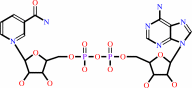 NAD(+)
|
=
|
[protein]-disulfide
|
+
|
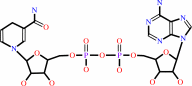 NADH
NADH
|
+
|
H(+)
|
|
|
|
|
|
|
[protein]-dithiol
|
+
|
 NADP(+)
|
=
|
[protein]-disulfide
|
+
|
 NADPH
NADPH
|
+
|
H(+)
|
|
|
|
|
|
|
|
|
|
|
|
|
Molecule diagrams generated from .mol files obtained from the
KEGG ftp site
|
|
|
|
|
|
|
|
|
|
|
|
|
|
 |
|
|
|
|
|
|
| |
|
|
| |
|
DOI no:
|
EMBO J
21:4774-4784
(2002)
|
|
PubMed id:
|
|
|
|
|
|
| |
|
The disulfide bond isomerase DsbC is activated by an immunoglobulin-fold thiol oxidoreductase: crystal structure of the DsbC-DsbDalpha complex.
|
|
P.W.Haebel,
D.Goldstone,
F.Katzen,
J.Beckwith,
P.Metcalf.
|
|
|
|
|
| |
ABSTRACT
|
|
|
|
| |
|
|
The Escherichia coli disulfide bond isomerase DsbC rearranges incorrect
disulfide bonds during oxidative protein folding. It is specifically activated
by the periplasmic N-terminal domain (DsbDalpha) of the transmembrane electron
transporter DsbD. An intermediate of the electron transport reaction was
trapped, yielding a covalent DsbC-DsbDalpha complex. The 2.3 A crystal structure
of the complex shows for the first time the specific interactions between two
thiol oxidoreductases. DsbDalpha is a novel thiol oxidoreductase with the active
site cysteines embedded in an immunoglobulin fold. It binds into the central
cleft of the V-shaped DsbC dimer, which assumes a closed conformation on complex
formation. Comparison of the complex with oxidized DsbDalpha reveals major
conformational changes in a cap structure that regulates the accessibility of
the DsbDalpha active site. Our results explain how DsbC is selectively activated
by DsbD using electrons derived from the cytoplasm.
|
|
|
|
|
|
| |
Selected figure(s)
|
|
|
|
| |
|
|

|
|

|
|
Figure 3.
Figure 3 Conformational changes during the thiol−disulfide
exchange reaction between DsbC and DsbD  .
(A) Ribbon presentation of the DsbC dimer showing the open
(white) and closed (blue and green) conformation of the
molecule. In the open conformation, the sulfur atoms (yellow
spheres) of the two DsbC active site Cys98 are 38 Å apart.
DsbC assumes a closed conformation on binding to DsbD and
the hinge movements observed in the DsbC linker helices result
in the reduction of the distance between the active sites to 29
Å in the closed form. (B) Representation of the open (red)
and shielded (white) form of the DsbD active
site. In the open form observed in the DsbC−DsbD complex,
the opening of the active site cap facilitates access to the
DsbC binding pocket. In the shielded oxidized form of DsbD ,
the binding pocket is protected from the environment by Phe70,
which makes close van der Waals interactions with the active
site disulfide (yellow). Phe70 moves 13 Å from its
position in oxidized DsbD . .
(A) Ribbon presentation of the DsbC dimer showing the open
(white) and closed (blue and green) conformation of the
molecule. In the open conformation, the sulfur atoms (yellow
spheres) of the two DsbC active site Cys98 are 38 Å apart.
DsbC assumes a closed conformation on binding to DsbD and
the hinge movements observed in the DsbC linker helices result
in the reduction of the distance between the active sites to 29
Å in the closed form. (B) Representation of the open (red)
and shielded (white) form of the DsbD active
site. In the open form observed in the DsbC−DsbD complex,
the opening of the active site cap facilitates access to the
DsbC binding pocket. In the shielded oxidized form of DsbD ,
the binding pocket is protected from the environment by Phe70,
which makes close van der Waals interactions with the active
site disulfide (yellow). Phe70 moves 13 Å from its
position in oxidized DsbD .
|
|
Figure 4.
Figure 4 Interactions of the two DsbC active sites with DsbD
residues.
(A) Stereo diagram of the primary binding site showing the DsbC
active site interacting with DsbD .
The primary binding surface of DsbD is
shown colored according to the calculated electrostatic
potential using GRASP. Negative charges are colored red and
positive charges are in blue. Important DsbC residues
(Ile96−Leu104, Gly181−Val185) are shown in blue
ball-and-stick and cartoon representation. DsbC residues are
labeled in black and DsbD residues
in green. DsbC Tyr100 binds into an uncharged pocket adjacent to
the DsbD active
site Cys109, which forms a disulfide bond with DsbC Cys98 and
hydrogen bonds to the cis-proline loop, Thr182−Pro183. (B)
Stereo diagram of the secondary binding site. The electrostatic
surface of the DsbD secondary
binding site is presented with DsbD residues
labeled in green. The DsbC active region is shown in green
ball-and-stick and ribbons representation with yellow labels.
DsbD Asp21
interacts with the DsbC active site Cys98 and Gly99, while
Tyr100 packs against DsbD Phe22.
|
|
|
|
|
|
| |
The above figures are
reprinted
from an Open Access publication published by Macmillan Publishers Ltd:
EMBO J
(2002,
21,
4774-4784)
copyright 2002.
|
|
| |
Figures were
selected
by an automated process.
|
|
|
|
|
|
|
|
|
|
|
|
|
|
|
|
 |
 |
 |
|
Literature references that cite this PDB file's key reference
|
|
|
| |
PubMed id
|
|
Reference
|
|
|
|
|
|
S.R.Shouldice,
B.Heras,
P.M.Walden,
M.Totsika,
M.A.Schembri,
and
J.L.Martin
(2011).
Structure and function of DsbA, a key bacterial oxidative folding catalyst.
|
| |
Antioxid Redox Signal,
14,
1729-1760.
|
|
|
|
|
|
|
H.Kadokura,
and
J.Beckwith
(2010).
Mechanisms of oxidative protein folding in the bacterial cell envelope.
|
| |
Antioxid Redox Signal,
13,
1231-1246.
|
|
|
|
|
|
|
J.F.Collet,
and
J.Messens
(2010).
Structure, function, and mechanism of thioredoxin proteins.
|
| |
Antioxid Redox Signal,
13,
1205-1216.
|
|
|
|
|
|
|
M.A.Wouters,
S.W.Fan,
and
N.L.Haworth
(2010).
Disulfides as redox switches: from molecular mechanisms to functional significance.
|
| |
Antioxid Redox Signal,
12,
53-91.
|
|
|
|
|
|
|
S.R.Shouldice,
S.H.Cho,
D.Boyd,
B.Heras,
M.Eser,
J.Beckwith,
P.Riggs,
J.L.Martin,
and
M.Berkmen
(2010).
In vivo oxidative protein folding can be facilitated by oxidation-reduction cycling.
|
| |
Mol Microbiol,
75,
13-28.
|
|
|
PDB codes:
|
|
|
|
|
|
|
|
B.Heras,
S.R.Shouldice,
M.Totsika,
M.J.Scanlon,
M.A.Schembri,
and
J.L.Martin
(2009).
DSB proteins and bacterial pathogenicity.
|
| |
Nat Rev Microbiol,
7,
215-225.
|
|
|
|
|
|
|
D.A.Mavridou,
J.M.Stevens,
A.D.Goddard,
A.C.Willis,
S.J.Ferguson,
and
C.Redfield
(2009).
Control of Periplasmic Interdomain Thiol:Disulfide Exchange in the Transmembrane Oxidoreductase DsbD.
|
| |
J Biol Chem,
284,
3219-3226.
|
|
|
|
|
|
|
J.J.Paxman,
N.A.Borg,
J.Horne,
P.E.Thompson,
Y.Chin,
P.Sharma,
J.S.Simpson,
J.Wielens,
S.Piek,
C.M.Kahler,
H.Sakellaris,
M.Pearce,
S.P.Bottomley,
J.Rossjohn,
and
M.J.Scanlon
(2009).
The structure of the bacterial oxidoreductase enzyme DsbA in complex with a peptide reveals a basis for substrate specificity in the catalytic cycle of DsbA enzymes.
|
| |
J Biol Chem,
284,
17835-17845.
|
|
|
PDB code:
|
|
|
|
|
|
|
|
M.Quinternet,
P.Tsan,
L.Selme-Roussel,
C.Jacob,
S.Boschi-Muller,
G.Branlant,
and
M.T.Cung
(2009).
Formation of the complex between DsbD and PilB N-terminal domains from Neisseria meningitidis necessitates an adaptability of nDsbD.
|
| |
Structure,
17,
1024-1033.
|
|
|
PDB code:
|
|
|
|
|
|
|
|
S.H.Cho,
and
J.Beckwith
(2009).
Two Snapshots of Electron Transport across the Membrane: INSIGHTS INTO THE STRUCTURE AND FUNCTION OF DsbD.
|
| |
J Biol Chem,
284,
11416-11424.
|
|
|
|
|
|
|
T.J.Jönsson,
L.C.Johnson,
and
W.T.Lowther
(2009).
Protein engineering of the quaternary sulfiredoxin.peroxiredoxin enzyme.substrate complex reveals the molecular basis for cysteine sulfinic acid phosphorylation.
|
| |
J Biol Chem,
284,
33305-33310.
|
|
|
PDB code:
|
|
|
|
|
|
|
|
H.Shen,
D.E.Walters,
and
D.M.Mueller
(2008).
Introduction of the chloroplast redox regulatory region in the yeast ATP synthase impairs cytochrome C oxidase.
|
| |
J Biol Chem,
283,
32937-32943.
|
|
|
|
|
|
|
S.Gleiter,
and
J.C.Bardwell
(2008).
Disulfide bond isomerization in prokaryotes.
|
| |
Biochim Biophys Acta,
1783,
530-534.
|
|
|
|
|
|
|
A.Hiniker,
G.Ren,
B.Heras,
Y.Zheng,
S.Laurinec,
R.W.Jobson,
J.A.Stuckey,
J.L.Martin,
and
J.C.Bardwell
(2007).
Laboratory evolution of one disulfide isomerase to resemble another.
|
| |
Proc Natl Acad Sci U S A,
104,
11670-11675.
|
|
|
PDB codes:
|
|
|
|
|
|
|
|
B.Heras,
M.Kurz,
S.R.Shouldice,
and
J.L.Martin
(2007).
The name's bond......disulfide bond.
|
| |
Curr Opin Struct Biol,
17,
691-698.
|
|
|
|
|
|
|
S.H.Cho,
A.Porat,
J.Ye,
and
J.Beckwith
(2007).
Redox-active cysteines of a membrane electron transporter DsbD show dual compartment accessibility.
|
| |
EMBO J,
26,
3509-3520.
|
|
|
|
|
|
|
S.M.Yeh,
N.Koon,
C.Squire,
and
P.Metcalf
(2007).
Structures of the dimerization domains of the Escherichia coli disulfide-bond isomerase enzymes DsbC and DsbG.
|
| |
Acta Crystallogr D Biol Crystallogr,
63,
465-471.
|
|
|
PDB codes:
|
|
|
|
|
|
|
|
A.Hiniker,
D.Vertommen,
J.C.Bardwell,
and
J.F.Collet
(2006).
Evidence for conformational changes within DsbD: possible role for membrane-embedded proline residues.
|
| |
J Bacteriol,
188,
7317-7320.
|
|
|
|
|
|
|
C.W.Gruber,
M.Cemazar,
B.Heras,
J.L.Martin,
and
D.J.Craik
(2006).
Protein disulfide isomerase: the structure of oxidative folding.
|
| |
Trends Biochem Sci,
31,
455-464.
|
|
|
|
|
|
|
J.Messens,
and
J.F.Collet
(2006).
Pathways of disulfide bond formation in Escherichia coli.
|
| |
Int J Biochem Cell Biol,
38,
1050-1062.
|
|
|
|
|
|
|
K.Maeda,
P.Hägglund,
C.Finnie,
B.Svensson,
and
A.Henriksen
(2006).
Structural basis for target protein recognition by the protein disulfide reductase thioredoxin.
|
| |
Structure,
14,
1701-1710.
|
|
|
PDB code:
|
|
|
|
|
|
|
|
L.Segatori,
L.Murphy,
S.Arredondo,
H.Kadokura,
H.Gilbert,
J.Beckwith,
and
G.Georgiou
(2006).
Conserved role of the linker alpha-helix of the bacterial disulfide isomerase DsbC in the avoidance of misoxidation by DsbB.
|
| |
J Biol Chem,
281,
4911-4919.
|
|
|
|
|
|
|
N.Ouyang,
Y.G.Gao,
H.Y.Hu,
and
Z.X.Xia
(2006).
Crystal structures of E. coli CcmG and its mutants reveal key roles of the N-terminal beta-sheet and the fingerprint region.
|
| |
Proteins,
65,
1021-1031.
|
|
|
PDB codes:
|
|
|
|
|
|
|
|
P.Jurado,
L.A.Fernández,
and
V.de Lorenzo
(2006).
In vivo drafting of single-chain antibodies for regulatory duty on the sigma54-promoter Pu of the TOL plasmid.
|
| |
Mol Microbiol,
60,
1218-1227.
|
|
|
|
|
|
|
V.M.Chen,
and
P.J.Hogg
(2006).
Allosteric disulfide bonds in thrombosis and thrombolysis.
|
| |
J Thromb Haemost,
4,
2533-2541.
|
|
|
|
|
|
|
C.S.Sevier,
H.Kadokura,
V.C.Tam,
J.Beckwith,
D.Fass,
and
C.A.Kaiser
(2005).
The prokaryotic enzyme DsbB may share key structural features with eukaryotic disulfide bond forming oxidoreductases.
|
| |
Protein Sci,
14,
1630-1642.
|
|
|
|
|
|
|
D.Goldstone,
E.N.Baker,
and
P.Metcalf
(2005).
Crystallization and preliminary diffraction studies of the C-terminal domain of the DipZ homologue from Mycobacterium tuberculosis.
|
| |
Acta Crystallogr Sect F Struct Biol Cryst Commun,
61,
243-245.
|
|
|
|
|
|
|
M.van Lith,
N.Hartigan,
J.Hatch,
and
A.M.Benham
(2005).
PDILT, a divergent testis-specific protein disulfide isomerase with a non-classical SXXC motif that engages in disulfide-dependent interactions in the endoplasmic reticulum.
|
| |
J Biol Chem,
280,
1376-1383.
|
|
|
|
|
|
|
A.Rozhkova,
C.U.Stirnimann,
P.Frei,
U.Grauschopf,
R.Brunisholz,
M.G.Grütter,
G.Capitani,
and
R.Glockshuber
(2004).
Structural basis and kinetics of inter- and intramolecular disulfide exchange in the redox catalyst DsbD.
|
| |
EMBO J,
23,
1709-1719.
|
|
|
PDB codes:
|
|
|
|
|
|
|
|
L.Segatori,
P.J.Paukstelis,
H.F.Gilbert,
and
G.Georgiou
(2004).
Engineered DsbC chimeras catalyze both protein oxidation and disulfide-bond isomerization in Escherichia coli: Reconciling two competing pathways.
|
| |
Proc Natl Acad Sci U S A,
101,
10018-10023.
|
|
|
|
|
|
|
M.Zhang,
A.F.Monzingo,
L.Segatori,
G.Georgiou,
and
J.D.Robertus
(2004).
Structure of DsbC from Haemophilus influenzae.
|
| |
Acta Crystallogr D Biol Crystallogr,
60,
1512-1518.
|
|
|
PDB code:
|
|
|
|
|
|
|
|
E.A.Kersteen,
and
R.T.Raines
(2003).
Catalysis of protein folding by protein disulfide isomerase and small-molecule mimics.
|
| |
Antioxid Redox Signal,
5,
413-424.
|
|
|
|
|
|
|
F.Arnesano,
L.Banci,
M.Benvenuti,
I.Bertini,
V.Calderone,
S.Mangani,
and
M.S.Viezzoli
(2003).
The evolutionarily conserved trimeric structure of CutA1 proteins suggests a role in signal transduction.
|
| |
J Biol Chem,
278,
45999-46006.
|
|
|
PDB codes:
|
|
|
|
|
|
|
|
F.Katzen,
and
J.Beckwith
(2003).
Role and location of the unusual redox-active cysteines in the hydrophobic domain of the transmembrane electron transporter DsbD.
|
| |
Proc Natl Acad Sci U S A,
100,
10471-10476.
|
|
|
|
|
|
|
H.Kadokura,
F.Katzen,
and
J.Beckwith
(2003).
Protein disulfide bond formation in prokaryotes.
|
| |
Annu Rev Biochem,
72,
111-135.
|
|
|
|
|
|
|
L.J.Matthias,
and
P.J.Hogg
(2003).
Redox control on the cell surface: implications for HIV-1 entry.
|
| |
Antioxid Redox Signal,
5,
133-138.
|
|
|
|
|
|
|
R.Ortenberg,
and
J.Beckwith
(2003).
Functions of thiol-disulfide oxidoreductases in E. coli: redox myths, realities, and practicalities.
|
| |
Antioxid Redox Signal,
5,
403-411.
|
|
|
|
|
|
The most recent references are shown first.
Citation data come partly from CiteXplore and partly
from an automated harvesting procedure. Note that this is likely to be
only a partial list as not all journals are covered by
either method. However, we are continually building up the citation data
so more and more references will be included with time.
Where a reference describes a PDB structure, the PDB
codes are
shown on the right.
|
 |


 Links
Links


