
|
|
|
|
|
 |
Contents |
 |
|
|
|
|
|
|
|
|
|
|
|
 121 a.a.
|
|
|
|
|
|
|
|
|
|
|


 118 a.a.
|
|
|
|
|
|
|
|
|
|
|
 125 a.a.
|
|
|
|
|
|
|
|
|
|
|
 113 a.a.
|
|
|
|
|
|
|
|
|
* Residue conservation analysis
|
|
|
|
|
|
PDB id:
|
|
|
|
| Name: |
|
Oxidoreductase
|
|
|
Title:
|
|
Crystal structure of the disulfide-linked complex between the n- terminal and c-terminal domain of the electron transfer catalyst dsbd
|
|
Structure:
|
|
Thiol:disulfide interchange protein dsbd. Chain: a, b, c. Fragment: n-terminal domain, residues 1-143. Synonym: protein-disulfide reductase, c-type cytochrome biogenesis protein cycz, inner membrane copper tolerance protein. Engineered: yes. Mutation: yes. Thiol:disulfide interchange protein dsbd. Chain: d, e, f.
|
|
Source:
|
|
Escherichia coli str. K12 substr.. Organism_taxid: 316407. Strain: w3110. Gene: dsbd, dipz, cycz, cuta2, b4136. Expressed in: escherichia coli. Expression_system_taxid: 562.
|
|
Biol. unit:
|
|
 Dimer (from
)
Dimer (from
)
|
|
Resolution:
|
|
|
2.85Å
|
R-factor:
|
0.224
|
R-free:
|
0.284
|
|
|
Authors:
|
|
A.Rozhkova,C.U.Stirnimann,P.Frei,U.Grauschopf,R.Brunisholz, M.G.Gruetter,G.Capitani,R.Glockshuber
|
Key ref:

|
|
A.Rozhkova
et al.
(2004).
Structural basis and kinetics of inter- and intramolecular disulfide exchange in the redox catalyst DsbD.
EMBO J,
23,
1709-1719.
PubMed id:
DOI:

|
|
|
Date:
|
|
|
17-Jun-05
|
Release date:
|
12-Jul-05
|
|
|
Supersedes:
|
|
|
|
|
|
|
|
PROCHECK
|

|
|
|
|
|
Headers
|
|
|
|
References
|
|
|
|
|
|

|
|
P36655
(DSBD_ECOLI) -
Thiol:disulfide interchange protein DsbD from Escherichia coli (strain K12)
|
|
|
|
Seq:
Struc:
|
|
|
|
565 a.a.
121 a.a.*
|
|

|

|
|
|
|
|
|
|
|
|
|
|
|
|

|
|
P36655
(DSBD_ECOLI) -
Thiol:disulfide interchange protein DsbD from Escherichia coli (strain K12)
|
|
|
|
Seq:
Struc:
|
|
|
|
565 a.a.
118 a.a.*
|
|
|

|
|
|
|
|
|
|
|
|
|
|
|
|
|
|
|
|
|
Enzyme class:
|
|
Chains A, D, B, E, C, F:
E.C.1.8.1.8
- protein-disulfide reductase.
|
|
|
|
|
|
|
Reaction:
|
|
|
1.
|
[protein]-dithiol + NAD+ = [protein]-disulfide + NADH + H+
|
|
2.
|
[protein]-dithiol + NADP+ = [protein]-disulfide + NADPH + H+
|
|
|
|
|
|
|
[protein]-dithiol
|
+
|
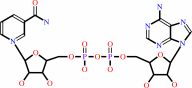 NAD(+)
|
=
|
[protein]-disulfide
|
+
|
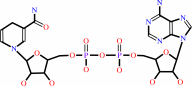 NADH
NADH
|
+
|
H(+)
|
|
|
|
|
|
|
[protein]-dithiol
|
+
|
 NADP(+)
|
=
|
[protein]-disulfide
|
+
|
 NADPH
NADPH
|
+
|
H(+)
|
|
|
|
|
|
|
|
|
|
|
|
|
Molecule diagrams generated from .mol files obtained from the
KEGG ftp site
|
|
|
|
|
|
|
|
|
|
|
|
|
|
 |
|
|
|
|
|
|
| |
|
|
| |
|
DOI no:
|
EMBO J
23:1709-1719
(2004)
|
|
PubMed id:
|
|
|
|
|
|
| |
|
Structural basis and kinetics of inter- and intramolecular disulfide exchange in the redox catalyst DsbD.
|
|
A.Rozhkova,
C.U.Stirnimann,
P.Frei,
U.Grauschopf,
R.Brunisholz,
M.G.Grütter,
G.Capitani,
R.Glockshuber.
|
|
|
|
|
| |
ABSTRACT
|
|
|
|
| |
|
|
DsbD from Escherichia coli catalyzes the transport of electrons from cytoplasmic
thioredoxin to the periplasmic disulfide isomerase DsbC. DsbD contains two
periplasmically oriented domains at the N- and C-terminus (nDsbD and cDsbD) that
are connected by a central transmembrane (TM) domain. Each domain contains a
pair of cysteines that are essential for catalysis. Here, we show that Cys109
and Cys461 form a transient interdomain disulfide bond between nDsbD and cDsbD
in the reaction cycle of DsbD. We solved the crystal structure of this catalytic
intermediate at 2.85 A resolution, which revealed large relative domain
movements in DsbD as a consequence of a strong overlap between the surface areas
of nDsbD that interact with DsbC and cDsbD. In addition, we have measured the
kinetics of all functional and nonfunctional disulfide exchange reactions
between redox-active, periplasmic proteins and protein domains from the
oxidative DsbA/B and the reductive DsbC/D pathway. We show that both pathways
are separated by large kinetic barriers for nonfunctional disulfide exchange
between components from different pathways.
|
|
|
|
|
|
| |
Selected figure(s)
|
|
|
|
| |
|
|

|
|

|
|
Figure 1.
Figure 1 Proposed electron flow from reduced thioredoxin in the
cytoplasm to oxidized, homodimeric DsbC in the periplasm via
DsbD. According to this mechanism, electron transport occurs
exclusively through intermolecular and intramolecular disulfide
exchange. DsbD consists of an N-terminal domain (nDsbD, residues
1 -143) and a C-terminal domain (cDsbD; residues 419 -546),
which are oriented toward the periplasm, and a central TM domain
(residues 144 -418). Numbered circles represent essential
cysteine residues in the respective protein.
|
|
Figure 5.
Figure 5 Surface representations and interface analysis of the
nDsbD-SS-cDsbD and nDsbD-SS-DsbC (1JZD) complexes. (A) Residues
of nDsbD involved in the interaction with cDsbD (green). (B)
Residues of nDsbD involved in the interaction with the first
interface (green) and the second interface (cyan) of DsbC. (C)
Details of the nDsbD-SS-cDsbD interface. Residues of nDsbD
participating in the dimer interface are shown in green on the
surface of the domain. The interacting residues of cDsbD appear
in ball-and-stick representation in pink and atom colors.
|
|
|
|
|
|
| |
The above figures are
reprinted
from an Open Access publication published by Macmillan Publishers Ltd:
EMBO J
(2004,
23,
1709-1719)
copyright 2004.
|
|
| |
Figures were
selected
by an automated process.
|
|
|
|
|
|
|
|
|
|
|
|
|
|
|
|
 |
 |
 |
|
Literature references that cite this PDB file's key reference
|
|
|
| |
PubMed id
|
|
Reference
|
|
|
|
|
|
S.R.Shouldice,
B.Heras,
P.M.Walden,
M.Totsika,
M.A.Schembri,
and
J.L.Martin
(2011).
Structure and function of DsbA, a key bacterial oxidative folding catalyst.
|
| |
Antioxid Redox Signal,
14,
1729-1760.
|
|
|
|
|
|
|
D.P.Sideris,
and
K.Tokatlidis
(2010).
Oxidative protein folding in the mitochondrial intermembrane space.
|
| |
Antioxid Redox Signal,
13,
1189-1204.
|
|
|
|
|
|
|
H.Kadokura,
and
J.Beckwith
(2010).
Mechanisms of oxidative protein folding in the bacterial cell envelope.
|
| |
Antioxid Redox Signal,
13,
1231-1246.
|
|
|
|
|
|
|
M.A.Wouters,
S.W.Fan,
and
N.L.Haworth
(2010).
Disulfides as redox switches: from molecular mechanisms to functional significance.
|
| |
Antioxid Redox Signal,
12,
53-91.
|
|
|
|
|
|
|
B.Heras,
S.R.Shouldice,
M.Totsika,
M.J.Scanlon,
M.A.Schembri,
and
J.L.Martin
(2009).
DSB proteins and bacterial pathogenicity.
|
| |
Nat Rev Microbiol,
7,
215-225.
|
|
|
|
|
|
|
D.A.Mavridou,
J.M.Stevens,
A.D.Goddard,
A.C.Willis,
S.J.Ferguson,
and
C.Redfield
(2009).
Control of Periplasmic Interdomain Thiol:Disulfide Exchange in the Transmembrane Oxidoreductase DsbD.
|
| |
J Biol Chem,
284,
3219-3226.
|
|
|
|
|
|
|
K.S.Jensen,
R.E.Hansen,
and
J.R.Winther
(2009).
Kinetic and thermodynamic aspects of cellular thiol-disulfide redox regulation.
|
| |
Antioxid Redox Signal,
11,
1047-1058.
|
|
|
|
|
|
|
M.Quinternet,
P.Tsan,
L.Selme-Roussel,
C.Jacob,
S.Boschi-Muller,
G.Branlant,
and
M.T.Cung
(2009).
Formation of the complex between DsbD and PilB N-terminal domains from Neisseria meningitidis necessitates an adaptability of nDsbD.
|
| |
Structure,
17,
1024-1033.
|
|
|
PDB code:
|
|
|
|
|
|
|
|
S.A.Arredondo,
T.F.Chen,
A.F.Riggs,
H.F.Gilbert,
and
G.Georgiou
(2009).
Role of dimerization in the catalytic properties of the Escherichia coli disulfide isomerase DsbC.
|
| |
J Biol Chem,
284,
23972-23979.
|
|
|
|
|
|
|
S.H.Cho,
and
J.Beckwith
(2009).
Two Snapshots of Electron Transport across the Membrane: INSIGHTS INTO THE STRUCTURE AND FUNCTION OF DsbD.
|
| |
J Biol Chem,
284,
11416-11424.
|
|
|
|
|
|
|
T.J.Jönsson,
L.C.Johnson,
and
W.T.Lowther
(2009).
Protein engineering of the quaternary sulfiredoxin.peroxiredoxin enzyme.substrate complex reveals the molecular basis for cysteine sulfinic acid phosphorylation.
|
| |
J Biol Chem,
284,
33305-33310.
|
|
|
PDB code:
|
|
|
|
|
|
|
|
D.Vertommen,
M.Depuydt,
J.Pan,
P.Leverrier,
L.Knoops,
J.P.Szikora,
J.Messens,
J.C.Bardwell,
and
J.F.Collet
(2008).
The disulphide isomerase DsbC cooperates with the oxidase DsbA in a DsbD-independent manner.
|
| |
Mol Microbiol,
67,
336-349.
|
|
|
|
|
|
|
J.L.Pan,
I.Sliskovic,
and
J.C.Bardwell
(2008).
Mutants in DsbB that appear to redirect oxidation through the disulfide isomerization pathway.
|
| |
J Mol Biol,
377,
1433-1442.
|
|
|
|
|
|
|
K.Maeda,
P.Hägglund,
C.Finnie,
B.Svensson,
and
A.Henriksen
(2008).
Crystal structures of barley thioredoxin h isoforms HvTrxh1 and HvTrxh2 reveal features involved in protein recognition and possibly in discriminating the isoform specificity.
|
| |
Protein Sci,
17,
1015-1024.
|
|
|
PDB codes:
|
|
|
|
|
|
|
|
L.Masip,
D.Klein-Marcuschamer,
S.Quan,
J.C.Bardwell,
and
G.Georgiou
(2008).
Laboratory evolution of Escherichia coli thioredoxin for enhanced catalysis of protein oxidation in the periplasm reveals a phylogenetically conserved substrate specificity determinant.
|
| |
J Biol Chem,
283,
840-848.
|
|
|
|
|
|
|
S.Gleiter,
and
J.C.Bardwell
(2008).
Disulfide bond isomerization in prokaryotes.
|
| |
Biochim Biophys Acta,
1783,
530-534.
|
|
|
|
|
|
|
T.T.Mac,
A.von Hacht,
K.C.Hung,
R.J.Dutton,
D.Boyd,
J.C.Bardwell,
and
T.S.Ulmer
(2008).
Insight into disulfide bond catalysis in Chlamydia from the structure and function of DsbH, a novel oxidoreductase.
|
| |
J Biol Chem,
283,
824-832.
|
|
|
PDB code:
|
|
|
|
|
|
|
|
A.Hiniker,
G.Ren,
B.Heras,
Y.Zheng,
S.Laurinec,
R.W.Jobson,
J.A.Stuckey,
J.L.Martin,
and
J.C.Bardwell
(2007).
Laboratory evolution of one disulfide isomerase to resemble another.
|
| |
Proc Natl Acad Sci U S A,
104,
11670-11675.
|
|
|
PDB codes:
|
|
|
|
|
|
|
|
B.Heras,
M.Kurz,
S.R.Shouldice,
and
J.L.Martin
(2007).
The name's bond......disulfide bond.
|
| |
Curr Opin Struct Biol,
17,
691-698.
|
|
|
|
|
|
|
C.S.Sevier,
H.Qu,
N.Heldman,
E.Gross,
D.Fass,
and
C.A.Kaiser
(2007).
Modulation of cellular disulfide-bond formation and the ER redox environment by feedback regulation of Ero1.
|
| |
Cell,
129,
333-344.
|
|
|
|
|
|
|
C.Thorpe,
and
D.L.Coppock
(2007).
Generating disulfides in multicellular organisms: emerging roles for a new flavoprotein family.
|
| |
J Biol Chem,
282,
13929-13933.
|
|
|
|
|
|
|
J.Ye,
S.H.Cho,
J.Fuselier,
W.Li,
J.Beckwith,
and
T.A.Rapoport
(2007).
Crystal structure of an unusual thioredoxin protein with a zinc finger domain.
|
| |
J Biol Chem,
282,
34945-34951.
|
|
|
|
|
|
|
S.Quan,
I.Schneider,
J.Pan,
A.Von Hacht,
and
J.C.Bardwell
(2007).
The CXXC motif is more than a redox rheostat.
|
| |
J Biol Chem,
282,
28823-28833.
|
|
|
|
|
|
|
A.Hiniker,
D.Vertommen,
J.C.Bardwell,
and
J.F.Collet
(2006).
Evidence for conformational changes within DsbD: possible role for membrane-embedded proline residues.
|
| |
J Bacteriol,
188,
7317-7320.
|
|
|
|
|
|
|
A.Lewin,
A.Crow,
A.Oubrie,
and
N.E.Le Brun
(2006).
Molecular basis for specificity of the extracytoplasmic thioredoxin ResA.
|
| |
J Biol Chem,
281,
35467-35477.
|
|
|
PDB codes:
|
|
|
|
|
|
|
|
C.S.Sevier,
and
C.A.Kaiser
(2006).
Conservation and diversity of the cellular disulfide bond formation pathways.
|
| |
Antioxid Redox Signal,
8,
797-811.
|
|
|
|
|
|
|
C.W.Gruber,
M.Cemazar,
B.Heras,
J.L.Martin,
and
D.J.Craik
(2006).
Protein disulfide isomerase: the structure of oxidative folding.
|
| |
Trends Biochem Sci,
31,
455-464.
|
|
|
|
|
|
|
G.Gopalan,
Z.He,
K.P.Battaile,
S.Luan,
and
K.Swaminathan
(2006).
Structural comparison of oxidized and reduced FKBP13 from Arabidopsis thaliana.
|
| |
Proteins,
65,
789-795.
|
|
|
|
|
|
|
J.Messens,
and
J.F.Collet
(2006).
Pathways of disulfide bond formation in Escherichia coli.
|
| |
Int J Biochem Cell Biol,
38,
1050-1062.
|
|
|
|
|
|
|
K.Maeda,
P.Hägglund,
C.Finnie,
B.Svensson,
and
A.Henriksen
(2006).
Structural basis for target protein recognition by the protein disulfide reductase thioredoxin.
|
| |
Structure,
14,
1701-1710.
|
|
|
PDB code:
|
|
|
|
|
|
|
|
L.Segatori,
L.Murphy,
S.Arredondo,
H.Kadokura,
H.Gilbert,
J.Beckwith,
and
G.Georgiou
(2006).
Conserved role of the linker alpha-helix of the bacterial disulfide isomerase DsbC in the avoidance of misoxidation by DsbB.
|
| |
J Biol Chem,
281,
4911-4919.
|
|
|
|
|
|
|
N.Brot,
J.F.Collet,
L.C.Johnson,
T.J.Jönsson,
H.Weissbach,
and
W.T.Lowther
(2006).
The thioredoxin domain of Neisseria gonorrhoeae PilB can use electrons from DsbD to reduce downstream methionine sulfoxide reductases.
|
| |
J Biol Chem,
281,
32668-32675.
|
|
|
PDB code:
|
|
|
|
|
|
|
|
A.M.Benham
(2005).
Oxidative protein folding: an update.
|
| |
Antioxid Redox Signal,
7,
835-838.
|
|
|
|
|
|
|
D.Goldstone,
E.N.Baker,
and
P.Metcalf
(2005).
Crystallization and preliminary diffraction studies of the C-terminal domain of the DipZ homologue from Mycobacterium tuberculosis.
|
| |
Acta Crystallogr Sect F Struct Biol Cryst Commun,
61,
243-245.
|
|
|
|
|
|
|
J.Haugstetter,
T.Blicher,
and
L.Ellgaard
(2005).
Identification and characterization of a novel thioredoxin-related transmembrane protein of the endoplasmic reticulum.
|
| |
J Biol Chem,
280,
8371-8380.
|
|
|
|
|
|
|
L.Segatori,
P.J.Paukstelis,
H.F.Gilbert,
and
G.Georgiou
(2004).
Engineered DsbC chimeras catalyze both protein oxidation and disulfide-bond isomerization in Escherichia coli: Reconciling two competing pathways.
|
| |
Proc Natl Acad Sci U S A,
101,
10018-10023.
|
|
|
|
|
|
The most recent references are shown first.
Citation data come partly from CiteXplore and partly
from an automated harvesting procedure. Note that this is likely to be
only a partial list as not all journals are covered by
either method. However, we are continually building up the citation data
so more and more references will be included with time.
Where a reference describes a PDB structure, the PDB
code is
shown on the right.
|

| |


 Links
Links


