 |
PDBsum entry 1j4o

|
|
|
|
|
 |
Contents |
 |
|
|
|
|
|
|
|
|
* Residue conservation analysis
|
|
|
|
|
|
|
|
|
|
|
Enzyme class:
|
|
E.C.2.7.12.1
- dual-specificity kinase.
|
|
|
|
|
|
|
Reaction:
|
|
|
1.
|
L-seryl-[protein] + ATP = O-phospho-L-seryl-[protein] + ADP + H+
|
|
2.
|
L-threonyl-[protein] + ATP = O-phospho-L-threonyl-[protein] + ADP + H+
|
|
3.
|
L-tyrosyl-[protein] + ATP = O-phospho-L-tyrosyl-[protein] + ADP + H+
|
|
|
|
|
|
|
L-seryl-[protein]
|
+
|
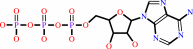 ATP
ATP
|
=
|
O-phospho-L-seryl-[protein]
|
+
|
 ADP
ADP
|
+
|
H(+)
|
|
|
|
|
|
|
L-threonyl-[protein]
|
+
|
ATP
|
=
|
O-phospho-L-threonyl-[protein]
|
+
|
ADP
|
+
|
H(+)
|
|
|
|
|
|
|
L-tyrosyl-[protein]
|
+
|
ATP
|
=
|
O-phospho-L-tyrosyl-[protein]
|
+
|
ADP
|
+
|
H(+)
|
|
|
|
|
|
|
|
|
|
|
|
|
Molecule diagrams generated from .mol files obtained from the
KEGG ftp site
|
|
|
|
|
|
|
|
|
|
|
|
|
|
 |
|
|
|
|
|
|
| |
|
|
| |
|
DOI no:
|
J Mol Biol
314:563-575
(2001)
|
|
PubMed id:
|
|
|
|
|
|
| |
|
Solution structures of two FHA1-phosphothreonine peptide complexes provide insight into the structural basis of the ligand specificity of FHA1 from yeast Rad53.
|
|
C.Yuan,
S.Yongkiettrakul,
I.J.Byeon,
S.Zhou,
M.D.Tsai.
|
|
|
|
|
| |
ABSTRACT
|
|
|
|
| |
|
|
Rad53, a yeast checkpoint protein involved in regulating the repair of DNA
damage, contains two forkhead-associated domains, FHA1 and FHA2. Previous
combinatorial library screening has shown that FHA1 strongly selects peptides
containing a pTXXD motif. Subsequent location of this motif within the sequence
of Rad9, the target protein, coupled with spectroscopic analysis has led to
identification of a tight binding sequence that is likely the binding site of
FHA1: (188)SLEV(pT)EADATFVQ(200). We present solution structures of FHA1 in
complex with this pT-peptide and with another Rad9-derived pT-peptide that has
ca 30-fold lower affinity, (148)KKMTFQ(pT)PTDPLE(160). Both complexes showed
intermolecular NOEs predominantly between three peptide residues (pT, +1, and +2
residues) and five FHA1 residues (S82, R83, S85, T106, and N107). Furthermore,
the following interactions were implicated on the basis of chemical shift
perturbations and structural analysis: the phosphate group of the pT residue
with the side-chain amide group of N86 and the guanidino group of R70, and the
carboxylate group of Asp (at the +3 position) with the guanidino group of R83.
The generated structures revealed a similar binding mode adopted by these two
peptides, suggesting that pT and the +3 residue Asp are the major contributors
to binding affinity and specificity, while +1 and +2 residues could provide
additional fine-tuning. It was also shown that FHA1 does not bind to the
corresponding pS-peptides or a related pY-peptide. We suggest that
differentiation between pT and pS-peptides by FHA1 can be attributed to
hydrophobic interactions between the methyl group of the pT residue and the
aliphatic protons of R83, S85, and T106 from FHA1.
|
|
|
|
|
|
| |
Selected figure(s)
|
|
|
|
| |
|
|

|
|

|
|
Figure 5.
Figure 5. Stereoview of 20 overlaid structures of (a)
FHA1-pT2 and (b) FHA1-pT1. The C^a traces of FHA1 include
residues from 28 to 157, and only the heavy atoms of residues pT
through the +3 position are shown. The phosphate groups are
highlighted in red.
|
|
Figure 6.
Figure 6. Charge distribution at the surface of FHA1.
Positive, negative, and neutral potentials are blue, red, and
white, respectively.
|
|
|
|
|
|
| |
The above figures are
reprinted
by permission from Elsevier:
J Mol Biol
(2001,
314,
563-575)
copyright 2001.
|
|
| |
Figures were
selected
by the author.
|
|
|
|
|
|
|
|
|
|
|
|
|
|
|
|
 |
 |
 |
|
Literature references that cite this PDB file's key reference
|
|
|
| |
PubMed id
|
|
Reference
|
|
|
|
|
|
C.A.King,
and
P.Bradley
(2010).
Structure-based prediction of protein-peptide specificity in Rosetta.
|
| |
Proteins,
78,
3437-3449.
|
|
|
|
|
|
|
S.Pennell,
S.Westcott,
M.Ortiz-Lombardía,
D.Patel,
J.Li,
T.J.Nott,
D.Mohammed,
R.S.Buxton,
M.B.Yaffe,
C.Verma,
and
S.J.Smerdon
(2010).
Structural and functional analysis of phosphothreonine-dependent FHA domain interactions.
|
| |
Structure,
18,
1587-1595.
|
|
|
PDB codes:
|
|
|
|
|
|
|
|
M.A.Brooks,
A.Dziembowski,
S.Quevillon-Cheruel,
V.Henriot,
C.Faux,
H.van Tilbeurgh,
and
B.Séraphin
(2009).
Structure of the yeast Pml1 splicing factor and its integration into the RES complex.
|
| |
Nucleic Acids Res,
37,
129-143.
|
|
|
PDB code:
|
|
|
|
|
|
|
|
C.C.Lin,
Y.S.Huoh,
K.R.Schmitz,
L.E.Jensen,
and
K.M.Ferguson
(2008).
Pellino proteins contain a cryptic FHA domain that mediates interaction with phosphorylated IRAK1.
|
| |
Structure,
16,
1806-1816.
|
|
|
PDB codes:
|
|
|
|
|
|
|
|
W.Kelly,
and
M.Stumpf
(2008).
Protein-protein interactions: from global to local analyses.
|
| |
Curr Opin Biotechnol,
19,
396-403.
|
|
|
|
|
|
|
X.Liang,
and
S.R.Van Doren
(2008).
Mechanistic insights into phosphoprotein-binding FHA domains.
|
| |
Acc Chem Res,
41,
991-999.
|
|
|
|
|
|
|
G.Guillemain,
E.Ma,
S.Mauger,
S.Miron,
R.Thai,
R.Guérois,
F.Ochsenbein,
and
M.C.Marsolier-Kergoat
(2007).
Mechanisms of checkpoint kinase Rad53 inactivation after a double-strand break in Saccharomyces cerevisiae.
|
| |
Mol Cell Biol,
27,
3378-3389.
|
|
|
|
|
|
|
Y.Tanaka,
M.Kuroda,
Y.Yasutake,
M.Yao,
K.Tsumoto,
N.Watanabe,
T.Ohta,
and
I.Tanaka
(2007).
Crystal structure analysis reveals a novel forkhead-associated domain of ESAT-6 secretion system C protein in Staphylococcus aureus.
|
| |
Proteins,
69,
659-664.
|
|
|
PDB code:
|
|
|
|
|
|
|
|
I.J.Byeon,
H.Li,
H.Song,
A.M.Gronenborn,
and
M.D.Tsai
(2005).
Sequential phosphorylation and multisite interactions characterize specific target recognition by the FHA domain of Ki67.
|
| |
Nat Struct Mol Biol,
12,
987-993.
|
|
|
PDB code:
|
|
|
|
|
|
|
|
Z.Ding,
G.I.Lee,
X.Liang,
F.Gallazzi,
A.Arunima,
and
S.R.Van Doren
(2005).
PhosphoThr peptide binding globally rigidifies much of the FHA domain from Arabidopsis receptor kinase-associated protein phosphatase.
|
| |
Biochemistry,
44,
10119-10134.
|
|
|
|
|
|
|
J.M.Sidorova,
and
L.L.Breeden
(2003).
Rad53 checkpoint kinase phosphorylation site preference identified in the Swi6 protein of Saccharomyces cerevisiae.
|
| |
Mol Cell Biol,
23,
3405-3416.
|
|
|
|
|
|
|
M.D.Tsai
(2002).
FHA: a signal transduction domain with diverse specificity and function.
|
| |
Structure,
10,
887-888.
|
|
|
|
|
|
The most recent references are shown first.
Citation data come partly from CiteXplore and partly
from an automated harvesting procedure. Note that this is likely to be
only a partial list as not all journals are covered by
either method. However, we are continually building up the citation data
so more and more references will be included with time.
Where a reference describes a PDB structure, the PDB
codes are
shown on the right.
|
|


 Links
Links


