 |
PDBsum entry 1et0

|
|
|
|
|
 |
Contents |
 |
|
|
|
|
|
|
|
|
|
|
|
|
* Residue conservation analysis
|
|
|
|
|
|
|
|
|
|
|
Enzyme class:
|
|
E.C.4.1.3.38
- aminodeoxychorismate lyase.
|
|
|
|
|
|
|
Pathway:
|
|
Folate Biosynthesis (late stages)
|
|
|
|
|
|
Reaction:
|
|
4-amino-4-deoxychorismate = 4-aminobenzoate + pyruvate + H+
|
|
|
|
|
|
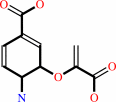 4-amino-4-deoxychorismate
|
=
|
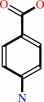 4-aminobenzoate
|
+
|
 pyruvate
|
+
|
H(+)
|
|
|
|
|
|
|
|
|
|
Cofactor:
|
|
Pyridoxal 5'-phosphate
|
|
|
|
|
|
Pyridoxal 5'-phosphate
Bound ligand (Het Group name =
PLP)
matches with 93.75% similarity
|
|
|
|
|
|
|
Molecule diagrams generated from .mol files obtained from the
KEGG ftp site
|
|
|
|
|
|
|
|
|
|
|
|
|
|
 |
|
|
|
|
|
|
| |
|
|
| |
|
|
J Biochem (tokyo)
128:29-38
(2000)
|
|
PubMed id:
|
|
|
|
|
|
| |
|
Three-dimensional structure of 4-amino-4-deoxychorismate lyase from Escherichia coli.
|
|
T.Nakai,
H.Mizutani,
I.Miyahara,
K.Hirotsu,
S.Takeda,
K.H.Jhee,
T.Yoshimura,
N.Esaki.
|
|
|
|
|
| |
ABSTRACT
|
|
|
|
| |
|
|
4-Amino-4-deoxychorismate lyase (ADCL) is a member of the fold-type IV of PLP
dependent enzymes that converts 4-amino-4-deoxychorismate (ADC) to
p-aminobenzoate and pyruvate. The crystal structure of ADCL from Escherichia
coli has been solved using MIR phases in combination with density modification.
The structure has been refined to an R-factor of 20.6% at 2.2 A resolution. The
enzyme is a homo dimer with a crystallographic twofold axis, and the polypeptide
chain is folded into small and large domains with an interdomain loop. The
coenzyme, pyridoxal 5'-phosphate, resides at the domain interface, its re-face
facing toward the protein. Although the main chain folding of the active site is
homologous to those of D-amino acid and L-branched-chain amino acid
aminotransferases, no residues in the active site are conserved among them
except for Arg59, Lys159, and Glu193, which directly interact with the coenzyme
and play critical roles in the catalytic functions. ADC was modeled into the
active site of the unliganded enzyme on the basis of the X-ray structures of the
unliganded and liganded forms in the D-amino acid and L-branched-chain amino
acid aminotransferases. According to this model, the carboxylates of ADC are
recognized by Asn256, Arg107, and Lys97, and the cyclohexadiene moiety makes van
der Waals contact with the side chain of Leu258. ADC forms a Schiff base with
PLP to release the catalytic residue Lys159, which forms a hydrogen bond with
Thr38. The neutral amino group of Lys159 eliminates the a-proton of ADC to give
a quinonoid intermediate to release a pyruvate in accord with the proton
transfer from Thr38 to the olefin moiety of ADC.
|
|
|
|
|
|
|
|
|
|
|
|
|
|
|
|
|
|
 |
 |
 |
|
Literature references that cite this PDB file's key reference
|
|
|
| |
PubMed id
|
|
Reference
|
|
|
|
|
|
S.M.Hashimi,
and
R.G.Birch
(2010).
Functional analysis of genes for benzoate metabolism in the albicidin biosynthetic region of Xanthomonas albilineans.
|
| |
Appl Microbiol Biotechnol,
87,
1475-1485.
|
|
|
|
|
|
|
J.Botet,
L.Mateos,
J.L.Revuelta,
and
M.A.Santos
(2007).
A chemogenomic screening of sulfanilamide-hypersensitive Saccharomyces cerevisiae mutants uncovers ABZ2, the gene encoding a fungal aminodeoxychorismate lyase.
|
| |
Eukaryot Cell,
6,
2102-2111.
|
|
|
|
|
|
|
K.Hirotsu,
M.Goto,
A.Okamoto,
and
I.Miyahara
(2005).
Dual substrate recognition of aminotransferases.
|
| |
Chem Rec,
5,
160-172.
|
|
|
|
|
|
|
G.J.Basset,
S.Ravanel,
E.P.Quinlivan,
R.White,
J.J.Giovannoni,
F.Rébeillé,
B.P.Nichols,
K.Shinozaki,
M.Seki,
J.F.Gregory,
and
A.D.Hanson
(2004).
Folate synthesis in plants: the last step of the p-aminobenzoate branch is catalyzed by a plastidial aminodeoxychorismate lyase.
|
| |
Plant J,
40,
453-461.
|
|
|
|
|
|
|
N.Yennawar,
J.Dunbar,
M.Conway,
S.Hutson,
and
G.Farber
(2001).
The structure of human mitochondrial branched-chain aminotransferase.
|
| |
Acta Crystallogr D Biol Crystallogr,
57,
506-515.
|
|
|
PDB codes:
|
|
|
|
|
|
|
The most recent references are shown first.
Citation data come partly from CiteXplore and partly
from an automated harvesting procedure. Note that this is likely to be
only a partial list as not all journals are covered by
either method. However, we are continually building up the citation data
so more and more references will be included with time.
Where a reference describes a PDB structure, the PDB
codes are
shown on the right.
|
|


 Links
Links


