|
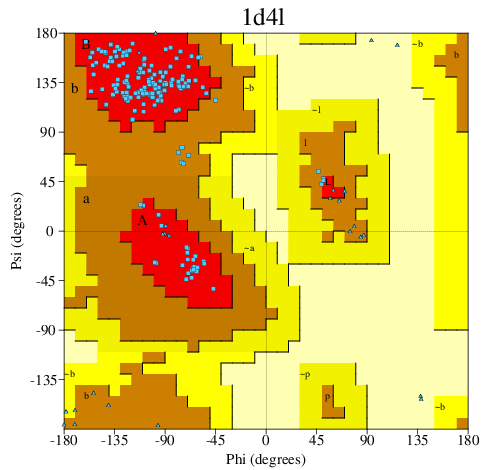
PDBsum entry 1d4l

|
|
|
|
|
 |
Contents |
 |
|
|
|
|
|
|
|
|
|
|
|
|
* Residue conservation analysis
|
|
|
|
|
References listed in PDB file
|
|
|
Key reference
|
|
|
Title
|
|
Synthesis, Stability, Antiviral activity, And protease-Bound structures of substrate-Mimicking constrained macrocyclic inhibitors of HIV-1 protease.
|
|
|
Authors
|
|
J.D.Tyndall,
R.C.Reid,
D.P.Tyssen,
D.K.Jardine,
B.Todd,
M.Passmore,
D.R.March,
L.K.Pattenden,
D.A.Bergman,
D.Alewood,
S.H.Hu,
P.F.Alewood,
C.J.Birch,
J.L.Martin,
D.P.Fairlie.
|
|
|
Ref.
|
|
J Med Chem, 2000,
43,
3495-3504.
[DOI no: ]
|
|
|
PubMed id
|
|
|
|
|
|
Abstract
|
|
|
Three new peptidomimetics (1-3) have been developed with highly stable and
conformationally constrained macrocyclic components that replace tripeptide
segments of protease substrates. Each compound inhibits both HIV-1 protease and
viral replication (HIV-1, HIV-2) at nanomolar concentrations without
cytotoxicity to uninfected cells below 10 microM. Their activities against HIV-1
protease (K(i) 1.7 nM (1), 0.6 nM (2), 0.3 nM (3)) are 1-2 orders of magnitude
greater than their antiviral potencies against HIV-1-infected primary peripheral
blood mononuclear cells (IC(50) 45 nM (1), 56 nM (2), 95 nM (3)) or
HIV-1-infected MT2 cells (IC(50) 90 nM (1), 60 nM (2)), suggesting suboptimal
cellular uptake. However their antiviral potencies are similar to those of
indinavir and amprenavir under identical conditions. There were significant
differences in their capacities to inhibit the replication of HIV-1 and HIV-2 in
infected MT2 cells, 1 being ineffective against HIV-2 while 2 was equally
effective against both virus types. Evidence is presented that 1 and 2 inhibit
cleavage of the HIV-1 structural protein precursor Pr55(gag) to p24 in virions
derived from chronically infected cells, consistent with inhibition of the viral
protease in cells. Crystal structures refined to 1.75 A (1) and 1.85 A (2) for
two of the macrocyclic inhibitors bound to HIV-1 protease establish structural
mimicry of the tripeptides that the cycles were designed to imitate. Structural
comparisons between protease-bound macrocyclic inhibitors, VX478 (amprenavir),
and L-735,524 (indinavir) show that their common acyclic components share the
same space in the active site of the enzyme and make identical interactions with
enzyme residues. This substrate-mimicking minimalist approach to drug design
could have benefits in the context of viral resistance, since mutations which
induce inhibitor resistance may also be those which prevent substrate processing.
|
|
|
Secondary reference #1
|
|
|
Title
|
|
Molecular recognition of macrocyclic peptidomimetic inhibitors by HIV-1 protease.
|
|
|
Authors
|
|
J.L.Martin,
J.Begun,
A.Schindeler,
W.A.Wickramasinghe,
D.Alewood,
P.F.Alewood,
D.A.Bergman,
R.I.Brinkworth,
G.Abbenante,
D.R.March,
R.C.Reid,
D.P.Fairlie.
|
|
|
Ref.
|
|
Biochemistry, 1999,
38,
7978-7988.
[DOI no: ]
|
|
|
PubMed id
|
|
|
|
|
|
|
|
|
Secondary reference #2
|
|
|
Title
|
|
Substrate based cyclic peptidomimetics of phe ile val that inhibit HIV-1 protease using a novel enzyme binding mode.
|
|
|
Authors
|
|
D.March,
G.Abbenante,
D.Bergman,
R.I.Brinkworth,
W.Wickramasinghe,
J.Begun,
J.L.Martin,
D.P.Fairlie.
|
|
|
Ref.
|
|
j am chem soc, 1996,
118,
3375.
|
|
|
|
Secondary reference #3
|
|
|
Title
|
|
Regioselective structural and functional mimicry of peptides: design of hydrolytically stable cyclic peptidomimetic inhibitors of HIV-1 protease.
|
|
|
Authors
|
|
G.Abbenante,
D.March,
D.Bergman,
P. A.Hunt,
B.Garnham,
R.J.Dancer,
J.L.Martin,
D.P.Fairlie.
|
|
|
Ref.
|
|
j am chem soc, 1995,
117,
10220.
|
|
|
|
|
|
|
|