 |
PDBsum entry 1bi9

|
|
|
|
|
|

|

|

|

|
|

|
|

|
|

|
|

|
|

|
|

|
|
|
 |

|

|
|
|
|
|
|
|
|
|
|
|
|
|
|
|
|
|
|
|
|
|
|
|
|
|
|
|
|
|
|
|
|
|
|
|
Aldehyde dehydrogenase
|
PDB id
|
|
|
|
1bi9
|
|
|
|
|
|
|
|
|
|
|
|
|
|
|

|

|

|
|
|
|
|
|
|
|
 |
Contents |
 |
|
|
|
|
|
|
|
|
|
|
|
|
|
|
* Residue conservation analysis
|
|
|
|
|
|
|
|
|
|
|
Enzyme class:
|
|
E.C.1.2.1.36
- retinal dehydrogenase.
|
|
|
|
|
|
|
Reaction:
|
|
retinal + NAD+ + H2O = retinoate + NADH + 2 H+
|
|
|
|
|
|
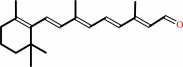 retinal
|
+
|
NAD(+)
Bound ligand (Het Group name = )
matches with 61.36% similarity
|
+
|
H2O
|
=
|
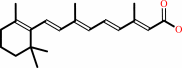 retinoate
|
+
|
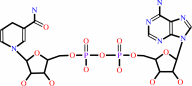 NADH
NADH
|
+
|
2
×
H(+)
|
|
|
|
|
|
|
|
|
|
Cofactor:
|
|
FAD
|
|
|
|
|
|
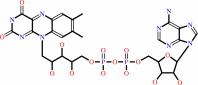 FAD
FAD
|
|
|
|
|
|
|
Molecule diagrams generated from .mol files obtained from the
KEGG ftp site
|
|
|
|
|
|
|
|
|
|
|
|
|
|
 |
|
|
|
|
|
|
| |
|
|
| |
|
DOI no:
|
Biochemistry
38:6003-6011
(1999)
|
|
PubMed id:
|
|
|
|
|
|
| |
|
The structure of retinal dehydrogenase type II at 2.7 A resolution: implications for retinal specificity.
|
|
A.L.Lamb,
M.E.Newcomer.
|
|
|
|
|
| |
ABSTRACT
|
|
|
|
| |
|
|
Retinoic acid, a hormonally active form of vitamin A, is produced in vivo in a
two step process: retinol is oxidized to retinal and retinal is oxidized to
retinoic acid. Retinal dehydrogenase type II (RalDH2) catalyzes this last step
in the production of retinoic acid in the early embryo, possibly producing this
putative morphogen to initiate pattern formation. The enzyme is also found in
the adult animal, where it is expressed in the testis, lung, and brain among
other tissues. The crystal structure of retinal dehydrogenase type II
cocrystallized with nicotinamide adenine dinucleotide (NAD) has been determined
at 2.7 A resolution. The structure was solved by molecular replacement using the
crystal structure of a mitochondrial aldehyde dehydrogenase (ALDH2) as a model.
Unlike what has been described for the structures of two aldehyde dehydrogenases
involved in the metabolism of acetaldehyde, the substrate access channel is not
a preformed cavity into which acetaldehyde can readily diffuse. Retinal
dehydrogenase appears to utilize a disordered loop in the substrate access
channel to discriminate between retinaldehyde and short-chain aldehydes.
|
|
|
|
|
|
|
|
|
|
|
|
|
|
|
|
|
|
 |
 |
 |
|
Literature references that cite this PDB file's key reference
|
|
|
| |
PubMed id
|
|
Reference
|
|
|
|
|
|
T.J.Sobreira,
F.Marlétaz,
M.Simões-Costa,
D.Schechtman,
A.C.Pereira,
F.Brunet,
S.Sweeney,
A.Pani,
J.Aronowicz,
C.J.Lowe,
B.Davidson,
V.Laudet,
M.Bronner,
P.S.de Oliveira,
M.Schubert,
and
J.Xavier-Neto
(2011).
Structural shifts of aldehyde dehydrogenase enzymes were instrumental for the early evolution of retinoid-dependent axial patterning in metazoans.
|
| |
Proc Natl Acad Sci U S A,
108,
226-231.
|
|
|
|
|
|
|
S.Perez-Miller,
H.Younus,
R.Vanam,
C.H.Chen,
D.Mochly-Rosen,
and
T.D.Hurley
(2010).
Alda-1 is an agonist and chemical chaperone for the common human aldehyde dehydrogenase 2 variant.
|
| |
Nat Struct Mol Biol,
17,
159-164.
|
|
|
PDB codes:
|
|
|
|
|
|
|
|
T.Negishi,
Y.Nagai,
Y.Asaoka,
M.Ohno,
M.Namae,
H.Mitani,
T.Sasaki,
N.Shimizu,
S.Terai,
I.Sakaida,
H.Kondoh,
T.Katada,
M.Furutani-Seiki,
and
H.Nishina
(2010).
Retinoic acid signaling positively regulates liver specification by inducing wnt2bb gene expression in medaka.
|
| |
Hepatology,
51,
1037-1045.
|
|
|
|
|
|
|
M.Pavan,
V.F.Ruiz,
F.A.Silva,
T.J.Sobreira,
R.M.Cravo,
M.Vasconcelos,
L.P.Marques,
S.M.Mesquita,
J.E.Krieger,
A.A.Lopes,
P.S.Oliveira,
A.C.Pereira,
and
J.Xavier-Neto
(2009).
ALDH1A2 (RALDH2) genetic variation in human congenital heart disease.
|
| |
BMC Med Genet,
10,
113.
|
|
|
|
|
|
|
R.S.Holmes
(2009).
Opossum aldehyde dehydrogenases: evidence for four ALDH1A1-like genes on chromosome 6 and ALDH1A2 and ALDH1A3 genes on chromosome 1.
|
| |
Biochem Genet,
47,
609-624.
|
|
|
|
|
|
|
S.A.Krupenko
(2009).
FDH: an aldehyde dehydrogenase fusion enzyme in folate metabolism.
|
| |
Chem Biol Interact,
178,
84-93.
|
|
|
|
|
|
|
J.J.Tanner
(2008).
Structural biology of proline catabolism.
|
| |
Amino Acids,
35,
719-730.
|
|
|
|
|
|
|
S.A.Marchitti,
C.Brocker,
D.Stagos,
and
V.Vasiliou
(2008).
Non-P450 aldehyde oxidizing enzymes: the aldehyde dehydrogenase superfamily.
|
| |
Expert Opin Drug Metab Toxicol,
4,
697-720.
|
|
|
|
|
|
|
F.Collard,
D.Vertommen,
J.Fortpied,
G.Duester,
and
E.Van Schaftingen
(2007).
Identification of 3-deoxyglucosone dehydrogenase as aldehyde dehydrogenase 1A1 (retinaldehyde dehydrogenase 1).
|
| |
Biochimie,
89,
369-373.
|
|
|
|
|
|
|
H.Donato,
N.I.Krupenko,
Y.Tsybovsky,
and
S.A.Krupenko
(2007).
10-formyltetrahydrofolate dehydrogenase requires a 4'-phosphopantetheine prosthetic group for catalysis.
|
| |
J Biol Chem,
282,
34159-34166.
|
|
|
|
|
|
|
L.Di Costanzo,
G.A.Gomez,
and
D.W.Christianson
(2007).
Crystal structure of lactaldehyde dehydrogenase from Escherichia coli and inferences regarding substrate and cofactor specificity.
|
| |
J Mol Biol,
366,
481-493.
|
|
|
PDB codes:
|
|
|
|
|
|
|
|
F.B.Rahman,
and
K.Yamauchi
(2006).
Uncompetitive inhibition of Xenopus laevis aldehyde dehydrogenase 1A1 by divalent cations.
|
| |
Zoolog Sci,
23,
239-244.
|
|
|
|
|
|
|
J.D.Larson,
J.L.Jenkins,
J.P.Schuermann,
Y.Zhou,
D.F.Becker,
and
J.J.Tanner
(2006).
Crystal structures of the DNA-binding domain of Escherichia coli proline utilization A flavoprotein and analysis of the role of Lys9 in DNA recognition.
|
| |
Protein Sci,
15,
2630-2641.
|
|
|
PDB codes:
|
|
|
|
|
|
|
|
E.Inagaki,
H.Takahashi,
C.Kuroishi,
and
T.H.Tahirov
(2005).
Crystallization and avoiding the problem of hemihedral twinning in crystals of Delta1-pyrroline-5-carboxylate dehydrogenase from Thermus thermophilus.
|
| |
Acta Crystallogr Sect F Struct Biol Cryst Commun,
61,
609-611.
|
|
|
|
|
|
|
H.N.Larson,
H.Weiner,
and
T.D.Hurley
(2005).
Disruption of the coenzyme binding site and dimer interface revealed in the crystal structure of mitochondrial aldehyde dehydrogenase "Asian" variant.
|
| |
J Biol Chem,
280,
30550-30556.
|
|
|
PDB code:
|
|
|
|
|
|
|
|
T.Bordelon,
S.K.Montegudo,
S.Pakhomova,
M.L.Oldham,
and
M.E.Newcomer
(2004).
A disorder to order transition accompanies catalysis in retinaldehyde dehydrogenase type II.
|
| |
J Biol Chem,
279,
43085-43091.
|
|
|
|
|
|
|
F.A.Mic,
R.J.Haselbeck,
A.E.Cuenca,
and
G.Duester
(2002).
Novel retinoic acid generating activities in the neural tube and heart identified by conditional rescue of Raldh2 null mutant mice.
|
| |
Development,
129,
2271-2282.
|
|
|
|
|
|
|
J.Russo,
A.Barnes,
K.Berger,
J.Desgrosellier,
J.Henderson,
A.Kanters,
and
L.Merkov
(2002).
4-(N,N-dipropylamino)benzaldehyde inhibits the oxidation of all-trans retinal to all-trans retinoic acid by ALDH1A1, but not the differentiation of HL-60 promyelocytic leukemia cells exposed to all-trans retinal.
|
| |
BMC Pharmacol,
2,
4.
|
|
|
|
|
|
|
K.Niederreither,
J.Vermot,
V.Fraulob,
P.Chambon,
and
P.Dolle
(2002).
Retinaldehyde dehydrogenase 2 (RALDH2)- independent patterns of retinoic acid synthesis in the mouse embryo.
|
| |
Proc Natl Acad Sci U S A,
99,
16111-16116.
|
|
|
|
|
|
|
S.Marchal,
and
G.Branlant
(2002).
Characterization of the amino acids involved in substrate specificity of nonphosphorylating glyceraldehyde-3-phosphate dehydrogenase from Streptococcus mutans.
|
| |
J Biol Chem,
277,
39235-39242.
|
|
|
|
|
|
|
V.Montplaisir,
N.C.Lan,
J.Guimond,
C.Savineau,
P.V.Bhat,
and
S.Mader
(2002).
Recombinant class I aldehyde dehydrogenases specific for all-trans- or 9-cis-retinal.
|
| |
J Biol Chem,
277,
17486-17492.
|
|
|
|
|
|
|
D.W.Crabb,
J.Pinairs,
R.Hasanadka,
M.Fang,
M.A.Leo,
C.S.Lieber,
H.Tsukamoto,
K.Motomura,
T.Miyahara,
M.Ohata,
W.Bosron,
S.Sanghani,
N.Kedishvili,
H.Shiraishi,
H.Yokoyama,
M.Miyagi,
H.Ishii,
I.Bergheim,
I.Menzl,
A.Parlesak,
and
C.Bode
(2001).
Alcohol and retinoids.
|
| |
Alcohol Clin Exp Res,
25,
207S-217S.
|
|
|
|
|
|
|
G.Duester
(2001).
Genetic dissection of retinoid dehydrogenases.
|
| |
Chem Biol Interact,
130,
469-480.
|
|
|
|
|
|
|
J.Hempel,
I.Kuo,
J.Perozich,
B.C.Wang,
R.Lindahl,
and
H.Nicholas
(2001).
Aldehyde dehydrogenase. Maintaining critical active site geometry at motif 8 in the class 3 enzyme.
|
| |
Eur J Biochem,
268,
722-726.
|
|
|
|
|
|
|
K.Yamauchi,
and
J.R.Tata
(2001).
Characterization of Xenopus cytosolic thyroid-hormone-binding protein (xCTBP) with aldehyde dehydrogenase activity.
|
| |
Chem Biol Interact,
130,
309-321.
|
|
|
|
|
|
|
L.Zhang,
B.Ahvazi,
R.Szittner,
A.Vrielink,
and
E.Meighen
(2001).
Differences in nucleotide specificity and catalytic mechanism between Vibrio harveyi aldehyde dehydrogenase and other members of the aldehyde dehydrogenase superfamily.
|
| |
Chem Biol Interact,
130,
29-38.
|
|
|
|
|
|
|
T.D.Hurley,
S.Perez-Miller,
and
H.Breen
(2001).
Order and disorder in mitochondrial aldehyde dehydrogenase.
|
| |
Chem Biol Interact,
130,
3.
|
|
|
PDB code:
|
|
|
|
|
|
|
|
E.C.Kathmann,
S.Naylor,
and
J.J.Lipsky
(2000).
Rat liver constitutive and phenobarbital-inducible cytosolic aldehyde dehydrogenases are highly homologous proteins that function as distinct isozymes.
|
| |
Biochemistry,
39,
11170-11176.
|
|
|
|
|
|
|
G.Duester
(2000).
Families of retinoid dehydrogenases regulating vitamin A function: production of visual pigment and retinoic acid.
|
| |
Eur J Biochem,
267,
4315-4324.
|
|
|
|
|
|
|
J.Perozich,
I.Kuo,
B.C.Wang,
J.S.Boesch,
R.Lindahl,
and
J.Hempel
(2000).
Shifting the NAD/NADP preference in class 3 aldehyde dehydrogenase.
|
| |
Eur J Biochem,
267,
6197-6203.
|
|
|
|
|
|
|
L.Zhang,
B.Ahvazi,
R.Szittner,
A.Vrielink,
and
E.Meighen
(2000).
A histidine residue in the catalytic mechanism distinguishes Vibrio harveyi aldehyde dehydrogenase from other members of the aldehyde dehydrogenase superfamily.
|
| |
Biochemistry,
39,
14409-14418.
|
|
|
|
|
|
|
L.Ni,
J.Zhou,
T.D.Hurley,
and
H.Weiner
(1999).
Human liver mitochondrial aldehyde dehydrogenase: three-dimensional structure and the restoration of solubility and activity of chimeric forms.
|
| |
Protein Sci,
8,
2784-2790.
|
|
|
PDB code:
|
|
|
|
|
|
|
The most recent references are shown first.
Citation data come partly from CiteXplore and partly
from an automated harvesting procedure. Note that this is likely to be
only a partial list as not all journals are covered by
either method. However, we are continually building up the citation data
so more and more references will be included with time.
Where a reference describes a PDB structure, the PDB
codes are
shown on the right.
|
|


 Links
Links


