|
PDBsum entry 7nip

|
|
|
|
|
|

|

|

|

|
|

|
|

|
|
|
 |

|

|
|
|
|
|
|
|
|
|
|
|
|
|
|
|
|
|
|
|
|
|
|
|
|
|
|
|
|
|
|
|
Structural protein
|
PDB id
|
|
|
|
7nip
|
|
|
|
|
|
|
|
|
|
|
|
|
|
|

|

|

|
|
|
|
|
|
|
|
|
Enzyme class:
|
|
E.C.2.7.11.1
- non-specific serine/threonine protein kinase.
|
|
|
|
|
|
|
Reaction:
|
|
|
1.
|
L-seryl-[protein] + ATP = O-phospho-L-seryl-[protein] + ADP + H+
|
|
2.
|
L-threonyl-[protein] + ATP = O-phospho-L-threonyl-[protein] + ADP + H+
|
|
|
|
|
|
|
L-seryl-[protein]
|
+
|
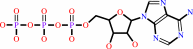 ATP
ATP
|
=
|
O-phospho-L-seryl-[protein]
|
+
|
 ADP
ADP
|
+
|
H(+)
|
|
|
|
|
|
|
L-threonyl-[protein]
|
+
|
ATP
|
=
|
O-phospho-L-threonyl-[protein]
|
+
|
ADP
|
+
|
H(+)
|
|
|
|
|
|
|
|
|
|
|
|
|
Molecule diagrams generated from .mol files obtained from the
KEGG ftp site
|
|
|
|
|
|
|
|
|
|
|
|
|
|
 |
|
|
|
|
|
|
| |
|
|
| |
|
DOI no:
|
J Mol Biol
433:166901-166901
(2021)
|
|
PubMed id:
|
|
|
|
|
|
| |
|
Molecular Characterisation of Titin N2A and Its Binding of CARP Reveals a Titin/Actin Cross-linking Mechanism.
|
|
T.Zhou,
J.R.Fleming,
S.Lange,
A.L.Hessel,
J.Bogomolovas,
C.Stronczek,
D.Grundei,
M.Ghassemian,
A.Biju,
E.Börgeson,
B.Bullard,
W.A.Linke,
J.Chen,
M.Kovermann,
O.Mayans.
|
|
|
|
|
| |
ABSTRACT
|
|
|
|
| |
|
|
Striated muscle responds to mechanical overload by rapidly up-regulating the
expression of the cardiac ankyrin repeat protein, CARP, which then targets the
sarcomere by binding to titin N2A in the I-band region. To date, the role of
this interaction in the stress response of muscle remains poorly understood.
Here, we characterise the molecular structure of the CARP-receptor site in titin
(UN2A) and its binding of CARP. We find that titin UN2A contains a central
three-helix bundle fold (ca 45 residues in length) that is joined to N- and
C-terminal flanking immunoglobulin domains by long, flexible linkers with
partial helical content. CARP binds titin by engaging an α-hairpin in the
three-helix fold of UN2A, the C-terminal linker sequence, and the BC loop in
Ig81, which jointly form a broad binding interface. Mutagenesis showed that the
CARP/N2A association withstands sequence variations in titin N2A and we use this
information to evaluate 85 human single nucleotide variants. In addition, actin
co-sedimentation, co-transfection in C2C12 cells, proteomics on heart lysates,
and the mechanical response of CARP-soaked myofibrils imply that CARP induces
the cross-linking of titin and actin myofilaments, thereby increasing myofibril
stiffness. We conclude that CARP acts as a regulator of force output in the
sarcomere that preserves muscle mechanical performance upon overload stress.
|
|
|
|
|
|
|
|
|
|
|
|
|
|
|
|
|
|
 |
 |
 |
|


 Links
Links