 |
PDBsum entry 6pvb

|
|
|
|
|
|

|

|

|

|
|

|
|

|
|

|
|

|
|

|
|
|
 |

|

|
|
|
|
|
|
|
|
|
|
|
|
|
|
|
|
|
|
|
|
|
|
|
|
|
|
|
|
|
|
|
|
|
|
Transferase/transferase inhibitor
|
PDB id
|
|
|
|
6pvb
|
|
|
|
|
|
|
|
|
|
|
|
|
|
|

|

|

|
|
|
|
|
|
|
PDB id:
|
|
|
|
| Name: |
|
Transferase/transferase inhibitor
|
|
|
Title:
|
|
The structure of ntmt1 in complex with compound 6
|
|
Structure:
|
|
N-terminal xaa-pro-lys n-methyltransferase 1. Chain: b. Synonym: alpha n-terminal protein methyltransferase 1a, methyltransferase-like protein 11a,n-terminal rcc1 methyltransferase, x-pro-lys n-terminal protein methyltransferase 1a,ntm1a. Engineered: yes. Amino group-()-(2~{s})-2-azanylpropanal-()-isoleucine-()- arginine-()-lysine-()-proline-()-amino-acetaldehyde-()-9-(5-{[(3s)-3- amino-3-carboxypropyl](pentyl)amino}-5-deoxy-beta-l-
|
|
Source:
|
|
Homo sapiens. Human. Organism_taxid: 9606. Gene: ntmt1, c9orf32, mettl11a, nrmt, nrmt1, ad-003. Expressed in: escherichia coli bl21(de3). Expression_system_taxid: 469008. Synthetic: yes. Synthetic construct. Organism_taxid: 32630
|
|
Resolution:
|
|
|
1.50Å
|
R-factor:
|
0.206
|
R-free:
|
0.224
|
|
|
Authors:
|
|
N.Noinaj,D.Chen,R.Huang
|
|
Key ref:
|
|
D.Chen
et al.
(2020).
Probing the Plasticity in the Active Site of Protein N-terminal Methyltransferase 1 Using Bisubstrate Analogues.
J Med Chem,
63,
8419-8431.
PubMed id:
DOI:
|
|
|
Date:
|
|
|
20-Jul-19
|
Release date:
|
19-Aug-20
|
|
|
|
|
|
|
PROCHECK
|

|
|
|
|
|
Headers
|
|
|
|
References
|
|
|
|
|
|

|
|
Q9BV86
(NTM1A_HUMAN) -
N-terminal Xaa-Pro-Lys N-methyltransferase 1 from Homo sapiens
|
|
|
|
Seq:
Struc:
|
|
|
|
223 a.a.
225 a.a.*
|
|

|

|
|
|
|
|
|
|
|
|
|
|
|
Key: |
 |
PfamA domain |
|
|
 |
Secondary structure |
|
|
*
PDB and UniProt seqs differ
at 1 residue position (black
cross)
|
|
|
|
|
|
|
|
|
|
|
|
|
Enzyme class:
|
|
E.C.2.1.1.244
- protein N-terminal methyltransferase.
|
|
|
|
|
|
|
Reaction:
|
|
|
1.
|
N-terminal L-alanyl-L-prolyl-L-lysyl-[protein] + 3 S-adenosyl-L- methionine = N-terminal N,N,N-trimethyl-L-alanyl-L-prolyl-L-lysyl- [protein] + 3 S-adenosyl-L-homocysteine + 3 H+
|
|
2.
|
N-terminal L-seryl-L-prolyl-L-lysyl-[protein] + 3 S-adenosyl-L- methionine = N-terminal N,N,N-trimethyl-L-seryl-L-prolyl-L-lysyl- [protein] + 3 S-adenosyl-L-homocysteine + 3 H+
|
|
3.
|
N-terminal L-prolyl-L-prolyl-L-lysyl-[protein] + 2 S-adenosyl-L- methionine = N-terminal N,N-dimethyl-L-prolyl-L-prolyl-L-lysyl-[protein] + 2 S-adenosyl-L-homocysteine + 2 H+
|
|
|
|
|
|
|
N-terminal L-alanyl-L-prolyl-L-lysyl-[protein]
|
+
|
 3
×
S-adenosyl-L- methionine
3
×
S-adenosyl-L- methionine
|
=
|
N-terminal N,N,N-trimethyl-L-alanyl-L-prolyl-L-lysyl- [protein]
|
+
|
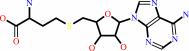 3
×
S-adenosyl-L-homocysteine
3
×
S-adenosyl-L-homocysteine
|
+
|
3
×
H(+)
Bound ligand (Het Group name = )
corresponds exactly
|
|
|
|
|
|
|
N-terminal L-seryl-L-prolyl-L-lysyl-[protein]
|
+
|
3
×
S-adenosyl-L- methionine
|
=
|
N-terminal N,N,N-trimethyl-L-seryl-L-prolyl-L-lysyl- [protein]
|
+
|
3
×
S-adenosyl-L-homocysteine
|
+
|
3
×
H(+)
Bound ligand (Het Group name = )
corresponds exactly
|
|
|
|
|
|
|
N-terminal L-prolyl-L-prolyl-L-lysyl-[protein]
|
+
|
2
×
S-adenosyl-L- methionine
|
=
|
N-terminal N,N-dimethyl-L-prolyl-L-prolyl-L-lysyl-[protein]
|
+
|
2
×
S-adenosyl-L-homocysteine
|
+
|
2
×
H(+)
Bound ligand (Het Group name = )
corresponds exactly
|
|
|
|
|
|
|
|
|
|
|
|
|
Molecule diagrams generated from .mol files obtained from the
KEGG ftp site
|
|
|
|
|
|
|
|
|
|
|
|
|
|
 |
|
|
|
|
|
|
| |
|
|
| |
|
DOI no:
|
J Med Chem
63:8419-8431
(2020)
|
|
PubMed id:
|
|
|
|
|
|
| |
|
Probing the Plasticity in the Active Site of Protein N-terminal Methyltransferase 1 Using Bisubstrate Analogues.
|
|
D.Chen,
C.Dong,
G.Dong,
K.Srinivasan,
J.Min,
N.Noinaj,
R.Huang.
|
|
|
|
|
| |
ABSTRACT
|
|
|
|
| |
|
|
The bisubstrate analogue strategy is a promising approach to develop potent and
selective inhibitors for protein methyltransferases. Herein, the interactions of
a series of bisubstrate analogues with protein N-terminal methyltransferase 1
(NTMT1) were examined to probe the molecular properties of the active site of
NTMT1. Our results indicate that a 2-C to 4-C atom linker enables its respective
bisubstrate analogue to occupy both substrate- and cofactor-binding sites of
NTMT1, but the bisubstrate analogue with a 5-C atom linker only interacts with
the substrate-binding site and functions as a substrate. Furthermore, the 4-C
atom linker is the optimal and produces the most potent inhibitor
(Ki,app = 130 ± 40 pM) for NTMT1 to date, displaying more
than 3000-fold selectivity for other methyltransferases and even for its
homologue NTMT2. This study reveals the molecular basis for the plasticity of
the active site of NTMT1. Additionally, our study outlines general guidance on
the development of bisubstrate inhibitors for any methyltransferases.
|
|
|
|
|
|
|
|
|
|
|
|
|
|
|
|
|
|
 |
 |
 |
|


 Links
Links


