 |
PDBsum entry 6pfe

|
|
|
|
|
|

|

|

|

|
|

|
|

|
|

|
|

|
|

|
|
|
 |

|

|
|
|
|
|
|
|
|
|
|
|
|
|
|
|
|
|
|
|
|
|
|
|
|
|
|
|
|
|
|
|
|
|
|
Transferase/transferase inhibitor
|
PDB id
|
|
|
|
6pfe
|
|
|
|
|
|
|
|
|
|
|
|
|
|
|

|

|

|
|
|
|
|
|
|
PDB id:
|
|
|
|
| Name: |
|
Transferase/transferase inhibitor
|
|
|
Title:
|
|
Crystal structure of ts-dhfr from cryptosporidium hominis in complex with NADPH, fdump and 2-(4-((2-amino-4-oxo-4,7-dihydro-3h-pyrrolo[2, 3-d]pyrimidin-5-yl)methyl)benzamido)-4-methoxybenzoic acid.
|
|
Structure:
|
|
Bifunctional dihydrofolate reductase-thymidylate synthase. Chain: a, b, c, d, e. Engineered: yes
|
|
Source:
|
|
Cryptosporidium hominis. Organism_taxid: 237895. Gene: chudea4_4460. Expressed in: escherichia coli bl21(de3). Expression_system_taxid: 469008. Expression_system_variant: pa-414
|
|
Resolution:
|
|
|
2.81Å
|
R-factor:
|
0.227
|
R-free:
|
0.257
|
|
|
Authors:
|
|
D.J.Czyzyk,M.Valhondo,W.L.Jorgensen,K.S.Anderson
|
|
Key ref:
|
|
D.J.Czyzyk
et al.
(2019).
Structure activity relationship towards design of cryptosporidium specific thymidylate synthase inhibitors.
Eur J Med Chem,
183,
111673.
PubMed id:
DOI:
|
|
|
Date:
|
|
|
21-Jun-19
|
Release date:
|
02-Oct-19
|
|
|
|
|
|
|
PROCHECK
|

|
|
|
|
|
Headers
|
|
|
|
References
|
|
|
|
|
|

|
|
A0A0S4TER9
(A0A0S4TER9_CRYHO) -
Bifunctional dihydrofolate reductase-thymidylate synthase from Cryptosporidium hominis
|
|
|
|
Seq:
Struc:
|
|
|
|
521 a.a.
506 a.a.
|
|

|

|
|
|
|
|
|
|
|
|
|
|
|
Key: |
 |
PfamA domain |
|
|
 |
Secondary structure |
|
|
|
|
|
|
|
|
|
|
|
|
|
Enzyme class 2:
|
|
E.C.1.5.1.3
- dihydrofolate reductase.
|
|
|
|
|
|
|
Pathway:
|
|
Folate Coenzymes
|
|
|
|
|
|
Reaction:
|
|
(6S)-5,6,7,8-tetrahydrofolate + NADP+ = 7,8-dihydrofolate + NADPH + H+
|
|
|
|
|
|
(6S)-5,6,7,8-tetrahydrofolate
|
+
|
NADP(+)
Bound ligand (Het Group name = )
corresponds exactly
|
=
|
7,8-dihydrofolate
Bound ligand (Het Group name = )
matches with 91.18% similarity
|
+
|
 NADPH
NADPH
|
+
|
H(+)
|
|
|
|
|
|
|
|
|
|
Enzyme class 3:
|
|
E.C.2.1.1.45
- thymidylate synthase.
|
|
|
|
|
|
|
Pathway:
|
|
|
|
|
|
|
|
Reaction:
|
|
dUMP + (6R)-5,10-methylene-5,6,7,8-tetrahydrofolate = 7,8-dihydrofolate + dTMP
|
|
|
|
|
|
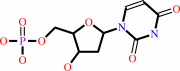 dUMP
dUMP
|
+
|
(6R)-5,10-methylene-5,6,7,8-tetrahydrofolate
Bound ligand (Het Group name = )
matches with 95.24% similarity
|
=
|
7,8-dihydrofolate
Bound ligand (Het Group name = )
matches with 91.18% similarity
|
+
|
dTMP
Bound ligand (Het Group name = )
matches with 40.82% similarity
|
|
|
|
|
|
|
|
|
|
|
|
|
Note, where more than one E.C. class is given (as above), each may
correspond to a different protein domain or, in the case of polyprotein
precursors, to a different mature protein.
|
|
|
|
Molecule diagrams generated from .mol files obtained from the
KEGG ftp site
|
|
|
|
|
|
|
|
|
|
|
|
|
|
 |
|
|
|
|
|
|
| |
|
|
| |
|
DOI no:
|
Eur J Med Chem
183:111673
(2019)
|
|
PubMed id:
|
|
|
|
|
|
| |
|
Structure activity relationship towards design of cryptosporidium specific thymidylate synthase inhibitors.
|
|
D.J.Czyzyk,
M.Valhondo,
L.Deiana,
J.Tirado-Rives,
W.L.Jorgensen,
K.S.Anderson.
|
|
|
|
|
| |
ABSTRACT
|
|
|
|
| |
|
|
Cryptosporidiosis is a human gastrointestinal disease caused by protozoans of
the genus Cryptosporidium, which can be fatal in immunocompromised individuals.
The essential enzyme, thymidylate synthase (TS), is responsible for de novo
synthesis of deoxythymidine monophosphate. The TS active site is relatively
conserved between Cryptosporidium and human enzymes. In previous work, we
identified compound 1,
(2-amino-4-oxo-4,7-dihydro-pyrrolo[2,3-d]pyrimidin-methyl-phenyl-l-glutamic
acid), as a promising selective Cryptosporidium hominis TS (ChTS) inhibitor. In
the present study, we explore the structure-activity relationship around 1
glutamate moiety by synthesizing and biochemically evaluating the inhibitory
activity of analogues against ChTS and human TS (hTS). X-Ray crystal structures
were obtained for compounds bound to both ChTS and hTS. We establish the
importance of the 2-phenylacetic acid moiety methylene linker in optimally
positioning compounds 23, 24, and 25 within the active site. Moreover, through
the comparison of structural data for 5, 14, 15, and 23 bound in both ChTS and
hTS identified that active site rigidity is a driving force in determining
inhibitor selectivity.
|
|
|
|
|
|
|
|
|
|
|
|
|
|
|
|
|
|
 |
 |
 |
|


 Links
Links


