 |
PDBsum entry 6dcf

|
|
|
|
|
|

|

|

|

|
|

|
|

|
|

|
|

|
|

|
|

|
|

|
|
|
 |

|

|
|
|
|
|
|
|
|
|
|
|
|
|
|
|
|
|
|
|
|
|
|
|
|
|
|
|
|
|
|
|
|
|
|
|
|
Transcription/DNA/antibiotic
|
PDB id
|
|
|
|
6dcf
|
|
|
|
|
|
|
|
|
|
|
|
|
|
|

|

|

|
|
|
|
|
|
|
|
 |
Contents |
 |
|
|
|
|
|
|
|
|
|
|
|
 85 a.a.
|
|
|
|
|
|
|
|
|
|
|

 219 a.a.
|
|
|
|
|
|
|
|
|
|
|
 858 a.a.
|
|
|
|
|
|
|
|
|
|
|
 1176 a.a.
|
|
|
|
|
|
|
|
|
|
|
 82 a.a.
|
|
|
|
|
|
|
|
|
|
|
 297 a.a.
|
|
|
|
|
|
|
|
|
|
|
|
|
|
|
|
|
|
|
PDB id:
|
|
|
|
| Name: |
|
Transcription/DNA/antibiotic
|
|
|
Title:
|
|
Crystal structure of a mycobacterium smegmatis transcription initiation complex with rifampicin-resistant RNA polymerase and bound to kanglemycin a
|
|
Structure:
|
|
RNA polymerase-binding protein rbpa. Chain: j. Engineered: yes. DNA-directed RNA polymerase subunit alpha. Chain: a, b. Synonym: rnap subunit alpha,RNA polymerase subunit alpha, transcriptase subunit alpha. DNA-directed RNA polymerase subunit beta. Chain: c.
|
|
Source:
|
|
Mycobacterium smegmatis (strain atcc 700084 / mc(2)155). Organism_taxid: 246196. Strain: atcc 700084 / mc(2)155. Gene: rbpa, msmeg_3858, msmei_3768. Expressed in: escherichia coli bl21(de3). Expression_system_taxid: 469008. Gene: rpob, msmeg_1367, msmei_1328. Expressed in: escherichia coli.
|
|
Resolution:
|
|
|
3.45Å
|
R-factor:
|
0.252
|
R-free:
|
0.290
|
|
|
Authors:
|
|
M.Lilic,S.A.Darst,E.A.Campbell
|
|
Key ref:
|
|
J.Peek
et al.
(2018).
Rifamycin congeners kanglemycins are active against rifampicin-resistant bacteria via a distinct mechanism.
Nat Commun,
9,
4147.
PubMed id:
DOI:
|
|
|
Date:
|
|
|
06-May-18
|
Release date:
|
05-Sep-18
|
|
|
|
|
|
|
PROCHECK
|

|
|
|
|
|
Headers
|
|
|
|
References
|
|
|
|
|
|

|
|
A0QZ11
(RBPA_MYCS2) -
RNA polymerase-binding protein RbpA from Mycolicibacterium smegmatis (strain ATCC 700084 / mc(2)155)
|
|
|
|
Seq:
Struc:
|
|
|
|
114 a.a.
85 a.a.
|
|

|

|
|
|
|
|
|
|
|
|
|
|
|
|

|
|
A0QSL8
(RPOA_MYCS2) -
DNA-directed RNA polymerase subunit alpha from Mycolicibacterium smegmatis (strain ATCC 700084 / mc(2)155)
|
|
|
|
Seq:
Struc:
|
|
|
|
350 a.a.
219 a.a.
|
|
|

|

|
|
|
|
|
|
|
|
|
|
|
|

|
|
P60281
(RPOB_MYCS2) -
DNA-directed RNA polymerase subunit beta from Mycolicibacterium smegmatis (strain ATCC 700084 / mc(2)155)
|
|
|
|
Seq:
Struc:
|
|
|
|
1169 a.a.
858 a.a.*
|
|
|

|
|
|
|
|
|
|
|
|
|
|
|
|

|
|
A0QS66
(RPOC_MYCS2) -
DNA-directed RNA polymerase subunit beta' from Mycolicibacterium smegmatis (strain ATCC 700084 / mc(2)155)
|
|
|
|
Seq:
Struc:
|
|
|
|
1317 a.a.
1176 a.a.
|
|
|

|

|
|
|
|
|
|
|
|
|
|
|
|
|
|
|
|
|
Enzyme class:
|
|
Chains A, B, D, E:
E.C.2.7.7.6
- DNA-directed Rna polymerase.
|
|
|
|
|
|
|
Reaction:
|
|
RNA(n) + a ribonucleoside 5'-triphosphate = RNA(n+1) + diphosphate
|
|
|
|
|
|
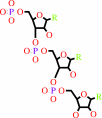 RNA(n)
|
+
|
ribonucleoside 5'-triphosphate
|
=
|
RNA(n+1)
|
+
|
 diphosphate
|
|
|
|
|
|
|
|
|
|
|
|
|
Molecule diagrams generated from .mol files obtained from the
KEGG ftp site
|
|
|
|
|
|
|
|
|
|
|
|
|
|
 |
|
|
|
|
|
|
| |
|
|
| |
|
DOI no:
|
Nat Commun
9:4147
(2018)
|
|
PubMed id:
|
|
|
|
|
|
| |
|
Rifamycin congeners kanglemycins are active against rifampicin-resistant bacteria via a distinct mechanism.
|
|
J.Peek,
M.Lilic,
D.Montiel,
A.Milshteyn,
I.Woodworth,
J.B.Biggins,
M.A.Ternei,
P.Y.Calle,
M.Danziger,
T.Warrier,
K.Saito,
N.Braffman,
A.Fay,
M.S.Glickman,
S.A.Darst,
E.A.Campbell,
S.F.Brady.
|
|
|
|
|
| |
ABSTRACT
|
|
|
|
| |
|
|
Rifamycin antibiotics (Rifs) target bacterial RNA polymerases (RNAPs) and are
widely used to treat infections including tuberculosis. The utility of these
compounds is threatened by the increasing incidence of resistance
(RifR). As resistance mechanisms found in clinical settings may also
occur in natural environments, here we postulated that bacteria could have
evolved to produce rifamycin congeners active against clinically relevant
resistance phenotypes. We survey soil metagenomes and identify a tailoring
enzyme-rich family of gene clusters encoding biosynthesis of rifamycin congeners
(kanglemycins, Kangs) with potent in vivo and in vitro activity against the most
common clinically relevant RifR mutations. Our structural and
mechanistic analyses reveal the basis for Kang inhibition of RifR
RNAP. Unlike Rifs, Kangs function through a mechanism that includes interfering
with 5'-initiating substrate binding. Our results suggest that examining soil
microbiomes for new analogues of clinically used antibiotics may uncover
metabolites capable of circumventing clinically important resistance mechanisms.
|
|
|
|
|
|
|
|
|
|
|
|
|
|
|
|
|
|
 |
 |
 |
| | |


 Links
Links


