 |
PDBsum entry 5ypr

|
|
|
|
|
|

|

|

|

|
|

|
|

|
|

|
|

|
|
|
 |

|

|
|
|
|
|
|
|
|
|
|
|
|
|
|
|
|
|
|
|
|
|
|
|
|
|
|
|
|
|
|
|
|
|
Protein binding
|
PDB id
|
|
|
|
5ypr
|
|
|
|
|
|
|
|
|
|
|
|
|
|
|

|

|

|
|
|
|
|
|
|
PDB id:
|
|
|
|
| Name: |
|
Protein binding
|
|
|
Title:
|
|
Crystal structure of psd-95 sh3-gk domain in complex with a synthesized inhibitor
|
|
Structure:
|
|
Disks large homolog 4. Chain: a. Synonym: postsynaptic density protein 95,psd-95,synapse-associated protein 90,sap90. Engineered: yes. Synthesized gk inhibitor. Chain: b. Engineered: yes
|
|
Source:
|
|
Rattus norvegicus. Rat. Organism_taxid: 10116. Gene: dlg4, dlgh4, psd95. Expressed in: escherichia coli bl21(de3). Expression_system_taxid: 469008. Synthetic: yes. Synthetic construct. Organism_taxid: 32630
|
|
Resolution:
|
|
|
2.35Å
|
R-factor:
|
0.224
|
R-free:
|
0.264
|
|
|
Authors:
|
|
J.Zhu,Q.Zhou,Y.Shang,Z.Weng,R.Zhu,M.Zhang
|
|
Key ref:
|
|
J.Zhu
et al.
(2017).
Synaptic Targeting and Function of SAPAPs Mediated by Phosphorylation-Dependent Binding to PSD-95 MAGUKs.
Cell Rep,
21,
3781-3793.
PubMed id:
DOI:
|
|
|
Date:
|
|
|
02-Nov-17
|
Release date:
|
14-Mar-18
|
|
|
|
|
|
|
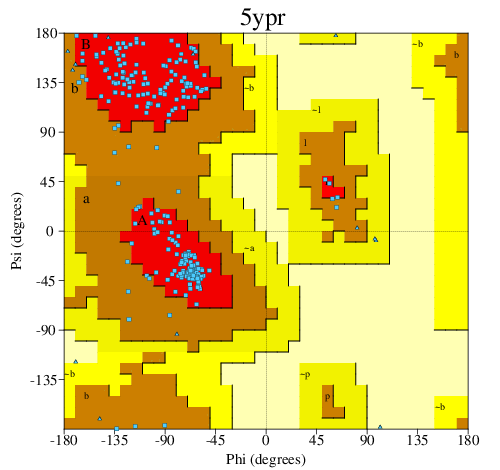
PROCHECK
|
|
|
|
|
|
Headers
|
|
|
|
References
|
|
|
|
|
|
|
|
|
|
|
|
|
|
|
|
 |
|
|
|
|
|
|
| |
|
DOI no:
|
Cell Rep
21:3781-3793
(2017)
|
|
PubMed id:
|
|
|
|
|
|
| |
|
Synaptic Targeting and Function of SAPAPs Mediated by Phosphorylation-Dependent Binding to PSD-95 MAGUKs.
|
|
J.Zhu,
Q.Zhou,
Y.Shang,
H.Li,
M.Peng,
X.Ke,
Z.Weng,
R.Zhang,
X.Huang,
S.S.C.Li,
G.Feng,
Y.Lu,
M.Zhang.
|
|
|
|
|
| |
ABSTRACT
|
|
|
|
| |
|
|
The PSD-95/SAPAP/Shank complex functions as the major scaffold in orchestrating
the formation and plasticity of the post-synaptic densities (PSDs). We
previously demonstrated that the exquisitely specific SAPAP/Shank interaction is
critical for Shank synaptic targeting and Shank-mediated synaptogenesis. Here,
we show that the PSD-95/SAPAP interaction, SAPAP synaptic targeting, and
SAPAP-mediated synaptogenesis require phosphorylation of the N-terminal repeat
sequences of SAPAPs. The atomic structure of the PSD-95 guanylate kinase (GK) in
complex with a phosphor-SAPAP repeat peptide, together with biochemical studies,
reveals the molecular mechanism underlying the phosphorylation-dependent
PSD-95/SAPAP interaction, and it also provides an explanation of a PSD-95
mutation found in patients with intellectual disabilities. Guided by the
structural data, we developed potent non-phosphorylated GK inhibitory peptides
capable of blocking the PSD-95/SAPAP interaction and interfering with
PSD-95/SAPAP-mediated synaptic maturation and strength. These peptides are
genetically encodable for investigating the functions of the PSD-95/SAPAP
interaction in vivo.
|
|
|
|
|
|
|
|
|
|
|
|
|
|
|
|
|
|
 |
 |
 |
|
|


 Links
Links


