 |
PDBsum entry 5ejm
|
|

|
|
PDB id:
|
|
|
|
| Name: |
|
Transferase
|
|
|
Title:
|
|
Thdp-mn2+ complex of r413a variant of ecmend soaked with 2- ketoglutarate for 35 min
|
|
Structure:
|
|
2-succinyl-5-enolpyruvyl-6-hydroxy-3-cyclohexene-1- carboxylate synthase. Chain: a, b, c, d, e, f, g, h. Synonym: thdp-dependent enzyme mend,sephchc synthase,menaquinone biosynthesis protein mend. Engineered: yes. Mutation: yes
|
|
Source:
|
|
Escherichia coli k12. Organism_taxid: 83333. Strain: k12 substr. Mg1655. Gene: mend, b2264, jw5374. Expressed in: escherichia coli bl21(de3). Expression_system_taxid: 469008.
|
|
Resolution:
|
|
|
1.72Å
|
R-factor:
|
0.165
|
R-free:
|
0.192
|
|
|
Authors:
|
|
H.G.Song,C.Dong,Y.Z.Chen,Y.R.Sun,Z.H.Guo
|
|
Key ref:
|
|
M.Qin
et al.
(2018).
Two active site arginines are critical determinants of substrate binding and catalysis in MenD: a thiamine-dependent enzyme in menaquinone biosynthesis.
Biochem J,
475,
3651-3667.
PubMed id:
DOI:
|
|
|
Date:
|
|
|
02-Nov-15
|
Release date:
|
02-Nov-16
|
|
|
|
|
|
|
PROCHECK
|

|
|
|
|
|
Headers
|
|
|
|
References
|
|
|
|
|
|

|
|
P17109
(MEND_ECOLI) -
2-succinyl-5-enolpyruvyl-6-hydroxy-3-cyclohexene-1-carboxylate synthase from Escherichia coli (strain K12)
|
|
|
|
Seq:
Struc:
|
|
|
|
556 a.a.
556 a.a.*
|
|

|

|
|
|
|
|
|
|
|
|
|
|
|
Key: |
 |
PfamA domain |
|
|
 |
Secondary structure |
|
 |
CATH domain |
|
|
*
PDB and UniProt seqs differ
at 1 residue position (black
cross)
|
|
|
|
|
|
|
|
|
|
|
|
|
Enzyme class:
|
|
E.C.2.2.1.9
- 2-succinyl-5-enolpyruvyl-6-hydroxy-3-cyclohexene-1-carboxylic-acid
|
|
|
|
|
|
|
Reaction:
|
|
isochorismate + 2-oxoglutarate + H+ = 5-enolpyruvoyl-6-hydroxy-2- succinyl-cyclohex-3-ene-1-carboxylate + CO2
|
|
|
|
|
|
isochorismate
Bound ligand (Het Group name = )
matches with 45.45% similarity
|
+
|
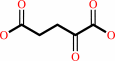 2-oxoglutarate
|
+
|
H(+)
|
=
|
5-enolpyruvoyl-6-hydroxy-2- succinyl-cyclohex-3-ene-1-carboxylate
|
+
|
CO2
Bound ligand (Het Group name = )
matches with 40.00% similarity
|
|
|
|
|
|
|
|
|
|
Cofactor:
|
|
Mg(2+)
|
|
|
|
|
|
|
|
|
Molecule diagrams generated from .mol files obtained from the
KEGG ftp site
|
|
|
|
|
|
|
|
|
|
|
|
|
|
 |
|
|
|
|
|
|
| |
|
|
| |
|
DOI no:
|
Biochem J
475:3651-3667
(2018)
|
|
PubMed id:
|
|
|
|
|
|
| |
|
Two active site arginines are critical determinants of substrate binding and catalysis in MenD: a thiamine-dependent enzyme in menaquinone biosynthesis.
|
|
M.Qin,
H.Song,
X.Dai,
Y.Chen,
Z.Guo.
|
|
|
|
|
| |
ABSTRACT
|
|
|
|
| |
|
|
The bacterial enzyme MenD, or
2-succinyl-5-enolpyruvyl-6-hydroxy-3-cyclohexene-1-carboxylate (SEPHCHC)
synthase, catalyzes an essential Stetter reaction in menaquinone (vitamin K2)
biosynthesis via thiamine diphosphate (ThDP)-bound tetrahedral
post-decarboxylation intermediates. The detailed mechanism of this intermediate
chemistry, however, is still poorly understood, but of significant interest
given that menaquinone is an essential electron transporter in many pathogenic
bacteria. Here, we used site-directed mutagenesis, enzyme kinetic assays, and
protein crystallography to reveal an active-inactive intermediate equilibrium in
MenD catalysis and its modulation by two conserved active site arginine
residues. We observed that these conserved residues play a key role in shifting
the equilibrium to the active intermediate by orienting the
C2-succinyl group of the intermediates through strong ionic hydrogen
bonding. We found that when this interaction is moderately weakened by amino
acid substitutions, the resulting proteins are catalytically competent with the
C2-succinyl group taking either the active or the inactive
orientation in the post-decarboxylation intermediate. When this hydrogen-bonding
interaction was strongly weakened, the succinyl group was re-oriented by 180°
relative to the native intermediate, resulting in the reversal of the
stereochemistry at the reaction center that disabled catalysis. Interestingly,
this inactive intermediate was formed with a distinct kinetic behavior, likely
as a result of a non-native mode of enzyme-substrate interaction. The
mechanistic insights gained from these findings improve our understanding of the
new ThDP-dependent catalysis. More importantly, the non-native-binding site of
the inactive MenD intermediate uncovered here provides a new target for the
development of antibiotics.
|
|
|
|
|
|
|
|
|
|
|
|
|
|
|
|
|
|
 |
 |
 |
|


 Links
Links


