 |
PDBsum entry 5dg9

|
|
|
|
|
|

|

|

|

|
|

|
|

|
|

|
|

|
|

|
|

|
|

|
|
|
 |

|

|
|
|
|
|
|
|
|
|
|
|
|
|
|
|
|
|
|
|
|
|
|
|
|
|
|
|
|
|
|
|
|
|
|
|
|
Transferase/DNA
|
PDB id
|
|
|
|
5dg9
|
|
|
|
|
|
|
|
|
|
|
|
|
|
|

|

|

|
|
|
|
|
|
|
|
|
Enzyme class:
|
|
E.C.2.7.7.7
- DNA-directed Dna polymerase.
|
|
|
|
|
|
|
Reaction:
|
|
DNA(n) + a 2'-deoxyribonucleoside 5'-triphosphate = DNA(n+1) + diphosphate
|
|
|
|
|
|
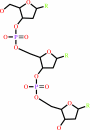 DNA(n)
|
+
|
2'-deoxyribonucleoside 5'-triphosphate
|
=
|
DNA(n+1)
|
+
|
 diphosphate
|
|
|
|
|
|
|
|
|
|
|
|
|
Molecule diagrams generated from .mol files obtained from the
KEGG ftp site
|
|
|
|
|
|
|
|
|
|
|
|
|
|
 |
|
|
|
|
|
|
| |
|
|
| |
|
DOI no:
|
J Biol Chem
291:14134-14145
(2016)
|
|
PubMed id:
|
|
|
|
|
|
| |
|
Structural and Kinetic Analysis of Miscoding Opposite the DNA Adduct 1,N6-Ethenodeoxyadenosine by Human Translesion DNA Polymerase η.
|
|
A.Patra,
Y.Su,
Q.Zhang,
K.M.Johnson,
F.P.Guengerich,
M.Egli.
|
|
|
|
|
| |
ABSTRACT
|
|
|
|
| |
|
|
1,N(6)-Ethenodeoxyadenosine (1,N(6)-ϵdA) is the major etheno lesion formed in
the reaction of DNA with epoxides substituted with good leaving groups (e.g.
vinyl chloride epoxide). This lesion is also formed endogenously in DNA from
lipid oxidation. Recombinant human DNA polymerase η (hpol η) can replicate
oligonucleotide templates containing 1,N(6)-ϵdA. In steady-state kinetic
analysis, hpol η preferred to incorporate dATP and dGTP, compared with dTTP.
Mass spectral analysis of incorporation products also showed preferred purine
(A, G) incorporation and extensive -1 frameshifts, suggesting pairing of the
inserted purine and slippage before further replication. Five x-ray crystal
structures of hpol η ternary complexes were determined, three at the insertion
and two at the extension stage. Two insertion complexes revealed incoming
non-hydrolyzable dATP or dGTP analogs not pairing with but instead in a
staggered configuration relative to 1,N(6)-ϵdA in the anti conformation, thus
opposite the 5'-T in the template, explaining the proclivity for frameshift
misincorporation. In another insertion complex, dTTP was positioned opposite
1,N(6)-ϵdA, and the adduct base was in the syn conformation, with formation of
two hydrogen bonds. At the extension stage, with either an incorporated dA or dT
opposite 1,N(6)-ϵdA and 2'-deoxythymidine-5'-[(α,β)-imido]triphosphate
opposite the 5'-A, the 3'-terminal nucleoside of the primer was disordered,
consistent with the tendency not to incorporate dTTP opposite 1,N(6)-ϵdA.
Collectively, the results show a preference for purine pairing opposite
1,N(6)-ϵdA and for -1 frameshifts.
|
|
|
|
|
|
|
|
|
|
|
|
|
|
|
|
|
|
 |
 |
 |
|


 Links
Links


