|
PDBsum entry 4zrr
 |
|
|
|
|
|
|
Enzyme class:
|
|
E.C.2.7.13.3
- histidine kinase.
|
|
|
|
|
|
|
Reaction:
|
|
ATP + protein L-histidine = ADP + protein N-phospho-L-histidine
|
|
|
|
|
|
 ATP
ATP
|
+
|
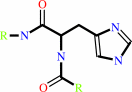 protein L-histidine
|
=
|
 ADP
ADP
|
+
|
protein N-phospho-L-histidine
|
|
|
|
|
|
|
|
|
|
|
|
|
Molecule diagrams generated from .mol files obtained from the
KEGG ftp site
|
|
|
|
|
|
|
|
|
|
|
|
|
|
 |
|
|
|
|
|
|
| |
|
|
| |
|
DOI no:
|
Front Mol Biosci
2:65
(2015)
|
|
PubMed id:
|
|
|
|
|
|
| |
|
Removal of Chromophore-Proximal Polar Atoms Decreases Water Content and Increases Fluorescence in a Near Infrared Phytofluor.
|
|
H.Lehtivuori,
S.Bhattacharya,
N.M.Angenent-Mari,
K.A.Satyshur,
K.T.Forest.
|
|
|
|
|
| |
ABSTRACT
|
|
|
|
| |
|
|
Genetically encoded fluorescent markers have revolutionized cell and molecular
biology due to their biological compatibility, controllable spatiotemporal
expression, and photostability. To achieve in vivo imaging in whole animals,
longer excitation wavelength probes are needed due to the superior ability of
near infrared light to penetrate tissues unimpeded by absorbance from
biomolecules or autofluorescence of water. Derived from near infrared-absorbing
bacteriophytochromes, phytofluors are engineered to fluoresce in this region of
the electromagnetic spectrum, although high quantum yield remains an elusive
goal. An invariant aspartate residue is of utmost importance for photoconversion
in native phytochromes, presumably due to the proximity of its backbone carbonyl
to the pyrrole ring nitrogens of the biliverdin (BV) chromophore as well as the
size and charge of the side chain. We hypothesized that the polar interaction
network formed by the charged side chain may contribute to the decay of the
excited state via proton transfer. Thus, we chose to further probe the role of
this amino acid by removing all possibility for polar interactions with its
carboxylate side chain by incorporating leucine instead. The resultant
fluorescent protein, WiPhy2, maintains BV binding, monomeric status, and long
maximum excitation wavelength while minimizing undesirable protoporphyrin IXα
binding in cells. A crystal structure and time-resolved fluorescence
spectroscopy reveal that water near the BV chromophore is excluded and thus
validate our hypothesis that removal of polar interactions leads to enhanced
fluorescence by increasing the lifetime of the excited state. This new
phytofluor maintains its fluorescent properties over a broad pH range and does
not suffer from photobleaching. WiPhy2 achieves the best compromise to date
between high fluorescence quantum yield and long illumination wavelength in this
class of fluorescent proteins.
|
|
|
|
|
|
|
|
|
|
|
|
|
|
|
|
|
|
 |
 |
 |
|


 Links
Links