 |
PDBsum entry 4zgj

|
|
|
|
|
 |
Contents |
 |
|
|
|
|
|
|
|
|
|
|
|


 (+ 2 more)
206 a.a.
(+ 2 more)
206 a.a.
|
|
|
|
|
|
|
|
|
|
|


 (+ 2 more)
206 a.a.
(+ 2 more)
206 a.a.
|
|
|
|
|
|
|
|
|
|
|
|
|
|
|
PDB id:
|
|
|
|
| Name: |
|
Lyase
|
|
|
Title:
|
|
Double mutant h80a/h81a of fe-type nitrile hydratase from comamonas testosteroni ni1
|
|
Structure:
|
|
Nitrile hydratase alpha subunit. Chain: a, c, e, g, i, k, m, o. Engineered: yes. Mutation: yes. Nitrile hydratase beta subunit. Chain: b, d, f, h, j, l, n, p. Engineered: yes
|
|
Source:
|
|
Comamonas testosteroni. Organism_taxid: 285. Expressed in: escherichia coli. Expression_system_taxid: 562. Expression_system_taxid: 562
|
|
Resolution:
|
|
|
2.00Å
|
R-factor:
|
0.221
|
R-free:
|
0.253
|
|
|
Authors:
|
|
R.Wu,S.Martinez,R.Holz,D.Liu
|
|
Key ref:
|
|
S.Martinez
et al.
(2015).
Analyzing the catalytic role of active site residues in the Fe-type nitrile hydratase from Comamonas testosteroni Ni1.
J Biol Inorg Chem,
20,
885-894.
PubMed id:
DOI:
|
|
|
Date:
|
|
|
23-Apr-15
|
Release date:
|
01-Jul-15
|
|
|
|
|
|
|
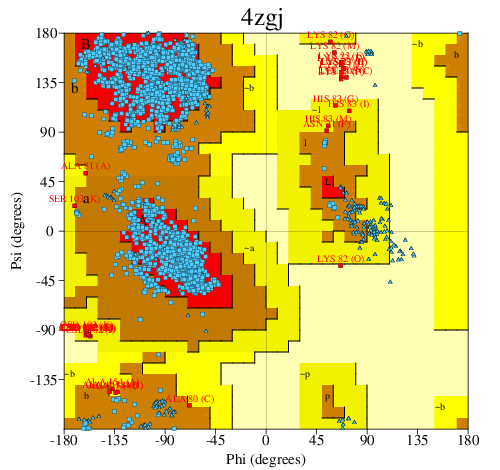
PROCHECK
|
|
|
|
|
|
Headers
|
|
|
|
References
|
|
|
|
|
|
|
|
|
|
|
|
Enzyme class:
|
|
Chains A, B, C, D, E, F, G, H, I, J, K, L, M, N, O, P:
E.C.4.2.1.84
- nitrile hydratase.
|
|
|
|
|
|
|
Reaction:
|
|
an aliphatic primary amide = an aliphatic nitrile + H2O
|
|
|
|
|
|
aliphatic primary amide
|
=
|
 aliphatic nitrile
|
+
|
H2O
|
|
|
|
|
|
|
|
|
|
|
|
|
Molecule diagrams generated from .mol files obtained from the
KEGG ftp site
|
|
|
|
|
|
|
|
|
|
|
|
|
|
 |
|
|
|
|
|
|
| |
|
|
| |
|
DOI no:
|
J Biol Inorg Chem
20:885-894
(2015)
|
|
PubMed id:
|
|
|
|
|
|
| |
|
Analyzing the catalytic role of active site residues in the Fe-type nitrile hydratase from Comamonas testosteroni Ni1.
|
|
S.Martinez,
R.Wu,
K.Krzywda,
V.Opalka,
H.Chan,
D.Liu,
R.C.Holz.
|
|
|
|
|
| |
ABSTRACT
|
|
|
|
| |
|
|
A strictly conserved active site arginine residue (αR157) and two histidine
residues (αH80 and αH81) located near the active site of the Fe-type nitrile
hydratase from Comamonas testosteroni Ni1 (CtNHase), were mutated. These mutant
enzymes were examined for their ability to bind iron and hydrate acrylonitrile.
For the αR157A mutant, the residual activity (k cat = 10 ± 2 s(-1))
accounts for less than 1 % of the wild-type activity (k
cat = 1100 ± 30 s(-1)) while the K m value is nearly unchanged at
205 ± 10 mM. On the other hand, mutation of the active site pocket αH80 and
αH81 residues to alanine resulted in enzymes with k cat values of 220 ± 40
and 77 ± 13 s(-1), respectively, and K m values of 187 ± 11 and
179 ± 18 mM. The double mutant (αH80A/αH81A) was also prepared and
provided an enzyme with a k cat value of 132 ± 3 s(-1) and a K m value of
213 ± 61 mM. These data indicate that all three residues are catalytically
important, but not essential. X-ray crystal structures of the αH80A/αH81A,
αH80W/αH81W, and αR157A mutant CtNHase enzymes were solved to 2.0, 2.8, and
2.5 Å resolutions, respectively. In each mutant enzyme, hydrogen-bonding
interactions crucial for the catalytic function of the αCys(104)-SOH ligand are
disrupted. Disruption of these hydrogen bonding interactions likely alters the
nucleophilicity of the sulfenic acid oxygen and the Lewis acidity of the active
site Fe(III) ion.
|
|
|
|
|
|
|
|
|
|
|
|
|
|
|
|
|
|
 |
 |
 |
|
|


 Links
Links


