 |
PDBsum entry 4pl5

|
|
|
|
|
|

|

|

|

|
|

|
|

|
|

|
|

|
|

|
|

|
|

|
|
|
 |

|

|
|
|
|
|
|
|
|
|
|
|
|
|
|
|
|
|
|
|
|
|
|
|
|
|
|
|
|
|
|
|
|
|
|
|
|
Transferase,hydrolase/inhibitor
|
PDB id
|
|
|
|
4pl5
|
|
|
|
|
|
|
|
|
|
|
|
|
|
|

|

|

|
|
|
|
|
|
|
PDB id:
|
|
|
|
| Name: |
|
Transferase,hydrolase/inhibitor
|
|
|
Title:
|
|
Crystal structure of murine ire1 in complex with oicr573 inhibitor
|
|
Structure:
|
|
Serine/threonine-protein kinase/endoribonuclease ire1. Chain: b, a, c, d. Fragment: unp residues 550-977. Synonym: endoplasmic reticulum-to-nucleus signaling 1,inositol- requiring protein 1,ire1-alpha,ire1a. Engineered: yes
|
|
Source:
|
|
Mus musculus. Mouse. Organism_taxid: 10090. Gene: ern1, ire1. Expressed in: escherichia coli. Expression_system_taxid: 562
|
|
Resolution:
|
|
|
3.40Å
|
R-factor:
|
0.225
|
R-free:
|
0.285
|
|
|
Authors:
|
|
M.Sanches,N.Duffy,M.Talukdar,N.Thevakumaran,D.Chiovitti,R.Al-Awar, J.B.Patterson,F.Sicheri
|
|
Key ref:
|
|
M.Sanches
et al.
(2014).
Structure and mechanism of action of the hydroxy-aryl-aldehyde class of IRE1 endoribonuclease inhibitors.
Nat Commun,
5,
4202.
PubMed id:
DOI:
|
|
|
Date:
|
|
|
16-May-14
|
Release date:
|
03-Sep-14
|
|
|
|
|
|
|
PROCHECK
|

|
|
|
|
|
Headers
|
|
|
|
References
|
|
|
|
|
|

|
|
Q9EQY0
(ERN1_MOUSE) -
Serine/threonine-protein kinase/endoribonuclease IRE1 from Mus musculus
|
|
|
|
Seq:
Struc:
|
|
|
|
977 a.a.
383 a.a.*
|
|

|

|

|
|
|
|
|
|
|
|
|
|
|
Key: |
 |
PfamA domain |
|
|
 |
Secondary structure |
|
 |
CATH domain |
|
|
*
PDB and UniProt seqs differ
at 1 residue position (black
cross)
|
|
|
|
|
|
|
|
|
|
|
|
|
Enzyme class 1:
|
|
E.C.2.7.11.1
- non-specific serine/threonine protein kinase.
|
|
|
|
|
|
|
Reaction:
|
|
|
1.
|
L-seryl-[protein] + ATP = O-phospho-L-seryl-[protein] + ADP + H+
|
|
2.
|
L-threonyl-[protein] + ATP = O-phospho-L-threonyl-[protein] + ADP + H+
|
|
|
|
|
|
|
L-seryl-[protein]
|
+
|
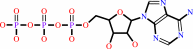 ATP
ATP
|
=
|
O-phospho-L-seryl-[protein]
Bound ligand (Het Group name = )
corresponds exactly
|
+
|
 ADP
ADP
|
+
|
H(+)
|
|
|
|
|
|
|
L-threonyl-[protein]
|
+
|
ATP
|
=
|
O-phospho-L-threonyl-[protein]
Bound ligand (Het Group name = )
corresponds exactly
|
+
|
ADP
|
+
|
H(+)
|
|
|
|
|
|
|
|
|
|
Enzyme class 2:
|
|
E.C.3.1.26.-
- ?????
|
|
|
|
|
|
|
|
|
|
Note, where more than one E.C. class is given (as above), each may
correspond to a different protein domain or, in the case of polyprotein
precursors, to a different mature protein.
|
|
|
|
Molecule diagrams generated from .mol files obtained from the
KEGG ftp site
|
|
|
|
|
|
|
|
|
|
|
|
|
|
 |
|
|
|
|
|
|
| |
|
|
| |
|
DOI no:
|
Nat Commun
5:4202
(2014)
|
|
PubMed id:
|
|
|
|
|
|
| |
|
Structure and mechanism of action of the hydroxy-aryl-aldehyde class of IRE1 endoribonuclease inhibitors.
|
|
M.Sanches,
N.M.Duffy,
M.Talukdar,
N.Thevakumaran,
D.Chiovitti,
M.D.Canny,
K.Lee,
I.Kurinov,
D.Uehling,
R.Al-awar,
G.Poda,
M.Prakesch,
B.Wilson,
V.Tam,
C.Schweitzer,
A.Toro,
J.L.Lucas,
D.Vuga,
L.Lehmann,
D.Durocher,
Q.Zeng,
J.B.Patterson,
F.Sicheri.
|
|
|
|
|
| |
ABSTRACT
|
|
|
|
| |
|
|
Endoplasmic reticulum (ER) stress activates the unfolded protein response and
its dysfunction is linked to multiple diseases. The stress transducer IRE1α is
a transmembrane kinase endoribonuclease (RNase) that cleaves mRNA substrates to
re-establish ER homeostasis. Aromatic ring systems containing hydroxy-aldehyde
moieties, termed hydroxy-aryl-aldehydes (HAA), selectively inhibit IRE1α RNase
and thus represent a novel chemical series for therapeutic development. We
solved crystal structures of murine IRE1α in complex with three HAA inhibitors.
HAA inhibitors engage a shallow pocket at the RNase-active site through
pi-stacking interactions with His910 and Phe889, an essential Schiff base with
Lys907 and a hydrogen bond with Tyr892. Structure-activity studies and
mutational analysis of contact residues define the optimal chemical space of
inhibitors and validate the inhibitor-binding site. These studies lay the
foundation for understanding both the biochemical and cellular functions of
IRE1α using small molecule inhibitors and suggest new avenues for inhibitor
design.
|
|
|
|
|
|
|
|
|
|
|
|
|
|
|
|
|
|
 |
 |
 |
|


 Links
Links


