 |
PDBsum entry 4eyh

|
|
|
|
|
|

|

|

|

|
|

|
|

|
|

|
|

|
|

|
|

|
|

|
|
|
 |

|

|
|
|
|
|
|
|
|
|
|
|
|
|
|
|
|
|
|
|
|
|
|
|
|
|
|
|
|
|
|
|
|
|
|
|
|
Transferase/DNA
|
PDB id
|
|
|
|
4eyh
|
|
|
|
|
|
|
|
|
|
|
|
|
|
|

|

|

|
|
|
|
|
|
|
|
|
Enzyme class:
|
|
E.C.2.7.7.7
- DNA-directed Dna polymerase.
|
|
|
|
|
|
|
Reaction:
|
|
DNA(n) + a 2'-deoxyribonucleoside 5'-triphosphate = DNA(n+1) + diphosphate
|
|
|
|
|
|
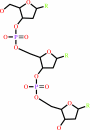 DNA(n)
|
+
|
2'-deoxyribonucleoside 5'-triphosphate
|
=
|
DNA(n+1)
|
+
|
 diphosphate
|
|
|
|
|
|
|
|
|
|
|
|
|
Molecule diagrams generated from .mol files obtained from the
KEGG ftp site
|
|
|
|
|
|
|
|
|
|
|
|
|
|
 |
|
|
|
|
|
|
| |
|
|
| |
|
|
Nucleic Acids Res
41:2060-2071
(2013)
|
|
PubMed id:
|
|
|
|
|
|
| |
|
Replication of a carcinogenic nitropyrene DNA lesion by human Y-family DNA polymerase.
|
|
K.N.Kirouac,
A.K.Basu,
H.Ling.
|
|
|
|
|
| |
ABSTRACT
|
|
|
|
| |
|
|
Nitrated polycyclic aromatic hydrocarbons are common environmental pollutants,
of which many are mutagenic and carcinogenic. 1-Nitropyrene is the most abundant
nitrated polycyclic aromatic hydrocarbon, which causes DNA damage and is
carcinogenic in experimental animals. Error-prone translesion synthesis of
1-nitropyrene-derived DNA lesions generates mutations that likely play a role in
the etiology of cancer. Here, we report two crystal structures of the human
Y-family DNA polymerase iota complexed with the major 1-nitropyrene DNA lesion
at the insertion stage, incorporating either dCTP or dATP nucleotide opposite
the lesion. Polι maintains the adduct in its active site in two distinct
conformations. dCTP forms a Watson-Crick base pair with the adducted guanine and
excludes the pyrene ring from the helical DNA, which inhibits replication beyond
the lesion. By contrast, the mismatched dATP stacks above the pyrene ring that
is intercalated in the helix and achieves a productive conformation for
misincorporation. The intra-helical bulky pyrene mimics a base pair in the
active site and facilitates adenine misincorporation. By structure-based
mutagenesis, we show that the restrictive active site of human polη prevents
the intra-helical conformation and A-base misinsertions. This work provides one
of the molecular mechanisms for G to T transversions, a signature mutation in
human lung cancer.
|
|
|
|
|
|
|
|
|
|
|
|
|
|
|
|
|
|
 |
 |
 |
|


 Links
Links


