 |
PDBsum entry 4tqs

|
|
|
|
|
|

|

|

|

|
|

|
|

|
|

|
|

|
|

|
|

|
|

|
|

|
|
|
 |

|

|
|
|
|
|
|
|
|
|
|
|
|
|
|
|
|
|
|
|
|
|
|
|
|
|
|
|
|
|
|
|
|
|
|
|
|
|
Transferase/DNA
|
PDB id
|
|
|
|
4tqs
|
|
|
|
|
|
|
|
|
|
|
|
|
|
|

|

|

|
|
|
|
|
|
|
|
|
Enzyme class:
|
|
E.C.2.7.7.7
- DNA-directed Dna polymerase.
|
|
|
|
|
|
|
Reaction:
|
|
DNA(n) + a 2'-deoxyribonucleoside 5'-triphosphate = DNA(n+1) + diphosphate
|
|
|
|
|
|
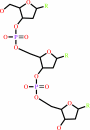 DNA(n)
|
+
|
2'-deoxyribonucleoside 5'-triphosphate
|
=
|
DNA(n+1)
|
+
|
 diphosphate
|
|
|
|
|
|
|
|
|
|
|
|
|
Molecule diagrams generated from .mol files obtained from the
KEGG ftp site
|
|
|
|
|
|
|
|
|
|
|
|
|
|
 |
|
|
|
|
|
|
| |
|
|
| |
|
DOI no:
|
Biochemistry
54:639-651
(2015)
|
|
PubMed id:
|
|
|
|
|
|
| |
|
Kinetic and structural mechanisms of (5'S)-8,5'-cyclo-2'-deoxyguanosine-induced dna replication stalling.
|
|
W.Xu,
A.M.Ouellette,
Z.Wawrzak,
S.J.Shriver,
S.M.Anderson,
L.Zhao.
|
|
|
|
|
| |
ABSTRACT
|
|
|
|
| |
|
|
The (5'S)-8,5'-cyclo-2'-deoxyguanosine (S-cdG) lesion is produced from reactions
of DNA with hydroxyl radicals generated from ionizing radiation or endogenous
oxidative metabolisms. An elevated level of S-cdG has been detected in Xeroderma
pigmentosum, Cockayne syndrome, breast cancer patients, and aged mice. S-dG
blocks DNA replication and transcription in vitro and in human cells and
produces mutant replication and transcription products in vitro and in vivo.
Major cellular protection against S-dG includes nucleotide excision repair and
translesion DNA synthesis. We used kinetic and crystallographic approaches to
elucidate the molecular mechanisms of S-cdG-induced DNA replication stalling
using model B-family Sulfolobus solfataricus P2 DNA polymerase B1 (Dpo1) and
Y-family S. solfataricus P2 DNA polymerase IV (Dpo4). Dpo1 and Dpo4
inefficiently bypassed S-cdG with dCTP preferably incorporated and dTTP (for
Dpo4) or dATP (for Dpo1) misincorporated. Pre-steady-state kinetics and
crystallographic data mechanistically explained the low-efficiency bypass. For
Dpo1, S-cdG attenuated Kd,dNTP,app and kpol. For Dpo4, the S-cdG-adducted duplex
caused a 6-fold decrease in Dpo4:DNA binding affinity and significantly reduced
the concentration of the productive Dpo4:DNA:dCTP complex. Consistent with the
inefficient bypass, crystal structures of Dpo4:DNA(S-cdG):dCTP (error-free) and
Dpo4:DNA(S-cdG):dTTP (error-prone) complexes were catalytically incompetent. In
the Dpo4:DNA(S-cdG):dTTP structure, S-cdG induced a loop structure and caused an
unusual 5'-template base clustering at the active site, providing the first
structural evidence of the previously suggested template loop structure that can
be induced by a cyclopurine lesion. Together, our results provided mechanistic
insights into S-cdG-induced DNA replication stalling.
|
|
|
|
|
|
|
|
|
|
|
|
|
|
|
|
|
|
 |
 |
 |
|


 Links
Links


