 |
PDBsum entry 4lsp

|
|
|
|
|
|

|

|

|

|
|

|
|

|
|

|
|

|
|

|
|

|
|

|
|
|
 |

|

|
|
|
|
|
|
|
|
|
|
|
|
|
|
|
|
|
|
|
|
|
|
|
|
|
|
|
|
|
|
|
|
|
|
|
|
Viral protein/immune system
|
PDB id
|
|
|
|
4lsp
|
|
|
|
|
|
|
|
|
|
|
|
|
|
|

|

|

|
|
|
|
|
|
|
|
 |
Contents |
 |
|
|
|
|
|
|
|
|
|
|
|
 347 a.a.
|
|
|
|
|
|
|
|
|
|
|
 216 a.a.
|
|
|
|
|
|
|
|
|
|
|
 208 a.a.
|
|
|
|
|
|
|
|
|
|
|
|
|
|
|
|
|
PDB id:
|
|
|
|
| Name: |
|
Viral protein/immune system
|
|
|
Title:
|
|
Crystal structure of broadly and potently neutralizing antibody vrc- ch31 in complex with HIV-1 clade a/e gp120 93th057
|
|
Structure:
|
|
HIV-1 clade a/e strain 93th057 gp120. Chain: g. Engineered: yes. Heavy chain of antibody vrc-ch31. Chain: h. Engineered: yes. Light chain of antibody vrc-ch31. Chain: l. Engineered: yes
|
|
Source:
|
|
Human immunodeficiency virus 1. Organism_taxid: 11676. Strain: 93th057. Gene: env. Expressed in: homo sapiens. Expression_system_taxid: 9606. Expression_system_cell_line: hek 293f. Homo sapiens. Organism_taxid: 9606.
|
|
Resolution:
|
|
|
2.15Å
|
R-factor:
|
0.182
|
R-free:
|
0.214
|
|
|
Authors:
|
|
T.Zhou,S.Moquin,P.D.Kwong
|
|
Key ref:
|
|
T.Zhou
et al.
(2013).
Multidonor analysis reveals structural elements, genetic determinants, and maturation pathway for HIV-1 neutralization by VRC01-class antibodies.
Immunity,
39,
245-258.
PubMed id:
DOI:
|
|
|
Date:
|
|
|
23-Jul-13
|
Release date:
|
04-Sep-13
|
|
|
|
|
|
|
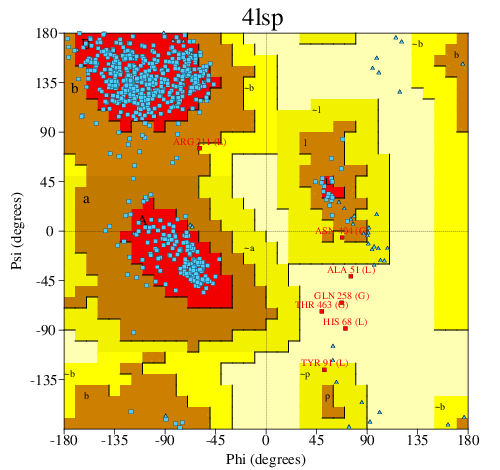
PROCHECK
|
|
|
|
|
|
Headers
|
|
|
|
References
|
|
|
|
|
|

|
|
Q0ED31
(Q0ED31_HV1) -
Envelope glycoprotein gp160 from Human immunodeficiency virus type 1
|
|
|
|
Seq:
Struc:
|
|
|
|
857 a.a.
347 a.a.*
|
|

|

|

|
|
|
|
|
|
|
|
|
|
|
|
|
|
|
|
|
|
|
|
|
 |
|
|
|
|
|
|
| |
|
DOI no:
|
Immunity
39:245-258
(2013)
|
|
PubMed id:
|
|
|
|
|
|
| |
|
Multidonor analysis reveals structural elements, genetic determinants, and maturation pathway for HIV-1 neutralization by VRC01-class antibodies.
|
|
T.Zhou,
J.Zhu,
X.Wu,
S.Moquin,
B.Zhang,
P.Acharya,
I.S.Georgiev,
H.R.Altae-Tran,
G.Y.Chuang,
M.G.Joyce,
Y.D.Kwon,
N.S.Longo,
M.K.Louder,
T.Luongo,
K.McKee,
C.A.Schramm,
J.Skinner,
Y.Yang,
Z.Yang,
Z.Zhang,
A.Zheng,
M.Bonsignori,
B.F.Haynes,
J.F.Scheid,
M.C.Nussenzweig,
M.Simek,
D.R.Burton,
W.C.Koff,
J.C.Mullikin,
M.Connors,
L.Shapiro,
G.J.Nabel,
J.R.Mascola,
P.D.Kwong.
|
|
|
|
|
| |
ABSTRACT
|
|
|
|
| |
|
|
Antibodies of the VRC01 class neutralize HIV-1, arise in diverse HIV-1-infected
donors, and are potential templates for an effective HIV-1 vaccine. However, the
stochastic processes that generate repertoires in each individual of >10(12)
antibodies make elicitation of specific antibodies uncertain. Here we determine
the ontogeny of the VRC01 class by crystallography and next-generation
sequencing. Despite antibody-sequence differences exceeding 50%, antibody-gp120
cocrystal structures reveal VRC01-class recognition to be remarkably similar. B
cell transcripts indicate that VRC01-class antibodies require few specific
genetic elements, suggesting that naive-B cells with VRC01-class features are
generated regularly by recombination. Virtually all of these fail to mature,
however, with only a few-likely one-ancestor B cell expanding to form a
VRC01-class lineage in each donor. Developmental similarities in multiple donors
thus reveal the generation of VRC01-class antibodies to be reproducible in
principle, thereby providing a framework for attempts to elicit similar
antibodies in the general population.
|
|
|
|
|
|
|
|
|
|
|
|
|
|
|
|
|
|
 |
 |
 |
|
| |


 Links
Links





