 |
PDBsum entry 4ddr

|
|
|
|
|
|

|

|

|

|
|

|
|

|
|

|
|

|
|
|
 |

|

|
|
|
|
|
|
|
|
|
|
|
|
|
|
|
|
|
|
|
|
|
|
|
|
|
|
|
|
|
|
|
|
|
Oxidoreductase/oxidoreductase inhibitor
|
PDB id
|
|
|
|
4ddr
|
|
|
|
|
|
|
|
|
|
|
|
|
|
|

|

|

|
|
|
|
|
|
|
PDB id:
|
|
|
|
| Name: |
|
Oxidoreductase/oxidoreductase inhibitor
|
|
|
Title:
|
|
Human dihydrofolate reductase complexed with NADPH and p218
|
|
Structure:
|
|
Dihydrofolate reductase. Chain: a. Engineered: yes
|
|
Source:
|
|
Homo sapiens. Human. Organism_taxid: 9606. Gene: dhfr. Expressed in: escherichia coli. Expression_system_taxid: 562.
|
|
Resolution:
|
|
|
2.05Å
|
R-factor:
|
0.205
|
R-free:
|
0.249
|
|
|
Authors:
|
|
Y.Yuthavong,B.Tarnchompoo,T.Vilaivan,P.Chitnumsub, S.Kamchonwongpaisan,S.A.Charman,D.N.Mclennan,K.L.White,L.Vivas, E.Bongard,C.Thongphanchang,S.Taweechai,J.Vanichtanankul, R.Rattanajak,U.Arwon,P.Fantauzzi,J.Yuvaniyama,W.N.Charman,D.Matthews
|
|
Key ref:
|
|
Y.Yuthavong
et al.
(2012).
Malarial dihydrofolate reductase as a paradigm for drug development against a resistance-compromised target.
Proc Natl Acad Sci U S A,
109,
16823-16828.
PubMed id:
|
|
|
Date:
|
|
|
19-Jan-12
|
Release date:
|
14-Nov-12
|
|
|
|
|
|
|
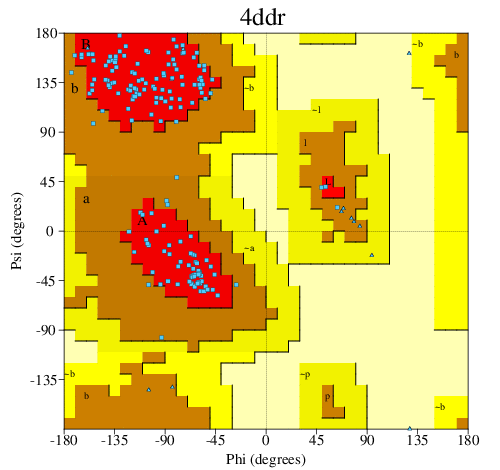
PROCHECK
|
|
|
|
|
|
Headers
|
|
|
|
References
|
|
|
|
|
|

|
|
P00374
(DYR_HUMAN) -
Dihydrofolate reductase from Homo sapiens
|
|
|
|
Seq:
Struc:
|
|
|
|
187 a.a.
186 a.a.
|
|

|

|
|
|
|
|
|
|
|
|
|
|
|
Key: |
 |
PfamA domain |
|
|
 |
Secondary structure |
|
 |
CATH domain |
|
|
|
|
|
|
|
|
|
|
|
|
|
Enzyme class:
|
|
E.C.1.5.1.3
- dihydrofolate reductase.
|
|
|
|
|
|
|
Pathway:
|
|
Folate Coenzymes
|
|
|
|
|
|
Reaction:
|
|
(6S)-5,6,7,8-tetrahydrofolate + NADP+ = 7,8-dihydrofolate + NADPH + H+
|
|
|
|
|
|
(6S)-5,6,7,8-tetrahydrofolate
|
+
|
NADP(+)
Bound ligand (Het Group name = )
corresponds exactly
|
=
|
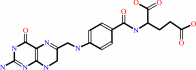 7,8-dihydrofolate
|
+
|
 NADPH
NADPH
|
+
|
H(+)
|
|
|
|
|
|
|
|
|
|
|
|
|
Molecule diagrams generated from .mol files obtained from the
KEGG ftp site
|
|
|
|
|
|
|
|
|
|
|
|
|
|
 |
|
|
|
|
|
|
| |
|
|
| |
|
|
Proc Natl Acad Sci U S A
109:16823-16828
(2012)
|
|
PubMed id:
|
|
|
|
|
|
| |
|
Malarial dihydrofolate reductase as a paradigm for drug development against a resistance-compromised target.
|
|
Y.Yuthavong,
B.Tarnchompoo,
T.Vilaivan,
P.Chitnumsub,
S.Kamchonwongpaisan,
S.A.Charman,
D.N.McLennan,
K.L.White,
L.Vivas,
E.Bongard,
C.Thongphanchang,
S.Taweechai,
J.Vanichtanankul,
R.Rattanajak,
U.Arwon,
P.Fantauzzi,
J.Yuvaniyama,
W.N.Charman,
D.Matthews.
|
|
|
|
|
| |
ABSTRACT
|
|
|
|
| |
|
|
Malarial dihydrofolate reductase (DHFR) is the target of antifolate antimalarial
drugs such as pyrimethamine and cycloguanil, the clinical efficacy of which have
been compromised by resistance arising through mutations at various sites on the
enzyme. Here, we describe the use of cocrystal structures with inhibitors and
substrates, along with efficacy and pharmacokinetic profiling for the design,
characterization, and preclinical development of a selective, highly
efficacious, and orally available antimalarial drug candidate that potently
inhibits both wild-type and clinically relevant mutated forms of Plasmodium
falciparum (Pf) DHFR. Important structural characteristics of P218 include
pyrimidine side-chain flexibility and a carboxylate group that makes
charge-mediated hydrogen bonds with conserved Arg122 (PfDHFR-TS amino acid
numbering). An analogous interaction of P218 with human DHFR is disfavored
because of three species-dependent amino acid substitutions in the vicinity of
the conserved Arg. Thus, P218 binds to the active site of PfDHFR in a
substantially different fashion from the human enzyme, which is the basis for
its high selectivity. Unlike pyrimethamine, P218 binds both wild-type and mutant
PfDHFR in a slow-on/slow-off tight-binding mode, which prolongs the target
residence time. P218, when bound to PfDHFR-TS, resides almost entirely within
the envelope mapped out by the dihydrofolate substrate, which may make it less
susceptible to resistance mutations. The high in vivo efficacy in a SCID mouse
model of P. falciparum malaria, good oral bioavailability, favorable enzyme
selectivity, and good safety characteristics of P218 make it a potential
candidate for further development.
|
|
|
|
|
|
|
|
|
|
|
|
|
|
|
|
|
|
 |
 |
 |
|


 Links
Links


