 |
PDBsum entry 3zk5

|
|
|
|
|
|

|

|

|

|
|

|
|

|
|

|
|

|
|

|
|

|
|
|
 |

|

|
|
|
|
|
|
|
|
|
|
|
|
|
|
|
|
|
|
|
|
|
|
|
|
|
|
|
|
|
|
|
|
|
|
|
Oxidoreductase
|
PDB id
|
|
|
|
3zk5
|
|
|
|
|
|
|
|
|
|
|
|
|
|
|

|

|

|
|
|
|
|
|
|
|
|
Enzyme class:
|
|
E.C.1.14.15.33
- pikromycin synthase.
|
|
|
|
|
|
|
Reaction:
|
|
|
1.
|
narbomycin + 2 reduced [2Fe-2S]-[ferredoxin] + O2 + 2 H+ = pikromycin + 2 oxidized [2Fe-2S]-[ferredoxin] + H2O
|
|
2.
|
narbomycin + 2 reduced [2Fe-2S]-[ferredoxin] + O2 + 2 H+ = neopikromycin + 2 oxidized [2Fe-2S]-[ferredoxin] + H2O
|
|
3.
|
narbomycin + 4 reduced [2Fe-2S]-[ferredoxin] + 2 O2 + 4 H+ = novapikromycin + 4 oxidized [2Fe-2S]-[ferredoxin] + 2 H2O
|
|
4.
|
10-deoxymethymycin + 2 reduced [2Fe-2S]-[ferredoxin] + O2 + 2 H+ = methymycin + 2 oxidized [2Fe-2S]-[ferredoxin] + H2O
|
|
5.
|
10-deoxymethymycin + 2 reduced [2Fe-2S]-[ferredoxin] + O2 + 2 H+ = neomethymycin + 2 oxidized [2Fe-2S]-[ferredoxin] + H2O
|
|
6.
|
10-deoxymethymycin +
|
|
|
|
|
|
|
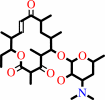 narbomycin
|
+
|
2
×
reduced [2Fe-2S]-[ferredoxin]
Bound ligand (Het Group name = )
matches with 61.54% similarity
|
+
|
 O2
O2
|
+
|
2
×
H(+)
|
=
|
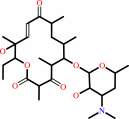 pikromycin
|
+
|
2
×
oxidized [2Fe-2S]-[ferredoxin]
|
+
|
H2O
|
|
|
|
|
|
|
narbomycin
|
+
|
2
×
reduced [2Fe-2S]-[ferredoxin]
Bound ligand (Het Group name = )
matches with 61.54% similarity
|
+
|
O2
|
+
|
2
×
H(+)
|
=
|
neopikromycin
|
+
|
2
×
oxidized [2Fe-2S]-[ferredoxin]
|
+
|
H2O
|
|
|
|
|
|
|
narbomycin
|
+
|
4
×
reduced [2Fe-2S]-[ferredoxin]
Bound ligand (Het Group name = )
matches with 61.54% similarity
|
+
|
2
×
O2
|
+
|
4
×
H(+)
|
=
|
novapikromycin
|
+
|
4
×
oxidized [2Fe-2S]-[ferredoxin]
|
+
|
2
×
H2O
|
|
|
|
|
|
|
10-deoxymethymycin
Bound ligand (Het Group name = )
matches with 68.57% similarity
|
+
|
2
×
reduced [2Fe-2S]-[ferredoxin]
|
+
|
O2
|
+
|
2
×
H(+)
|
=
|
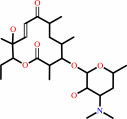 methymycin
|
+
|
2
×
oxidized [2Fe-2S]-[ferredoxin]
|
+
|
H2O
|
|
|
|
|
|
|
10-deoxymethymycin
Bound ligand (Het Group name = )
matches with 68.57% similarity
|
+
|
2
×
reduced [2Fe-2S]-[ferredoxin]
|
+
|
O2
|
+
|
2
×
H(+)
|
=
|
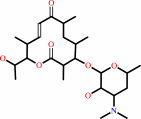 neomethymycin
|
+
|
2
×
oxidized [2Fe-2S]-[ferredoxin]
|
+
|
H2O
|
|
|
|
|
|
|
10-deoxymethymycin
Bound ligand (Het Group name = )
matches with 68.57% similarity
|
+
|
|
|
|
|
|
|
|
|
|
Cofactor:
|
|
Heme-thiolate
|
|
|
|
|
|
|
|
|
Molecule diagrams generated from .mol files obtained from the
KEGG ftp site
|
|
|
|
|
|
|
|
|
|
|
|
|
|
 |
|
|
|
|
|
|
| |
|
|
| |
|
DOI no:
|
J Am Chem Soc
136:4901-4904
(2014)
|
|
PubMed id:
|
|
|
|
|
|
| |
|
Directing group-controlled regioselectivity in an enzymatic C-H bond oxygenation.
|
|
S.Negretti,
A.R.Narayan,
K.C.Chiou,
P.M.Kells,
J.L.Stachowski,
D.A.Hansen,
L.M.Podust,
J.Montgomery,
D.H.Sherman.
|
|
|
|
|
| |
ABSTRACT
|
|
|
|
| |
|
|
Highly regioselective remote hydroxylation of a natural product scaffold is
demonstrated by exploiting the anchoring mechanism of the biosynthetic P450
monooxygenase PikCD50N-RhFRED. Previous studies have revealed structural and
biochemical evidence for the role of a salt bridge between the desosamine
N,N-dimethylamino functionality of the natural substrate YC-17 and carboxylate
residues within the active site of the enzyme, and selectivity in subsequent C-H
bond functionalization. In the present study, a substrate-engineering approach
was conducted that involves replacing desosamine with varied synthetic
N,N-dimethylamino anchoring groups. We then determined their ability to mediate
enzymatic total turnover numbers approaching or exceeding that of the natural
sugar, while enabling ready introduction and removal of these amino anchoring
groups from the substrate. The data establish that the size, stereochemistry,
and rigidity of the anchoring group influence the regioselectivity of enzymatic
hydroxylation. The natural anchoring group desosamine affords a 1:1 mixture of
regioisomers, while synthetic anchors shift YC-17 analogue C-10/C-12
hydroxylation from 20:1 to 1:4. The work demonstrates the utility of substrate
engineering as an orthogonal approach to protein engineering for modulation of
regioselective C-H functionalization in biocatalysis.
|
|
|
|
|
|
|
|
|
|
|
|
|
|
|
|
|
|
 |
 |
 |
|


 Links
Links


