 |
PDBsum entry 3x0c
|
|

|
|
PDB id:
|
|
|
|
| Name: |
|
Transferase
|
|
|
Title:
|
|
Crystal structure of pip4kiibeta i368a complex with gmp
|
|
Structure:
|
|
Phosphatidylinositol 5-phosphate 4-kinase type-2 beta. Chain: a, b. Fragment: unp residues 31-416. Synonym: 1-phosphatidylinositol 5-phosphate 4-kinase 2-beta, diphosphoinositide kinase 2-beta, phosphatidylinositol 5-phosphate 4- kinase type ii beta, pi(5)p 4-kinase type ii beta, pip4kii-beta, ptdins(5)p-4-kinase isoform 2-beta. Engineered: yes. Mutation: yes
|
|
Source:
|
|
Homo sapiens. Human. Organism_taxid: 9606. Gene: pip4k2b. Expressed in: escherichia coli. Expression_system_taxid: 562
|
|
Resolution:
|
|
|
2.55Å
|
R-factor:
|
0.225
|
R-free:
|
0.268
|
|
|
Authors:
|
|
K.Takeuchi,Y.H.Lo,K.Sumita,M.Senda,J.Terakawa,A.Dimitoris, J.W.Locasale,M.Sasaki,H.Yoshino,Y.Zhang,E.R.Kahoud,T.Takano, T.Yokota,B.Emerling,J.A.Asara,T.Ishida,I.Shimada,T.Daikoku, L.C.Cantley,T.Senda,A.T.Sasaki
|
|
Key ref:
|
|
K.Sumita
et al.
(2016).
The Lipid Kinase PI5P4Kβ Is an Intracellular GTP Sensor for Metabolism and Tumorigenesis.
Mol Cell,
61,
187-198.
PubMed id:
DOI:
|
|
|
Date:
|
|
|
09-Oct-14
|
Release date:
|
14-Oct-15
|
|
|
|
|
|
|
PROCHECK
|

|
|
|
|
|
Headers
|
|
|
|
References
|
|
|
|
|
|

|
|
P78356
(PI42B_HUMAN) -
Phosphatidylinositol 5-phosphate 4-kinase type-2 beta from Homo sapiens
|
|
|
|
Seq:
Struc:
|
|
|
|
416 a.a.
319 a.a.*
|
|

|

|

|
|
|
|
|
|
|
|
|
|
|
Key: |
|
 |
Secondary structure |
|
 |
CATH domain |
|
|
*
PDB and UniProt seqs differ
at 1 residue position (black
cross)
|
|
|
|
|
|
|
|
|
|
|
|
|
Enzyme class:
|
|
E.C.2.7.1.149
- 1-phosphatidylinositol-5-phosphate 4-kinase.
|
|
|
|
|
|
|
Pathway:
|
|
1-Phosphatidyl-myo-inositol Metabolism
|
|
|
|
|
|
Reaction:
|
|
a 1,2-diacyl-sn-glycero-3-phospho-(1D-myo-inositol-5-phosphate) + ATP = a 1,2-diacyl-sn-glycero-3-phospho-(1D-myo-inositol-4,5-bisphosphate) + ADP + H+
|
|
|
|
|
|
1,2-diacyl-sn-glycero-3-phospho-(1D-myo-inositol-5-phosphate)
|
+
|
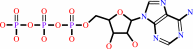 ATP
ATP
|
=
|
1,2-diacyl-sn-glycero-3-phospho-(1D-myo-inositol-4,5-bisphosphate)
|
+
|
ADP
Bound ligand (Het Group name = )
matches with 82.14% similarity
|
+
|
H(+)
|
|
|
|
|
|
|
|
|
|
|
|
|
Molecule diagrams generated from .mol files obtained from the
KEGG ftp site
|
|
|
|
|
|
|
|
|
|
|
|
|
|
 |
|
|
|
|
|
|
| |
|
|
| |
|
DOI no:
|
Mol Cell
61:187-198
(2016)
|
|
PubMed id:
|
|
|
|
|
|
| |
|
The Lipid Kinase PI5P4Kβ Is an Intracellular GTP Sensor for Metabolism and Tumorigenesis.
|
|
K.Sumita,
Y.H.Lo,
K.Takeuchi,
M.Senda,
S.Kofuji,
Y.Ikeda,
J.Terakawa,
M.Sasaki,
H.Yoshino,
N.Majd,
Y.Zheng,
E.R.Kahoud,
T.Yokota,
B.M.Emerling,
J.M.Asara,
T.Ishida,
J.W.Locasale,
T.Daikoku,
D.Anastasiou,
T.Senda,
A.T.Sasaki.
|
|
|
|
|
| |
ABSTRACT
|
|
|
|
| |
|
|
While cellular GTP concentration dramatically changes in response to an
organism's cellular status, whether it serves as a metabolic cue for biological
signaling remains elusive due to the lack of molecular identification of GTP
sensors. Here we report that PI5P4Kβ, a phosphoinositide kinase that regulates
PI(5)P levels, detects GTP concentration and converts them into lipid second
messenger signaling. Biochemical analyses show that PI5P4Kβ preferentially
utilizes GTP, rather than ATP, for PI(5)P phosphorylation, and its activity
reflects changes in direct proportion to the physiological GTP concentration.
Structural and biological analyses reveal that the GTP-sensing activity of
PI5P4Kβ is critical for metabolic adaptation and tumorigenesis. These results
demonstrate that PI5P4Kβ is the missing GTP sensor and that GTP concentration
functions as a metabolic cue via PI5P4Kβ. The critical role of the GTP-sensing
activity of PI5P4Kβ in cancer signifies this lipid kinase as a cancer
therapeutic target.
|
|
|
|
|
|
|
|
|
|
|
|
|
|
|
|
|
|
 |
 |
 |
|


 Links
Links


