 |
PDBsum entry 3vcl

|
|
|
|
|
|

|

|

|

|
|

|
|

|
|

|
|

|
|

|
|

|
|

|
|
|
 |

|

|
|
|
|
|
|
|
|
|
|
|
|
|
|
|
|
|
|
|
|
|
|
|
|
|
|
|
|
|
|
|
|
|
|
|
|
Immune system
|
PDB id
|
|
|
|
3vcl
|
|
|
|
|
|
|
|
|
|
|
|
|
|
|

|

|

|
|
|
|
|
|
|
PDB id:
|
|
|
|
| Name: |
|
Immune system
|
|
|
Title:
|
|
Crystal structure of hla-b7 with the hcmv pp65 peptide rpherngftvl
|
|
Structure:
|
|
Hla class i histocompatibility antigen, b-7 alpha chain. Chain: a. Fragment: unp residues 25-299. Synonym: mhc class i antigen b 7. Engineered: yes. Beta-2-microglobulin. Chain: b. Synonym: beta-2-microglobulin form pi 5.3. Engineered: yes.
|
|
Source:
|
|
Homo sapiens. Human. Organism_taxid: 9606. Gene: hla-b. Expressed in: escherichia coli. Expression_system_taxid: 562. Gene: b2m. Synthetic: yes. Human herpesvirus 5.
|
|
Resolution:
|
|
|
1.70Å
|
R-factor:
|
0.186
|
R-free:
|
0.217
|
|
|
Authors:
|
|
J.Petersen,J.Rossjohn
|
|
Key ref:
|
|
R.M.Brennan
et al.
(2012).
The impact of a large and frequent deletion in the human TCR β locus on antiviral immunity.
J Immunol,
188,
2742-2748.
PubMed id:
|
|
|
Date:
|
|
|
04-Jan-12
|
Release date:
|
21-Nov-12
|
|
|
|
|
|
|
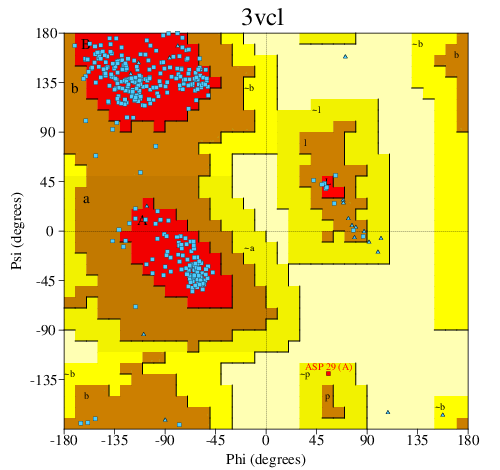
PROCHECK
|
|
|
|
|
|
Headers
|
|
|
|
References
|
|
|
|
|
|

|
|
P01889
(1B07_HUMAN) -
HLA class I histocompatibility antigen, B alpha chain from Homo sapiens
|
|
|
|
Seq:
Struc:
|
|
|
|
362 a.a.
275 a.a.
|
|

|

|

|
|
|
|
|
|
|
|
|
|
|
|
|
|
|
|
|
|
|
|
|
 |
|
|
|
|
|
|
| |
|
|
J Immunol
188:2742-2748
(2012)
|
|
PubMed id:
|
|
|
|
|
|
| |
|
The impact of a large and frequent deletion in the human TCR β locus on antiviral immunity.
|
|
R.M.Brennan,
J.Petersen,
M.A.Neller,
J.J.Miles,
J.M.Burrows,
C.Smith,
J.McCluskey,
R.Khanna,
J.Rossjohn,
S.R.Burrows.
|
|
|
|
|
| |
ABSTRACT
|
|
|
|
| |
|
|
The TCR plays a critical role in recognizing intracellular pathogens and
initiating pathways leading to the destruction of infected cells by the immune
system. Although genetic variability is known to greatly impact on the human
immune system and the outcome of infection, the influence of sequence variation
leading to the inactivation or deletion of TCR gene segments is unknown. To
investigate this issue, we examined the CD8(+) T cell response to an
HLA-B7-restricted epitope ((265)RPHERNGFTVL(275)) from the pp65 Ag of human CMV
that was highly biased and frequently dominated by a public TCR β-chain encoded
by the variable gene segment TRBV4-3. Approximately 40% of humans lack T cells
expressing TRBV4-3 because of a 21.5-kb insertion/deletion polymorphism, but
these individuals remain responsive to this epitope, using a diverse T cell
repertoire characterized by private TCR usage. Although most residues within the
bulged 11-mer peptide were accessible for TCR contact, the public and private
TCRs showed distinct patterns of sensitivity to amino acid substitution at
different positions within the peptide, thereby suggesting that the repertoire
diversity generated in the absence of the dominant public TRBV4-3(+) TCR could
lead to better protection from viral escape mutation. Thus, variation in the
size of the TRBV repertoire clearly contributes toward interindividual
variability in immune responses and is presumably maintained in many ethnic
groups to enhance the diversity of Ag-specific T cell responses.
|
|
|
|
|
|
|
|
|
|
|
|
|
|
|
|
|
|
 |
 |
 |
|
| |


 Links
Links


