 |
PDBsum entry 3v3v

|
|
|
|
|
|

|

|

|

|
|

|
|

|
|

|
|

|
|
|
 |

|

|
|
|
|
|
|
|
|
|
|
|
|
|
|
|
|
|
|
|
|
|
|
|
|
|
|
|
|
|
|
|
|
|
Transferase/transferase inhibitor
|
PDB id
|
|
|
|
3v3v
|
|
|
|
|
|
|
|
|
|
|
|
|
|
|

|

|

|
|
|
|
|
|
|
PDB id:
|
|
|
|
| Name: |
|
Transferase/transferase inhibitor
|
|
|
Title:
|
|
Structural and functional analysis of quercetagetin, a natural jnk1 inhibitor
|
|
Structure:
|
|
Mitogen-activated protein kinase 8. Chain: a. Fragment: unp residues 1-363. Synonym: map kinase 8, mapk 8, jnk-46, stress-activated protein kinase 1c, sapk1c, stress-activated protein kinase jnk1, c-jun n- terminal kinase 1. Engineered: yes. C-jun-amino-terminal kinase-interacting protein 1. Chain: b.
|
|
Source:
|
|
Homo sapiens. Human. Organism_taxid: 9606. Gene: mapk8, jnk1, prkm8, sapk1, sapk1c. Expressed in: escherichia coli. Expression_system_taxid: 469008. Synthetic: yes. Mus musculus. Mouse.
|
|
Resolution:
|
|
|
2.70Å
|
R-factor:
|
0.228
|
R-free:
|
0.266
|
|
|
Authors:
|
|
S.Baek,N.J.Kang,G.M.Popowicz,M.Arciniega,S.K.Jung,S.Byun,N.R.Song, Y.S.Heo,B.Y.Kim,H.J.Lee,T.A.Holak,M.Augustin,A.M.Bode,R.Huber, Z.Dong,K.W.Lee
|
|
Key ref:
|
|
S.Baek
et al.
(2013).
Structural and functional analysis of the natural JNK1 inhibitor quercetagetin.
J Mol Biol,
425,
411-423.
PubMed id:
|
|
|
Date:
|
|
|
14-Dec-11
|
Release date:
|
05-Dec-12
|
|
|
|
|
|
|
PROCHECK
|

|
|
|
|
|
Headers
|
|
|
|
References
|
|
|
|
|
|

|
|
P45983
(MK08_HUMAN) -
Mitogen-activated protein kinase 8 from Homo sapiens
|
|
|
|
Seq:
Struc:
|
|
|
|
427 a.a.
351 a.a.*
|
|

|

|

|
|
|
|
|
|
|
|
|
|
|
Key: |
|
 |
Secondary structure |
|
 |
CATH domain |
|
|
*
PDB and UniProt seqs differ
at 9 residue positions (black
crosses)
|
|
|
|
|
|
|
|
|
|
|
|
|
Enzyme class:
|
|
E.C.2.7.11.24
- mitogen-activated protein kinase.
|
|
|
|
|
|
|
Reaction:
|
|
|
1.
|
L-seryl-[protein] + ATP = O-phospho-L-seryl-[protein] + ADP + H+
|
|
2.
|
L-threonyl-[protein] + ATP = O-phospho-L-threonyl-[protein] + ADP + H+
|
|
|
|
|
|
|
L-seryl-[protein]
|
+
|
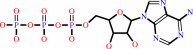 ATP
ATP
|
=
|
O-phospho-L-seryl-[protein]
|
+
|
 ADP
ADP
|
+
|
H(+)
|
|
|
|
|
|
|
L-threonyl-[protein]
|
+
|
ATP
|
=
|
O-phospho-L-threonyl-[protein]
|
+
|
ADP
|
+
|
H(+)
|
|
|
|
|
|
|
|
|
|
|
|
|
Molecule diagrams generated from .mol files obtained from the
KEGG ftp site
|
|
|
|
|
|
|
|
|
|
|
|
|
|
 |
|
|
|
|
|
|
| |
|
|
| |
|
|
J Mol Biol
425:411-423
(2013)
|
|
PubMed id:
|
|
|
|
|
|
| |
|
Structural and functional analysis of the natural JNK1 inhibitor quercetagetin.
|
|
S.Baek,
N.J.Kang,
G.M.Popowicz,
M.Arciniega,
S.K.Jung,
S.Byun,
N.R.Song,
Y.S.Heo,
B.Y.Kim,
H.J.Lee,
T.A.Holak,
M.Augustin,
A.M.Bode,
R.Huber,
Z.Dong,
K.W.Lee.
|
|
|
|
|
| |
ABSTRACT
|
|
|
|
| |
|
|
c-Jun NH2-terminal kinases (JNKs) and phosphatidylinositol 3-kinase (PI3-K) play
critical roles in chronic diseases such as cancer, type II diabetes, and
obesity. We describe here the binding of quercetagetin
(3,3',4',5,6,7-hydroxyflavone), related flavonoids, and SP600125 to JNK1 and
PI3-K by ATP-competitive and immobilized metal ion affinity-based fluorescence
polarization assays and measure the effect of quercetagetin on JNK1 and PI3-K
activities. Quercetagetin attenuated the phosphorylation of c-Jun and AKT,
suppressed AP-1 and NF-κB promoter activities, and also reduced cell
transformation. It attenuated tumor incidence and reduced tumor volumes in a
two-stage skin carcinogenesis mouse model. Our crystallographic structure
determination data show that quercetagetin binds to the ATP-binding site of
JNK1. Notably, the interaction between Lys55, Asp169, and Glu73 of JNK1 and the
catechol moiety of quercetagetin reorients the N-terminal lobe of JNK1, thereby
improving compatibility of the ligand with its binding site. The results of a
theoretical docking study suggest a binding mode of PI3-K with the hydroxyl
groups of the catechol moiety forming hydrogen bonds with the side chains of
Asp964 and Asp841 in the p110γ catalytic subunit. These interactions could
contribute to the high inhibitory activity of quercetagetin against PI3-K. Our
study suggests the potential use of quercetagetin in the prevention or therapy
of cancer and other chronic diseases.
|
|
|
|
|
|
|
|
|
|
|
|
|
|
|
|
|
|
 |
 |
 |
|


 Links
Links


