 |
PDBsum entry 3ibh

|
|
|
|
|
 |
Contents |
 |
|
|
|
|
|
|
|
|
|
|
|
|
* Residue conservation analysis
|
|
|
|
|
|
|
|
|
|
|
Enzyme class:
|
|
E.C.2.5.1.18
- glutathione transferase.
|
|
|
|
|
|
|
Reaction:
|
|
RX + glutathione = an S-substituted glutathione + a halide anion + H+
|
|
|
|
|
|
RX
Bound ligand (Het Group name = )
corresponds exactly
|
+
|
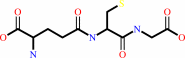 glutathione
|
=
|
S-substituted glutathione
|
+
|
halide anion
|
+
|
H(+)
|
|
|
|
|
|
|
|
|
|
|
|
|
Molecule diagrams generated from .mol files obtained from the
KEGG ftp site
|
|
|
|
|
|
|
|
|
|
|
|
|
|
 |
|
|
|
|
|
|
| |
|
|
| |
|
|
Embo Rep
10:1320-1326
(2009)
|
|
PubMed id:
|
|
|
|
|
|
| |
|
Structures of yeast glutathione-S-transferase Gtt2 reveal a new catalytic type of GST family.
|
|
X.X.Ma,
Y.L.Jiang,
Y.X.He,
R.Bao,
Y.Chen,
C.Z.Zhou.
|
|
|
|
|
| |
ABSTRACT
|
|
|
|
| |
|
|
Glutathione-S-transferases (GSTs) are ubiquitous detoxification enzymes that
catalyse the conjugation of electrophilic substrates to glutathione. Here, we
present the crystal structures of Gtt2, a GST of Saccharomyces cerevisiae, in
apo and two ligand-bound forms, at 2.23 A, 2.20 A and 2.10 A, respectively.
Although Gtt2 has the overall structure of a GST, the absence of the classic
catalytic essential residues--tyrosine, serine and cysteine--distinguishes it
from all other cytosolic GSTs of known structure. Site-directed mutagenesis in
combination with activity assays showed that instead of the classic catalytic
residues, a water molecule stabilized by Ser129 and His123 acts as the
deprotonator of the glutathione sulphur atom. Furthermore, only glycine and
alanine are allowed at the amino-terminus of helix-alpha1 because of
stereo-hindrance. Taken together, these results show that yeast Gtt2 is a novel
atypical type of cytosolic GST.
|
|
|
|
|
|
|
|
|
|
|
|
|
|
|
|
|
|
 |
 |
 |
|


 Links
Links


